
For years, ecommerce automation meant following rigid if-then rules: when an order is placed, send an email. When inventory drops below 10, create a purchase order. When a product is tagged "clearance," apply a discount. These deterministic workflows served businesses well, but they had a fundamental limitation—they couldn't think, adapt, or improve on their own.
The emergence of AI agentic workflows is changing everything. Instead of blindly following predefined rules, these intelligent systems can analyze context, make autonomous decisions, and dynamically adjust their approach based on real-time conditions. Imagine an automation system that doesn't just execute tasks but actually reasons through problems, learns from outcomes, and handles complexity you never explicitly programmed it to solve.
This shift from static automation to intelligent, autonomous systems represents the next evolution in how ecommerce businesses operate. Agentic workflows leverage AI agents—powered by large language models—to break down complex tasks, select the right tools for each situation, and continuously refine their performance. The result? Automation that scales with your business complexity rather than breaking under it.
In this comprehensive guide, you'll learn:
- What agentic workflows are and how they differ from traditional automation
- The core components that make workflows "agentic" (AI agents, reasoning, memory, and tools)
- Key design patterns including planning, tool use, and reflection
- Practical ecommerce applications from product management to customer service
- How to implement agentic workflows using platforms like MESA
- Benefits, challenges, and best practices for getting started
Whether you're managing a growing Shopify store, overseeing operations for a multi-channel brand, or exploring AI automation for your ecommerce business, understanding agentic workflows will help you work smarter, scale faster, and stay competitive in 2026 and beyond.
MESA makes agentic workflows accessible through natural language workflow creation, pre-built templates, and 100+ integrations—enabling you to multiply your impact without multiplying your effort. Let's dive into how agentic AI is transforming ecommerce automation.
TL;DR: there's a template for that
What are agentic workflows?
At their core, agentic workflows are dynamic, AI-agent-driven processes where autonomous systems make decisions, take actions, and coordinate tasks with minimal human intervention. Unlike traditional automation that rigidly follows predefined rules, agentic workflows leverage artificial intelligence to reason through problems, adapt to changing conditions, and improve their performance over time.
To truly understand what makes a workflow "agentic," it helps to see how it compares to other types of automation.
The 3 types of workflows
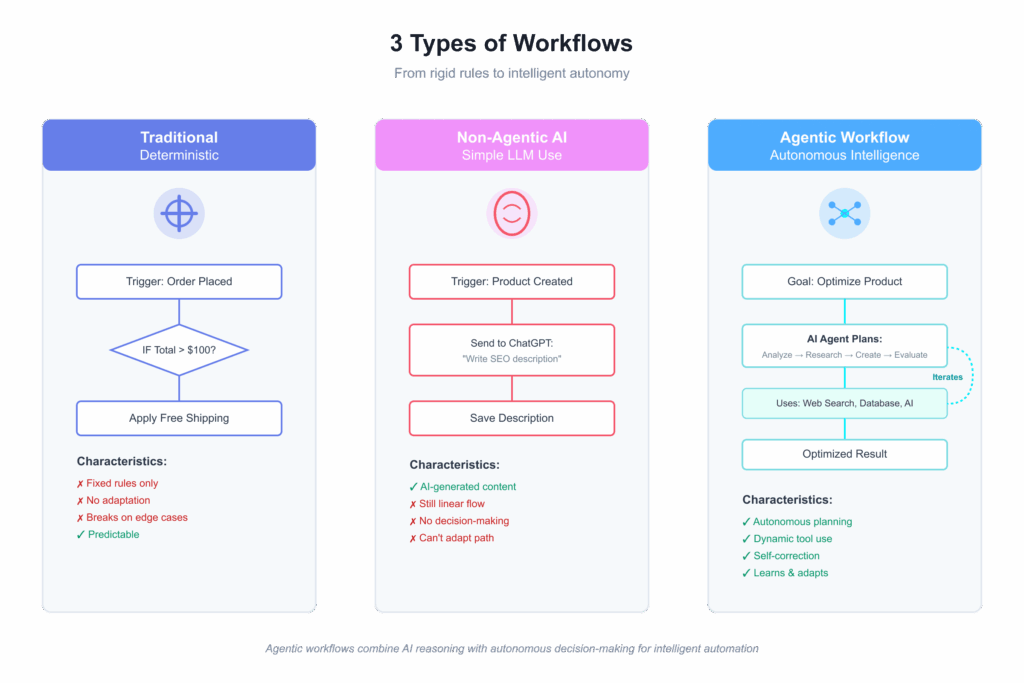
Traditional deterministic workflows
These are the rule-based automations most ecommerce businesses use today. They follow a strict if-then logic: "If order total exceeds $100, then apply free shipping." "If inventory quantity falls below 5, then send a Slack notification." These workflows are predictable, reliable for simple tasks, and break immediately when they encounter scenarios you haven't explicitly programmed.
For example, a traditional workflow might automatically tag customers as "VIP" if their lifetime spend exceeds $1,000. But it can't consider nuanced factors like purchase frequency, product preferences, or engagement patterns unless you've manually coded every possible rule.
Non-agentic AI workflows
These workflows incorporate AI—typically large language models (LLMs)—but in a limited, non-autonomous way. You might use an LLM to generate a product description based on a prompt, or to summarize customer reviews into key themes. The AI performs a single task when called upon, but it doesn't make decisions about what to do next, which tools to use, or how to adapt its approach.
For instance, you could have a workflow that triggers when a product is created, sends the product attributes to ChatGPT with a prompt like "Write an SEO-optimized description," and saves the output to your Shopify store. The AI generates content, but the workflow itself is still deterministic—it follows the same linear path every time.
Agentic workflows
Agentic workflows represent the next evolution. Here, AI agents don't just execute individual tasks—they orchestrate entire processes autonomously. When given a goal like "enrich this new product and prepare it for launch," an agentic workflow can:
- Analyze the product attributes to determine what information is missing
- Search the web for competitor pricing and positioning
- Generate multiple description variations and evaluate them for quality
- Select the most appropriate SEO keywords based on current search trends
- Create complementary marketing copy for different channels
- Tag and categorize the product based on learned patterns from your catalog
- Validate that all requirements are met before publishing
The agent makes dozens of micro-decisions throughout this process, adapting its approach based on what it discovers at each step.
What makes a workflow "agentic"?
Four core capabilities distinguish agentic workflows from their predecessors:
1. Autonomous planning and task decomposition
Agentic workflows can break down complex, ambiguous goals into concrete, actionable steps. Rather than requiring you to map out every possible scenario, the agent reasons through the problem and creates its own execution plan.
When you ask an agentic system to "optimize underperforming products," it doesn't need explicit instructions for every step. Instead, it decomposes this goal into subtasks: identify products with low conversion rates, analyze their listings for common issues, research competitor offerings, generate improvement recommendations, and prioritize actions based on potential impact.
2. Dynamic tool use and real-world interaction
Agentic workflows can select and use different tools based on the situation. They're not locked into a predefined sequence of actions. If an agent needs current pricing data, it might query your database. If it needs market context, it might search the web. If it needs to validate information, it might cross-reference multiple sources.
This dynamic tool selection happens autonomously. The agent assesses what information it needs, determines which tool can provide it, executes the appropriate API call or query, and integrates the results into its decision-making process.
3. Reflection and iterative improvement
Perhaps the most powerful capability is an agent's ability to evaluate its own outputs and refine them. After generating a product description, an agentic workflow might assess whether it matches your brand voice, includes key features, optimizes for search terms, and meets length requirements. If any criteria fall short, the agent iterates—revising and improving until the output meets quality standards.
This self-correction extends beyond individual tasks. Agents can analyze patterns across multiple executions, identifying what approaches work best and adjusting their strategies accordingly.
4. Memory (short-term and long-term)
Agentic workflows maintain context across interactions. Short-term memory allows an agent to track the current task's progress, remember decisions it's made, and maintain coherence throughout a multi-step process. Long-term memory enables learning over time—the agent remembers which strategies were successful, which product categories require special handling, and what user preferences guide its decisions.
For an ecommerce business, this means your automation system gets smarter with use. An agent that's tagged thousands of your products learns your taxonomy. One that's written hundreds of descriptions understands your brand voice. One that's managed inventory across seasons recognizes your business patterns.
These four capabilities—planning, dynamic tool use, reflection, and memory—transform workflows from rigid automation into intelligent systems that can handle complexity, ambiguity, and change. This is what makes workflows truly "agentic."
Core components of agentic workflows
Understanding what makes workflows truly "agentic" requires examining the four foundational components that enable autonomous, intelligent automation: AI agents powered by large language models, dynamic tools and integrations, memory systems that maintain context, and reasoning capabilities that allow for planning and reflection. Let's explore each component and how they work together to create workflows that can think, adapt, and improve.
AI agents & LLMs
At the heart of every agentic workflow is an AI agent powered by a large language model (LLM). These aren't simple chatbots or content generators—they're reasoning engines capable of understanding complex instructions, analyzing context, and making decisions about how to accomplish goals.
The role of large language models in reasoning
LLMs like GPT-4, Claude, and Gemini have fundamentally changed what's possible in automation. They can:
- Interpret natural language instructions and translate them into executable workflows
- Analyze unstructured data like product descriptions, customer emails, or market research
- Make contextual decisions based on multiple variables and nuanced conditions
- Generate human-quality content that adapts to brand voice and audience
- Reason through multi-step problems by breaking them down logically
The key insight is that LLMs don't just follow patterns—they actually reason. When you ask an LLM-powered agent to "optimize this product listing," it understands what optimization means in your business context, identifies what needs improvement, and determines the best approach.
How MESA uses AI for decision-making
MESA takes an AI-first approach to workflow automation through MESA's AI, your conversational AI assistant. It fundamentally changes how you interact with automation:
Natural language workflow creation with MESA's AI
Instead of manually configuring triggers, actions, and conditions, you can simply describe what you want to accomplish: "When a high-value customer places an order, send them a personalized thank-you email and notify our VIP support team." It understands your intent and translates it into a complete workflow using MESA's powerful automation engine.
It leverages Model Context Protocol (MCP) to create sophisticated workflows through natural conversation. You can iterate on workflows by asking it to add steps, modify conditions, or handle edge cases—all without touching configuration panels.
AI-powered workflow steps with MESA's AI
Beyond creating workflows, you can embed it directly into any automation as a workflow step. This enables powerful AI-driven operations at any point in your processes:
- Summarize lengthy customer support tickets before routing them to your team
- Calculate complex metrics like customer lifetime value or profitability per order
- Format and transform data from one structure to another intelligently
- Analyze patterns across multiple data points to make informed decisions
- Generate content like personalized email copy, product descriptions, or social media posts
For example, imagine a workflow triggered by a product return. MESA's AI can analyze the return reason, customer history, and product data to intelligently route the case—sending simple exchanges to automated processing while flagging potential quality issues for human review with a detailed summary.
Tools & Integrations
AI agents become truly powerful when they can interact with the real world. In agentic workflows, tools are the mechanisms through which agents gather information, perform actions, and connect with external systems.
The foundation: APIs, web search, and databases
At a technical level, agentic workflows need access to:
- APIs for real-time data retrieval and actions (querying inventory, placing orders, sending notifications)
- Web search for current information beyond their training data
- Databases for storing, retrieving, and analyzing structured information
Powerful built-in tools
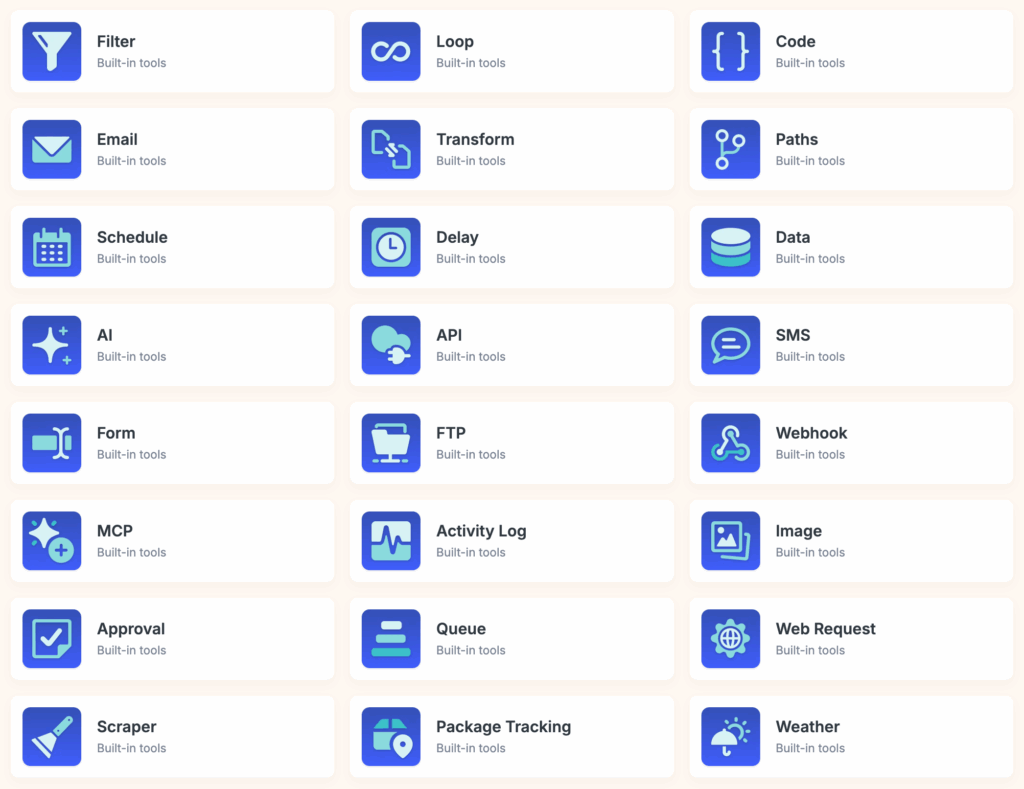
MESA provides a comprehensive toolkit that enables sophisticated agentic behavior without requiring external services:
- Database - Store and query structured data across workflow executions, enabling memory and context persistence
- API - Make HTTP requests to any REST API, connecting to unlimited external services
- Approval - Inject human oversight into automated processes for high-stakes decisions
- Webhook - Receive real-time events from external systems to trigger workflows
- Paths - Create conditional branches that route data down different execution paths
- Loop - Iterate over collections of items to process batches efficiently
- Filter - Evaluate conditions to decide whether workflows should continue
- Schedule - Trigger workflows at specific times or intervals
- Delay - Pause execution for strategic timing of actions
- Code - Execute custom JavaScript for complex transformations
- Format Data - Transform data structures between different formats
- Forms - Collect structured input from users to feed into workflows
- Queue - Manage workflow execution order and handle rate limiting
Function calling and dynamic tool selection
In truly agentic workflows, the AI agent decides which tools to use based on the task at hand. This is called "function calling" or "tool use," and it's what enables agents to solve problems autonomously.
When you ask MESA's AI to "enrich this new product with competitive pricing data," the agent:
- Identifies that it needs external market data (requires web search or API)
- Determines the product category and key competitors (requires reasoning)
- Structures the data appropriately (requires formatting)
- Validates the results before proceeding (requires conditional logic)
The agent selects the right tool for each subtask without you having to explicitly map out every step.
100+ third-party app integrations
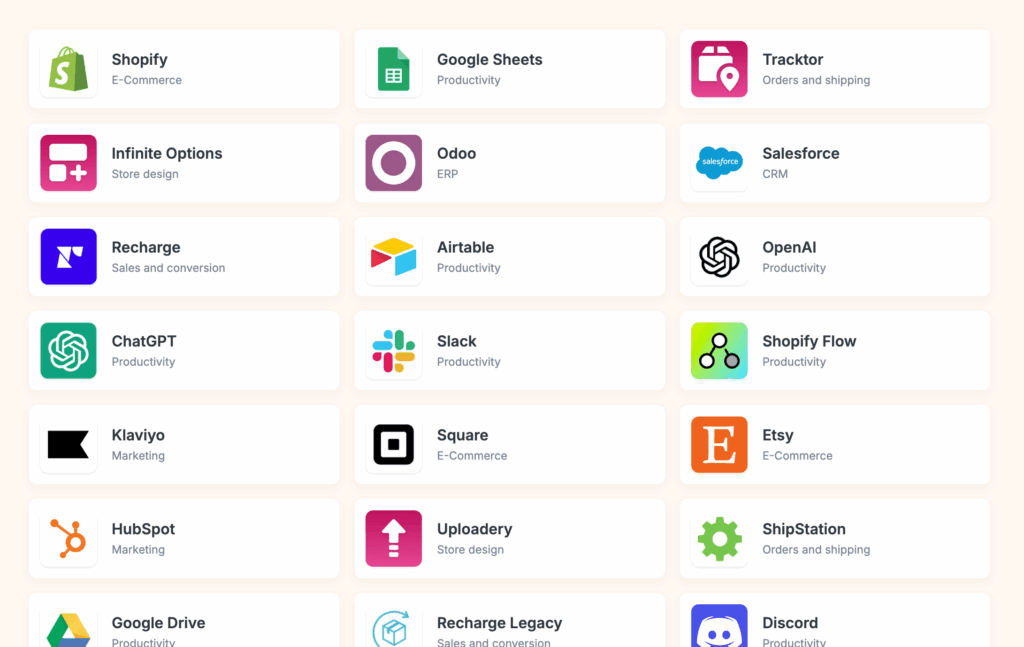
Beyond built-in tools, MESA connects with 100+ popular ecommerce and business applications through pre-built integrations:
- Ecommerce platforms: Shopify, Etsy, Amazon, BigCommerce
- Communication: Slack, Discord, Gmail, SMS
- Data & Analytics: Google Sheets, Airtable, Excel
- Marketing: Klaviyo, Mailchimp, HubSpot
- Fulfillment: ShipStation, Shippo, EasyPost
- Customer Service: Zendesk, Gorgias, Help Scout
- And many more across every business function
This extensive ecosystem means your agentic workflows can orchestrate actions across your entire tech stack—automatically syncing inventory, routing support tickets, updating CRM records, and triggering marketing campaigns based on intelligent analysis of business events.
Memory systems
One of the defining characteristics of agentic workflows is their ability to remember—both within a single execution and across multiple interactions over time.
Short-term memory: Conversation history and session context
Within a workflow execution, agents need to maintain context about what's happened so far. This short-term memory allows agents to:
- Track variables and data as they flow through multi-step processes
- Remember decisions made earlier in the workflow
- Maintain coherence across conditional branches
- Reference prior API responses when making subsequent calls
Think of short-term memory as the agent's "working memory" during task execution—it holds all the relevant context needed to complete the current goal.
Long-term memory: Learning from past workflows
The real power emerges when agents can learn from historical executions and apply those lessons to future tasks. Long-term memory enables:
- Pattern recognition across thousands of workflow runs
- Personalization based on business-specific preferences
- Continuous improvement of decision quality
- Context awareness about seasonal trends, customer behaviors, and operational patterns
Reasoning capabilities
The most advanced agentic workflows demonstrate sophisticated reasoning—the ability to plan complex sequences of actions and reflect on outcomes to self-correct and improve.
Planning: Breaking down complex tasks
Planning, or "task decomposition," is when an agent takes a high-level goal and autonomously breaks it into smaller, actionable subtasks. Instead of requiring explicit instructions for every step, the agent reasons through what needs to happen and in what order.
Reflection: Self-correction and improvement
Reflection is the ability to evaluate outputs, identify issues, and iteratively improve until quality standards are met. An agent with reflection capabilities might generate a product description, assess whether it matches brand voice and includes key features, then revise it if needed—repeating this cycle until the output is excellent.
Agentic workflows in ecommerce
The true power of agentic workflows becomes clear when you see them solving real ecommerce challenges. Unlike traditional automation that requires you to anticipate every scenario, agentic workflows adapt to your business context, make intelligent decisions, and improve outcomes over time. Let's explore five critical areas where agentic workflows are transforming ecommerce operations.
Product Intelligence
Managing product data at scale is one of the most time-consuming challenges for ecommerce businesses. Traditional approaches require manual work or rigid templates that produce generic, formulaic content. Agentic workflows change this entirely.
❇️ Auto-generating SEO-optimized descriptions with quality checks
Consider a workflow triggered when you add a new product to your Shopify store. Instead of simply generating a description and calling it done, an agentic workflow orchestrates a sophisticated process:
The AI agent first analyzes the product attributes you've provided—title, vendor, type, tags, price point. It then uses web search tools to research similar products, identifying how competitors position them and which keywords they target. The agent queries your database to understand your brand voice by examining descriptions of similar products you've already published.
With this context gathered, the agent generates an initial description optimized for your target keywords. But here's where reflection comes in: the agent evaluates its own output against quality criteria—Does it include key product features? Is it the appropriate length? Does it match your brand tone? Are the target keywords naturally integrated? If any criteria fall short, the agent iteratively refines the description until it meets your standards.
Autonomous decision-making involved:
- Determining which competitive keywords to target based on search volume and relevance
- Selecting the appropriate tone and style based on product category
- Deciding which product features to emphasize based on market positioning
- Evaluating output quality and deciding whether revision is needed
Benefits over traditional automation: Traditional automation might use a template like "This {product_type} from {vendor} features {tag1}, {tag2}, and {tag3}." This produces mechanical, repetitive content that hurts SEO and conversion rates. Agentic workflows create unique, contextual descriptions that read naturally, incorporate strategic keywords, and adapt to each product's unique characteristics—all while maintaining consistent brand voice across hundreds or thousands of products.
❇️ Dynamic product tagging based on trends and inventory
Product tagging seems simple but becomes complex at scale. An agentic workflow can continuously analyze your catalog and apply intelligent tags based on multiple dynamic factors.
When inventory levels drop, the agent can automatically apply "low-stock" tags and adjust marketing priorities. When analyzing sales velocity, it might tag products as "trending," "seasonal," or "slow-moving" to inform merchandising decisions. By monitoring external market data, it can tag products aligned with emerging trends—like tagging activewear products with "wellness" during January or adding "back-to-school" tags to relevant items in July.
The agent plans this entire process autonomously: it identifies which products need re-evaluation, determines which data sources to consult (your database for historical sales, web search for trend data, inventory APIs for stock levels), applies appropriate tags, and triggers downstream workflows like adjusting ad spend or featuring products in collections.
Autonomous decision-making involved:
- Identifying which products warrant tag updates based on changing conditions
- Selecting relevant tags from your taxonomy or creating new ones when needed
- Prioritizing tagging actions based on business impact
- Triggering appropriate follow-up actions (collection updates, marketing adjustments)
Benefits over traditional automation: Static rules like "tag as low-stock when quantity < 5" work for basic scenarios but miss nuance. What if 5 units is plenty for a slow-moving item but critically low for a bestseller? Agentic workflows consider context—sales velocity, seasonality, reorder timing—to make intelligent decisions that actually help your business.
❇️ Cross-channel content adaptation
Selling across Shopify, Etsy, and Square requires adapted content for each platform's audience and requirements. An agentic workflow can intelligently transform your product content for each channel.
When you publish a new product on Shopify, the agent analyzes the listing and plans the adaptation strategy: Etsy customers value handmade qualities and story, so the agent emphasizes craftsmanship and origin. Square POS customers are often in-person shoppers, so the description focuses on immediate benefits and physical features. The agent reformats specifications to match each platform's structure, adjusts pricing strategy based on platform fees, and ensures all marketplace-specific requirements (title length, tag limits) are met.
Autonomous decision-making involved:
- Determining which content elements to emphasize for each platform's audience
- Reformatting and restructuring content to meet platform requirements
- Adjusting positioning and messaging based on channel context
- Deciding which products are suitable for each channel
Benefits over traditional automation: Simple content syndication copies identical information everywhere, ignoring that Etsy shoppers and Square POS customers have different needs and expectations. Agentic workflows create contextually appropriate content for each channel, improving discoverability and conversion across your entire multi-channel presence.
Customer Service & Communication
Customer service often involves complex, multi-step processes that require contextual decision-making—exactly where agentic workflows excel.
❇️ Intelligent order status monitoring with proactive alerts
Rather than waiting for customers to ask "where's my order?", agentic workflows can proactively monitor order progress and communicate intelligently.
The agent continuously monitors orders against expected delivery timelines, checking fulfillment status, tracking information, and carrier updates. When it detects potential delays, it doesn't just send a generic notification. Instead, it analyzes the context: Is this a first-time customer or a VIP? Is the order a gift with a specific deadline? How severe is the delay?
Based on this analysis, the agent plans the appropriate response: It might automatically expedite shipping at no cost for VIP customers, send a personalized apology with a discount code, or flag orders for human review if the delay impacts time-sensitive deliveries. The agent also learns from outcomes—tracking which interventions lead to customer satisfaction versus complaints.
Autonomous decision-making involved:
- Detecting anomalies in order progress based on historical patterns
- Assessing delay severity and customer impact
- Selecting appropriate remediation actions
- Personalizing communication based on customer value and history
- Escalating to human agents when needed
Benefits over traditional automation: Traditional automation might send the same "your order is delayed" email to everyone. Agentic workflows recognize that a 2-day delay on a gift order is urgent while a week's delay on a pre-order is expected, and they respond accordingly with context-appropriate actions.
❇️ Context-aware customer communication
When customers reach out with questions or concerns, agentic workflows can analyze the inquiry, gather relevant context, and generate appropriate responses.
The agent examines the customer's message, identifies the core issue (order status, product question, return request), and gathers necessary information by querying your order database, checking inventory status, reviewing past interactions, and pulling relevant policy documentation. It then generates a personalized response that directly addresses their concern with accurate, specific information.
The reflection pattern ensures quality: the agent evaluates whether the response fully addresses the question, maintains your brand voice, includes all necessary details (order numbers, tracking links), and follows company policies. If any element is missing or unclear, it revises before sending.
Autonomous decision-making involved:
- Categorizing inquiry type and urgency
- Determining which information needs to be gathered
- Deciding whether to auto-respond or route to human agents
- Personalizing tone and content based on customer sentiment and history
Benefits over traditional automation: Canned responses frustrate customers because they often don't address the actual question. Agentic workflows generate contextual, accurate responses that feel personal because they incorporate specific information about that customer's situation.
Inventory & Operations
Operational efficiency directly impacts profitability, and this is where autonomous decision-making creates measurable ROI.
❇️ Predictive inventory monitoring
Instead of simple "reorder when quantity < X" rules, agentic workflows can predict inventory needs based on multiple dynamic factors.
The agent continuously analyzes your inventory alongside sales velocity, seasonal patterns, lead times from suppliers, upcoming marketing campaigns, and market trends. It identifies products likely to stock out before the next shipment arrives and those accumulating excess inventory. Based on these predictions, it plans appropriate actions: automatically generating purchase orders for fast-moving items, alerting you to excess stock that needs promotional pricing, and adjusting marketing spend to balance inventory levels.
Autonomous decision-making involved:
- Forecasting demand based on historical data and current trends
- Calculating optimal reorder points for each SKU
- Prioritizing which inventory issues require immediate action
- Determining appropriate intervention (reorder, promotion, supplier communication)
Benefits over traditional automation: Static reorder points don't account for seasonality, trends, or marketing campaigns. An item that typically sells 10 units weekly might need different inventory levels in December versus February, or when featured in an email campaign. Agentic workflows adapt to these dynamics.
❇️ Multi-channel fulfillment orchestration
When orders come from multiple channels with different fulfillment requirements, agentic workflows can intelligently route and coordinate.
For each new order, the agent analyzes shipping destination, product availability across warehouses, customer tier, shipping method requested, and current fulfillment capacity. It then plans the optimal fulfillment strategy: which warehouse should fulfill the order, whether to split shipments or wait for full inventory, which carrier to use, and when to send tracking information.
Autonomous decision-making involved:
- Selecting optimal warehouse based on proximity, inventory, and capacity
- Deciding whether to split multi-item orders for faster delivery
- Choosing carriers based on cost, speed, and reliability data
- Prioritizing order processing based on customer value and commitments
Benefits over traditional automation: Simple "first come, first served" fulfillment misses optimization opportunities. Agentic workflows might fulfill a VIP customer's order from a closer warehouse even if it costs slightly more, or strategically batch orders going to similar destinations to reduce shipping costs—decisions that traditional automation can't make because they require contextual judgment.
Marketing & Personalization
Marketing automation has existed for years, but agentic workflows enable true personalization at scale.
❇️ Automated segmentation with continuous refinement
Customer segmentation traditionally requires manual analysis and periodic updates. Agentic workflows can continuously refine segments based on behavior and outcomes.
The agent analyzes customer data—purchase history, browsing behavior, email engagement, lifetime value—and creates dynamic segments. But it goes further: it tracks which segments respond best to different types of campaigns, identifies customers transitioning between segments (like first-time buyers becoming repeat customers), and automatically adjusts segment definitions to improve targeting effectiveness.
Autonomous decision-making involved:
- Identifying meaningful patterns in customer behavior
- Creating and updating segment definitions dynamically
- Determining which customers belong in multiple segments
- Evaluating segment performance and refining criteria
Benefits over traditional automation: Static segments like "customers who spent >$500" become outdated quickly. Agentic workflows recognize that a customer who spent $600 last year but hasn't purchased in 8 months is fundamentally different from one who spent $600 last month, and they adjust marketing strategy accordingly.
❇️ Cross-platform content optimization
Marketing content needs adaptation across email, social media, SMS, and ads. Agentic workflows can intelligently transform your core message for each channel.
Given a product launch or promotion, the agent plans a multi-channel campaign: it creates detailed email copy with product features and benefits, condenses the message into compelling social media posts optimized for each platform's character limits and audience expectations, crafts concise SMS messages with clear CTAs, and generates ad copy that drives clicks within strict character constraints.
The agent uses real-time performance data to optimize: if Instagram posts with lifestyle imagery outperform product shots, it adjusts image selection. If SMS campaigns convert better with discount codes than product links, it adapts future messages.
Autonomous decision-making involved:
- Adapting message length and format for each platform
- Selecting appropriate imagery and media for each channel
- Determining optimal posting times based on engagement patterns
- Adjusting strategy based on performance metrics
Benefits over traditional automation: Copy-paste marketing wastes effort and underperforms. Agentic workflows create native content for each platform that resonates with how audiences engage there, dramatically improving campaign effectiveness.
Analytics & Business Intelligence
Perhaps the most transformative application of agentic workflows is turning data into actionable insights automatically.
❇️ Autonomous data collection and analysis
Rather than manually pulling reports and analyzing metrics, agentic workflows can continuously monitor your business and surface meaningful insights.
The agent establishes a plan for data collection: it queries sales data across channels, monitors marketing metrics, tracks inventory turnover, analyzes customer acquisition costs, and compiles competitive intelligence. It then identifies noteworthy patterns—unexpected spikes or drops in performance, emerging product trends, channel performance changes, or seasonal anomalies.
When the agent detects something significant, it doesn't just report raw numbers. It provides context: "Your average order value increased 15% this week, primarily driven by a 40% increase in accessory attachments to main product purchases. This coincides with the new product bundling suggestions we implemented." This narrative analysis transforms data into strategy.
Autonomous decision-making involved:
- Determining which metrics matter most for current business priorities
- Identifying statistically significant changes versus normal variation
- Connecting multiple data points to explain causation
- Deciding which insights warrant immediate attention versus routine reporting
Benefits over traditional automation: Scheduled reports dump data but require human analysis. Agentic workflows act as your intelligent analyst, continuously monitoring everything and alerting you only to insights that matter, complete with context and recommendations.
❇️ Competitive intelligence gathering
Staying aware of competitive moves traditionally requires manual research. Agentic workflows can autonomously monitor the competitive landscape.
The agent regularly checks competitor websites, monitors their pricing and promotions, tracks their product catalog changes, analyzes their marketing messages, and identifies strategic shifts. It compares this intelligence to your own performance, flagging opportunities (competitors out of stock on popular items) and threats (aggressive price competition on key products).
Autonomous decision-making involved:
- Selecting which competitors and metrics to monitor
- Determining when competitive changes warrant attention
- Assessing the strategic impact of competitor moves
- Recommending responsive actions based on intelligence gathered
Benefits over traditional automation: Manual competitive research is time-consuming and sporadic. Agentic workflows provide continuous intelligence, ensuring you never miss important market moves and can respond quickly to competitive threats or opportunities.
These practical applications demonstrate how agentic workflows transform ecommerce operations from reactive task execution to proactive, intelligent business management. The autonomous decision-making capabilities enable your automation to handle complexity and nuance that traditional systems simply cannot address.
How to build agentic workflows with MESA
The power of agentic workflows becomes accessible when you have the right platform. MESA is designed to make building intelligent, autonomous workflows straightforward—whether you're automating a single task or orchestrating complex multi-step processes. Let's explore how to get started and build your first agentic workflow.
Natural language workflow creation with MESA's AI transforms workflow creation from a technical configuration task into a conversation. Instead of navigating dropdown menus and configuration panels, you simply describe what you need. This conversational approach dramatically reduces the time and technical knowledge required to build sophisticated automations.
Template-based workflows provide pre-built solutions for common ecommerce scenarios. With 1000+ templates covering everything from product management to customer service, you can deploy proven workflows in minutes. Templates are fully customizable—use them as-is or modify them to fit your specific needs. This is the fastest path to value, especially when you're getting started or implementing well-established use cases.
Custom workflows give you complete flexibility to build exactly what your business needs. Whether you're connecting MESA's 100+ integrations in unique ways, using custom APIs, or implementing proprietary business logic, MESA's AI helps you build from scratch through natural conversation. Custom workflows are ideal when your processes are differentiated or you're solving problems specific to your business model.
The best approach often combines both: start with templates for standard operations, then build custom workflows for your unique competitive advantages.
Step-by-step example: Building an agentic product description workflow
Time needed: 10 minutes.
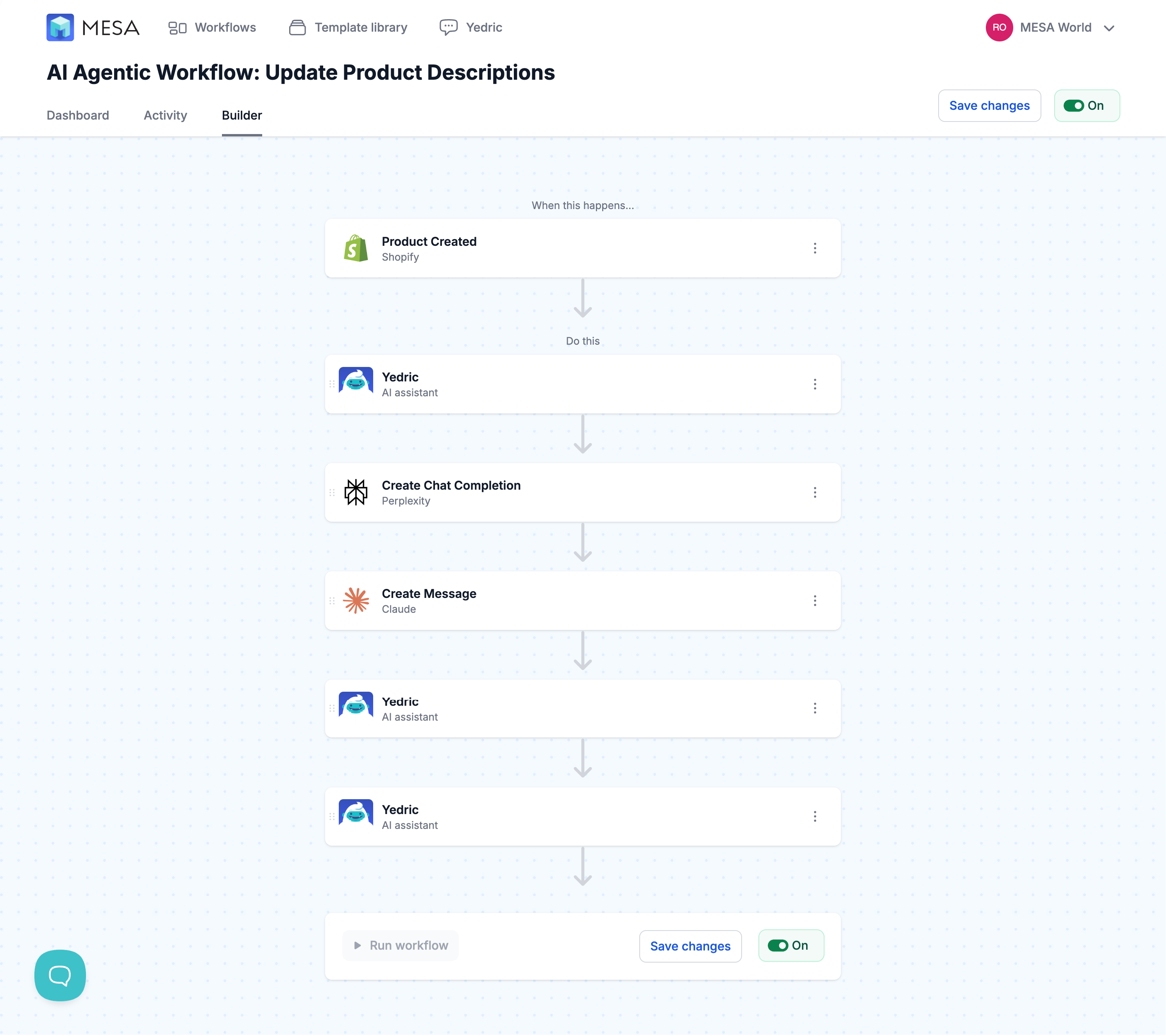
Let's walk through building an agentic workflow that automatically creates optimized, multi-platform product content when you add new products to Shopify. This example demonstrates how AI agents and tools work together autonomously.
- Create reusable MCP skills for MESA's AI
Before building the main workflow, you'll create individual MCP skills for each platform update action. Navigate to the Skills tab in MESA and create the following skills:
Shopify Product Update Skill: Set the MCP trigger, then add Shopify's "Update Product" action. Configure it to accept a product ID and updated description as inputs. This skill becomes a reusable tool that any workflow can call to update Shopify products.
Etsy Listing Update Skill: Create another skill with the MCP trigger, followed by Etsy's "Update Listing" action. Configure it to format descriptions according to Etsy's requirements and handle Etsy-specific fields like tags and categories.
Square Product Update Skill: If you sell through Square, create a fourth skill for updating Square catalog items with optimized descriptions.
These skills act as modular building blocks—create them once, use them across multiple workflows. They also make your main workflow cleaner and easier to maintain.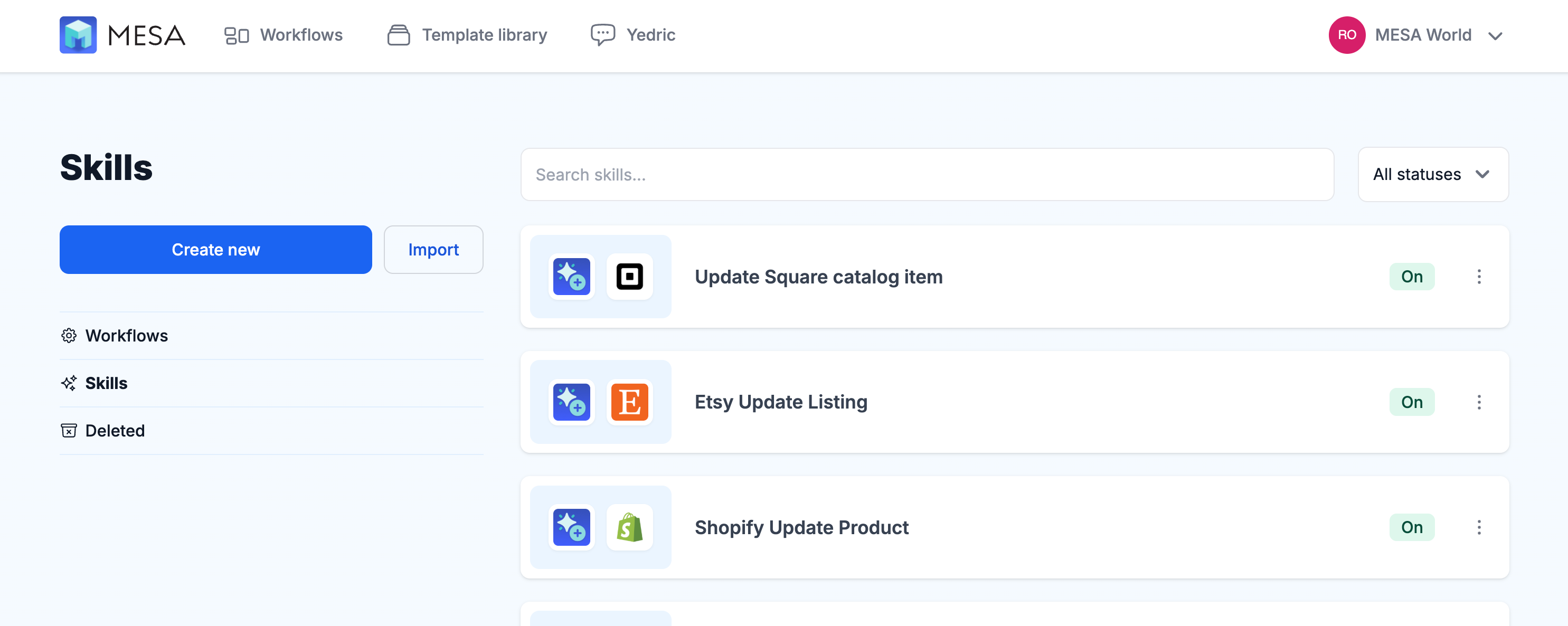
- Build the main orchestration workflow
Now you'll create the sophisticated workflow that orchestrates the entire process. You can build this manually or ask MESA's AI to create it through natural conversation.
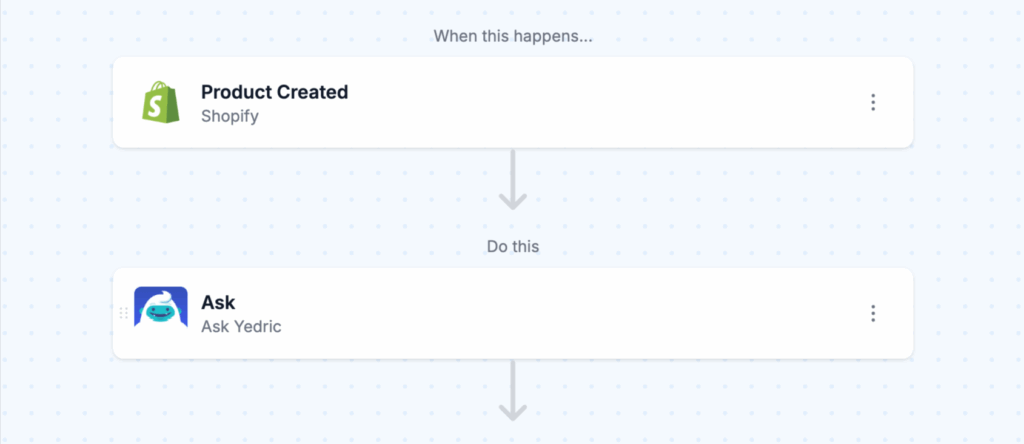
Trigger: Shopify Product Created
The workflow begins when a new product is added to your Shopify store. MESA's Shopify integration monitors for this event and automatically triggers the workflow, passing all product data—title, vendor, type, variants, images, and existing attributes—into the subsequent steps.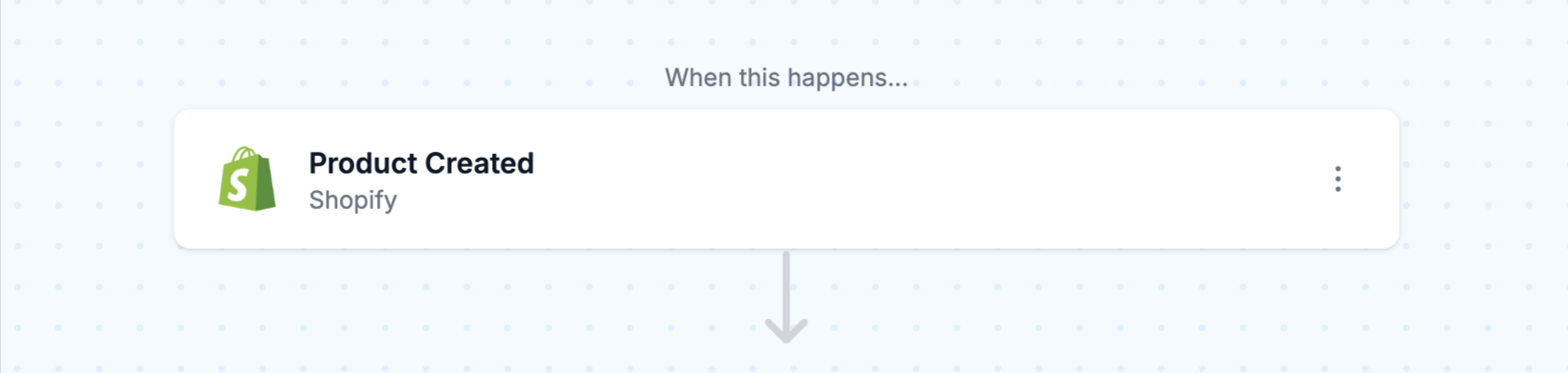
- Ask MESA's AI to analyze product attributes
Add a MESA AI step to examine and analyze the incoming product data. It evaluates what information is present, identifies what's missing, determines the product category and positioning, extracts key features from the title and existing attributes, and creates a strategic plan for content generation. It outputs a structured analysis that guides the next steps.

- Context gathering with Perplexity
Add a Perplexity step to research the competitive landscape. Using the product information from Step 1, Perplexity searches for similar products from competitors, identifies trending keywords and positioning strategies in this category, analyzes pricing benchmarks and common features, and discovers customer pain points and benefits to emphasize. This external intelligence provides the market context needed for differentiated content.

- Generate description with Claude
Add a Claude step to generate the optimized product description. The prompt you send to Claude includes the product attributes analyzed by MESA's AI, competitive intelligence from Perplexity, your brand voice guidelines, and target keywords. Claude generates naturally-written, SEO-optimized content that highlights key benefits, incorporates keywords organically, matches your brand tone, and differentiates from competitors.

- Quality check and refinement with MESA's AI
Add another MESA AI step to evaluate the generated description against quality criteria. It checks whether the description includes all essential product features, is the appropriate length for your store standards, naturally integrates target keywords, matches your established brand voice, and meets readability standards. If improvements are needed, it can refine the content before proceeding to publishing.

- Multi-platform publishing with AI agent skills
Here's where the modular approach shines. Add a final MESA AI step configured to call the MCP skills you created earlier. Within this single step, you can trigger multiple skills:
Call Shopify Product Update Skill: Pass the product ID and optimized description to update the original Shopify listing
Call Etsy Product Update Skill: Pass the product data with Etsy-formatted content to create or update the Etsy listing
Call Square Product Update Skill: Pass Square-formatted content to update your Square catalog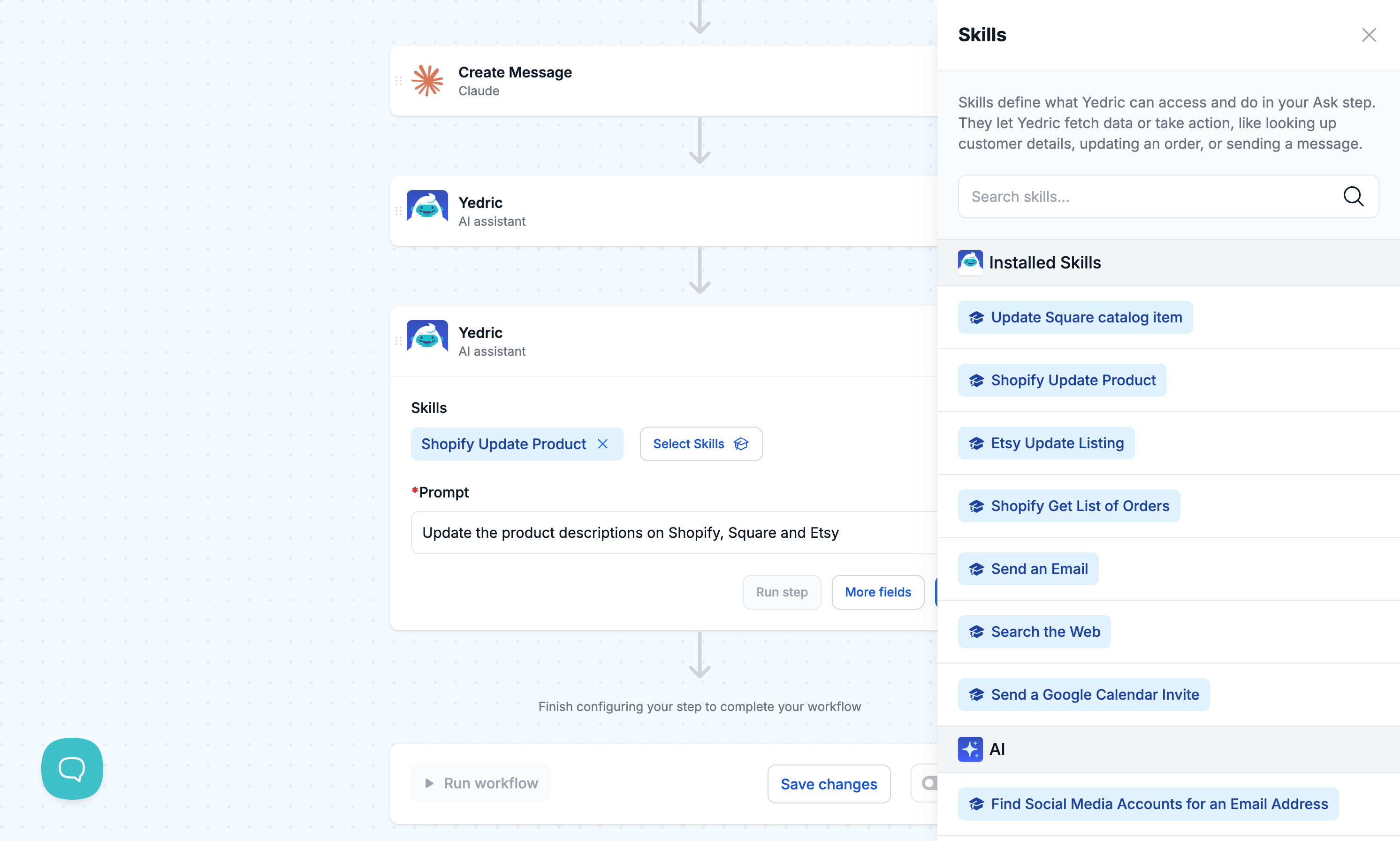
- Turn your workflows "On"
Each skill executes its specific platform update autonomously. Because you're calling pre-configured skills rather than manually building each action in the workflow, your orchestration workflow stays clean and maintainable.
This architecture provides several advantages:
Reusability: The MCP skills you create can be called from any workflow. Build them once, use them everywhere. When you create a different product workflow (like seasonal updates or price changes), those same skills are ready to use.
Maintainability: If Shopify changes its API or you want to modify how descriptions are formatted for Etsy, you update the skill once rather than editing multiple workflows.
Flexibility: MESA's AI can intelligently decide which skills to call based on conditions. For example, you might have it only call the Etsy skill for handmade products, or only update Amazon for products above a certain price point.
Scalability: As you add more sales channels (TikTok Shop, Facebook Marketplace, your own headless storefront), you simply create new MCP skills and add them to the MESA AI step. The core workflow logic remains unchanged.
Challenges & Best Practices
Agentic workflows represent a powerful evolution in automation, but they're not a universal solution for every business problem. Understanding when to use them—and when simpler approaches are better—is crucial for success. Let's explore the decision framework and best practices for implementing agentic workflows effectively.
When agentic workflows make sense
Agentic workflows deliver the most value when you're dealing with complexity that deterministic automation can't handle. Here are the scenarios where the investment pays off:
Complex, multi-step processes
When your workflow involves numerous sequential decisions that depend on contextual factors, agentic approaches excel. Consider product launches that require coordinating content creation, pricing strategy, inventory allocation, marketing campaigns, and channel-specific adaptations. Traditional automation would require you to map out every possible scenario explicitly. Agentic workflows can reason through the process, making appropriate decisions at each step based on the specific product and market conditions.
High variability in inputs
If every instance of your workflow encounters significantly different conditions, rigid rules become impractical. Customer service scenarios exemplify this: each inquiry is unique, requiring different information gathering, analysis, and responses. Agentic workflows can adapt their approach based on what they discover—following up with additional questions, pulling different data sources, or escalating to humans when complexity exceeds their capabilities.
Need for continuous adaptation
Markets change, customer behaviors evolve, and competitive landscapes shift. Agentic workflows can incorporate new information, learn from outcomes, and adjust their strategies over time. If you're managing dynamic pricing, inventory optimization across seasonal trends, or marketing personalization that needs to respond to behavioral signals, agentic workflows continuously improve rather than becoming outdated like static rules.
When traditional automation is better
Despite their power, agentic workflows aren't always the right choice. Simpler automation often works better in these situations:
Simple, repetitive tasks
When you have straightforward, predictable workflows—like sending an order confirmation email when an order is placed, or updating a spreadsheet when inventory changes—traditional automation is faster, cheaper, and more reliable. The deterministic nature isn't a limitation; it's a feature. You want order confirmations to work identically every time, without any "intelligent" variation.
Fully predictable inputs
If your workflow processes data that follows consistent structures and contains no ambiguity, traditional automation handles it perfectly. Syncing product quantities between your warehouse management system and Shopify follows fixed logic. Adding AI decision-making adds cost and complexity without improving outcomes.
Strict compliance requirements
Regulated industries or processes with stringent audit requirements often need deterministic, fully traceable workflows. When you must demonstrate exactly why a decision was made and guarantee identical handling of similar inputs, traditional automation's predictability is essential. Financial calculations, regulatory reporting, and legal compliance workflows typically fall into this category.
The key question to ask: Does this workflow require judgment, or just execution? If it's purely execution, stick with traditional automation.
Common challenges
Implementing agentic workflows comes with real challenges that you should anticipate and plan for:
Initial setup complexity
Agentic workflows require more upfront thought than simple automations. You need to define what "good" looks like for quality evaluation, establish brand voice guidelines for content generation, determine appropriate levels of autonomy for different decisions, and create monitoring systems to track performance. This investment pays dividends over time, but expect a steeper learning curve initially.
Balancing autonomy with control
One of the hardest decisions is determining how much autonomy to grant your agentic workflows. Too little autonomy and you're constantly approving decisions, negating the efficiency benefits. Too much autonomy and you risk inconsistent outputs or decisions that don't align with business strategy. Finding the right balance requires iteration—start conservative and gradually increase autonomy as you build confidence in outcomes.
Ensuring quality and consistency
AI-generated outputs can vary in quality, and while reflection patterns help, they're not foolproof. You may encounter descriptions that technically meet criteria but lack polish, decisions that are logically sound but don't align with brand strategy, or responses that are accurate but use inappropriate tone. Establishing quality thresholds, implementing review mechanisms, and continuously refining your prompts and guidelines are ongoing requirements.
Cost considerations
AI-powered steps in workflows incur API costs from providers like OpenAI, Anthropic, or Perplexity. For high-volume workflows, these costs can add up. You need to model the economics: calculate the cost per workflow execution, compare against labor costs for manual processes, and identify the volume at which automation becomes cost-effective. Sometimes a hybrid approach—using AI for high-value decisions and traditional automation for routine steps—optimizes the cost-benefit equation.
Best practices for success
Drawing from successful implementations, here are proven practices for building effective agentic workflows:
Start with templates, customize gradually
Don't try to build sophisticated custom workflows from day one. Begin with MESA's pre-built templates for common use cases—they represent proven patterns and give you working automation immediately. Use these templates to learn how agentic workflows function, then customize incrementally based on your specific needs. This approach reduces risk and accelerates time to value.
Implement monitoring and safeguards
Build visibility into your workflows from the start. Set up notifications for workflow failures or unusual patterns, log key decision points so you can audit outcomes, track quality metrics for AI-generated content, and establish alerts when workflows deviate from expected behavior. MESA's Activity Log and Database tools make this straightforward. Good monitoring lets you catch issues early and continuously improve your workflows.
Use human-in-the-loop for high-stakes decisions
For decisions with significant business impact or customer-facing implications, implement approval steps that require human review before execution. MESA's Approval tool makes this easy—workflows can pause, present the proposed action with context, and wait for a team member to approve or reject. This is particularly important when you're first implementing agentic workflows and building confidence in their decision-making. As patterns prove reliable, you can selectively remove approval requirements.
Iterate based on performance data
Your first version of an agentic workflow won't be perfect, and that's expected. The key is systematic improvement: regularly review workflow outputs and outcomes, identify patterns in failures or suboptimal results, refine prompts and quality criteria based on what you learn, and adjust autonomy levels based on performance trends. Treat your workflows as living systems that improve through feedback loops rather than one-time implementations.
Additional tips and tricks:
Document your guidelines: Maintain clear documentation of brand voice, business rules, quality standards, and decision criteria. This documentation directly improves AI outputs and helps team members understand how workflows operate.
Version your workflows: When making significant changes, duplicate workflows and test the new version alongside the original. This lets you compare performance before fully switching over.
Start with non-critical processes: Initially deploy agentic workflows in areas where imperfect outputs have low consequences. Use these implementations as learning opportunities before tackling business-critical processes.
Plan for failure: Even sophisticated workflows encounter edge cases they can't handle. Design workflows with graceful failure modes—when the AI can't determine the right action, route to humans rather than guessing.
Measure business impact: Track metrics that matter—time saved, error reduction, conversion rate improvements, customer satisfaction—not just whether workflows execute successfully. This ensures your automation delivers actual business value.
Implementing agentic workflows successfully requires thoughtful planning, realistic expectations, and commitment to continuous improvement. By understanding when they're appropriate, anticipating common challenges, and following these best practices, you can build automation that genuinely transforms your ecommerce operations rather than just adding complexity.
Conclusion & Next steps
The evolution from traditional automation to agentic workflows represents more than just a technological upgrade—it's a fundamental shift in how ecommerce businesses can operate. Where static, rule-based automation breaks under complexity, agentic workflows adapt. Where traditional systems require constant manual updates, agentic workflows learn and improve. Where simple automation executes tasks, agentic workflows make intelligent decisions.
Throughout this guide, we've explored how agentic workflows leverage AI agents, LLMs, dynamic tools, and memory systems to create automation that truly thinks. We've examined the core patterns—planning, tool use, and reflection—that enable workflows to decompose complex tasks, select appropriate tools autonomously, and iteratively refine their outputs. Most importantly, we've seen practical applications across product intelligence, customer service, inventory operations, marketing personalization, and business analytics that deliver measurable business value.
The ROI of agentic workflows
The business case for agentic workflows is compelling. By automating complex decision-making processes that previously required skilled human effort, you multiply your team's impact without expanding headcount. A single agentic workflow can handle product optimization across hundreds of SKUs, provide personalized customer service at scale, optimize inventory decisions across fluctuating demand patterns, and generate marketing content adapted for multiple channels—tasks that would otherwise consume days of manual work weekly.
Companies implementing agentic workflows report significant improvements: 60-80% reduction in time spent on routine content creation, 40-50% decrease in customer service response times, 25-35% improvement in inventory turnover through predictive monitoring, and 30-45% increase in marketing efficiency through automated personalization. These aren't aspirational metrics—they're outcomes from businesses that have embraced intelligent automation.
Your path forward
Getting started with agentic workflows doesn't require a massive transformation project. Here's how to begin:
1. Try MESA templates
Start your 7-day free trial and explore MESA's template library. Choose 2-3 pre-built workflows that address current pain points in your business—perhaps automated product tagging, order status monitoring, or customer segmentation. Deploy these templates to see immediate value and learn how agentic patterns function in practice.
2. Start with one high-impact workflow
Identify a single process that's currently time-consuming and involves complex decision-making. Product content creation, inventory reordering, or customer inquiry routing are excellent candidates. Use MESA's AI to build or customize a workflow that addresses this specific need. Focus on getting one workflow working exceptionally well rather than deploying many mediocre automations.
3. Scale gradually
Once your first workflow proves its value, expand systematically. Add complementary workflows that build on your success, increase autonomy as you gain confidence in AI decision-making, and incorporate learnings from initial implementations into new workflows. This gradual approach minimizes risk while building organizational capability.
Take the first step today
The future of ecommerce belongs to businesses that can scale intelligently without scaling complexity. Agentic workflows give you that capability—automating not just tasks, but the thinking behind them.
Ready to multiply your impact without multiplying your effort?
Start your free 7-day trial of MESA and deploy your first agentic workflow today. Full access to templates, integrations, and MESA's AI assistant.
Have questions about implementing agentic workflows for your specific business? Connect with our automation experts—we're here to help you succeed.
The shift from working harder to working smarter starts with a single workflow. Make today the day you begin.
Frequently asked questions
What is an agentic workflow?
An agentic workflow is a dynamic, AI-driven automation where intelligent agents make autonomous decisions, adapt to changing conditions, and coordinate tasks with minimal human intervention. Unlike traditional automation that follows fixed if-then rules, agentic workflows can plan multi-step processes, select appropriate tools based on context, reflect on their outputs to self-correct, and learn from past executions. They leverage large language models (LLMs) for reasoning, connect to external tools and data sources, and maintain memory across interactions to become increasingly effective over time.
How are agentic workflows different from traditional automation?
Traditional automation follows rigid, predetermined rules—if X happens, do Y. It breaks when encountering unexpected scenarios and requires manual updates to handle new conditions. Agentic workflows use AI to reason through problems, adapt their approach based on context, and make nuanced decisions autonomously. For example, traditional automation might tag all orders over $100 as "VIP," while an agentic workflow considers purchase history, customer lifetime value, and engagement patterns to make intelligent segmentation decisions. Agentic workflows handle complexity and variability that deterministic systems cannot.
What are the core components of agentic workflows?
Agentic workflows consist of four foundational components:
(1) AI agents powered by large language models that enable reasoning and decision-making,
(2) dynamic tools and integrations (APIs, databases, web search) that agents use to gather information and take actions,
(3) memory systems—both short-term for maintaining context during execution and long-term for learning from historical data, and
(4) reasoning capabilities including planning to break down complex tasks and reflection to evaluate and improve outputs.
These components work together to create automation that truly thinks.
Can small businesses benefit from agentic workflows?
Absolutely. Small businesses often lack the resources to hire specialists for every function, making agentic workflows especially valuable. They enable small teams to operate with the efficiency of much larger organizations by automating complex tasks like content creation, customer service, inventory management, and marketing personalization. With platforms like MESA offering templates and natural language workflow creation, small businesses can deploy sophisticated automation without technical expertise or large budgets. The ROI is often higher for smaller businesses because each automated workflow has proportionally greater impact.
What are common use cases for agentic workflows in ecommerce?
Common ecommerce applications include: product intelligence (auto-generating SEO descriptions, dynamic tagging, cross-channel content adaptation), customer service (intelligent order monitoring, context-aware communication, proactive issue resolution), inventory operations (predictive reordering, dynamic pricing, multi-channel fulfillment optimization), marketing personalization (automated segmentation, personalized campaigns, channel-specific content), and business analytics (autonomous data analysis, trend detection, competitive intelligence gathering). Any process involving complex decisions, variable inputs, or multi-step coordination benefits from agentic approaches.
How much does it cost to implement agentic workflows?
MESA offers pricing tiers starting with a free 7-day trial, followed by plans beginning at affordable monthly rates based on workflow complexity and execution volume. The primary costs include the MESA platform subscription and API costs for AI services (like Claude or GPT-4) used within workflows—typically pennies per execution. For most businesses, the ROI is immediate: a single workflow automating 10 hours of weekly manual work pays for itself many times over. Many workflows use minimal AI calls, keeping costs low while delivering significant value.
Does MESA require coding knowledge?
No. MESA is designed for non-technical users through its natural language interface with its AI assistant. Simply describe what you want to automate, and it builds the workflow for you. The platform also offers 1,000+ pre-built templates you can deploy immediately or customize through conversation. For users who want advanced customization, MESA provides a Code tool for JavaScript, but it's entirely optional. Most businesses successfully implement sophisticated agentic workflows without writing a single line of code, relying on MESA's visual interface and AI assistance.
How do I get started with agentic workflows?
Start with MESA's 7-day free trial to explore templates addressing your biggest pain points—product management, customer service, or marketing automation. Deploy 1-2 pre-built workflows to see immediate results and understand how agentic patterns work. Next, identify one high-impact process that's currently time-consuming and involves complex decisions. Use MESA's AI to build a custom workflow through natural conversation, or customize a template. Monitor results, gather feedback, and iterate. Once successful, gradually expand to additional processes. MESA's support team provides guidance throughout your journey.