

Agentic AI automation for Shopify: Complete guide
-
- •
- Last updated: Feb. 19, 2026
- •
- 36 min read

You’ve built the workflows. You’ve set the conditions. You’ve configured the triggers. And yet, every morning brings the same reality: exceptions that break your automation, edge cases that require manual intervention, and a growing sense that the more workflows you create, the more complex your operations become.
This is the automation paradox merchants face today. What promised freedom has become a different kind of burden—not the burden of manual work, but the burden of managing increasingly fragile automation that can’t keep up with the complexity of real commerce.

The automation paradox merchants face today
The average Shopify merchant runs 15-30 active workflows across their business. Each workflow was built to solve a specific problem: tag high-value customers, alert on low inventory, route support tickets, prevent fraud, recover abandoned carts. Each workflow works perfectly—until it doesn’t.
The problem isn’t that your workflows fail completely. It’s that they succeed 80% of the time and fail 20% of the time. And that 20%? It consumes 80% of your team’s attention.
80% of workflows work perfectly. The other 20% consumes 80% of your team’s time. ⌛
For example, your inventory alert triggers when stock drops below 10 units. Except Product A sells 20 units per day while Product B sells 2 units per month. The same threshold means you’re drowning in alerts for slow-movers while running out of fast-sellers before you even get notified.
Static rules break when faced with the reality of commerce: context matters, customers are nuanced, and business conditions change constantly.
What this guide covers
This guide is about a fundamental shift in how automation works for Shopify merchants. Not better rules. Not more workflows. A different approach entirely: agentic AI automation.
You’ll learn how AI agents differ from static workflows—not just in capability, but in how they understand context, make decisions, and continuously improve without constant reprogramming. You’ll discover MESA’s unique hybrid approach that lets you inject AI intelligence at any point in your workflows, not just at the beginning or end.
This isn’t theoretical. Thousands of merchants already use MESA to power their Shopify automation, and the addition of Yedric—MESA’s AI assistant powered by ChatGPT—represents the next evolution: automation that thinks, not just executes.
Why agentic AI matters now
For years, AI in ecommerce has been more promise than reality. Experimental features, unreliable outputs, systems that required constant supervision. That era is over. The technology has reached production-grade reliability. The question is no longer “Does AI work for commerce?” but “When will you adopt it?”
🗓️ Static Rules (2020) → 🗓️ Workflows (2023) → 🗓️ Agentic AI (2026)
The competitive landscape is already shifting. Merchants leveraging agentic AI operate at fundamentally different speed and scale than those relying on manual processes or static workflows. They respond to market changes in minutes, not days. They handle exceptions automatically instead of routing them to overwhelmed teams. They scale operations without scaling headcount proportionally.
Your competitors aren’t just automating more—they’re automating smarter. The merchants who win in 2026 and beyond will be those who learned to delegate operations to intelligent agents, not just automate them with rigid rules.
What makes MESA unique: The agentic platform
Most automation platforms force a choice: visual workflow builders with no intelligence, or pure AI systems with less control over structure. MESA offers something different—a hybrid agentic platform that combines the best of both approaches.
Traditional workflow power: Build workflows visually with MESA’s proven workflow builder. Configure triggers, set conditions, and define actions. Everything you expect from a mature automation platform, with hundreds of app connectors and built-in tools for email, SMS, data storage, scheduling, and more.
Conversational AI creation: Talk to Yedric, MESA’s AI assistant, in plain English. “Yedric, identify high-value customers and send a personalized thank-you email to everyone.” Yedric asks clarifying questions, builds the workflow structure, and deploys it—all through natural conversation.
Intelligence mid-workflow (MESA’s unique advantage): Inject Yedric as an intelligent decision-making step at any point in your workflows. Your workflow triggers, performs initial actions, then hands decision-making to Yedric. Yedric fetches data from multiple systems using MCP (Model Context Protocol) skills, reasons across all data sources, and returns structured intelligence that informs your workflow’s next steps.
⚙️ Traditional Workflow Builder + 💬 Conversational AI + 💙 Intelligent Middleware
This means you can enhance existing proven workflows without rebuilding them from scratch. That order processing workflow you’ve perfected over the years? Keep the structure. Add a Yedric intelligence step at the decision point where fraud evaluation happens. Suddenly, your workflow can access customer support history from Help Scout, fraud scoring from your database, and customer lifetime value calculations—then make a nuanced decision based on all that context.
MCP-powered extensibility: Through the Model Context Protocol introduced by Anthropic in 2024, Yedric can connect to any system, any API, any data source. MESA offers pre-built MCP skills for common integrations like Shopify, Google Sheets, Help Scout, Zendesk, and WordPress. But Yedric can also create custom MCP skills on demand: “Yedric, I need to fetch data from our custom ERP system.” No coding required.
This architecture—traditional workflows + conversational creation + intelligent middleware + unlimited data access—is what makes MESA the only true agentic automation platform for Shopify.
The shift from workflows to AI agents isn’t about replacing what works. It’s about making your automation intelligent exactly where complexity demands it, while keeping deterministic execution where simple rules suffice.
You maintain control. You maintain visibility. But now, your automation can think.
Let’s explore what that means in practice.
Table of Contents:
Understanding agentic AI automation
The term “agentic AI” sounds like tech jargon, but it describes something fundamentally different from the automation you’ve used before. Understanding this distinction is essential because it fundamentally changes how your Shopify operations work.
What makes AI “agentic”
An agent is a system that acts on your behalf to achieve goals—not just executing predefined steps, but working toward outcomes independently. Four core capabilities define agency:
Autonomy: Acts without step-by-step human direction. You set the objective—”identify customers at risk of churning”—and the agent determines how to achieve it. No need to specify every condition or decision branch.
Reasoning: Evaluates context and makes informed decisions rather than matching patterns against rules. Considers multiple factors simultaneously, weighs their importance, and reaches conclusions based on the specific situation.
Adaptation: Learns from outcomes and adjusts behavior. Good results reinforce approaches. Poor outcomes trigger recalibration. This operational learning happens continuously as the agent works.
Goal-orientation: Works toward outcomes, not just task completion. If the goal is “maximize customer lifetime value,” the agent considers which actions best serve that objective and makes tradeoffs accordingly.
The fundamental shift: From “if-this-then-that” to “understand-decide-act”
Traditional automation follows rigid logic. Every scenario must be explicitly programmed. Every exception requires a new rule.
Static workflows:
If order total > $500
Then add customer tag "High Value"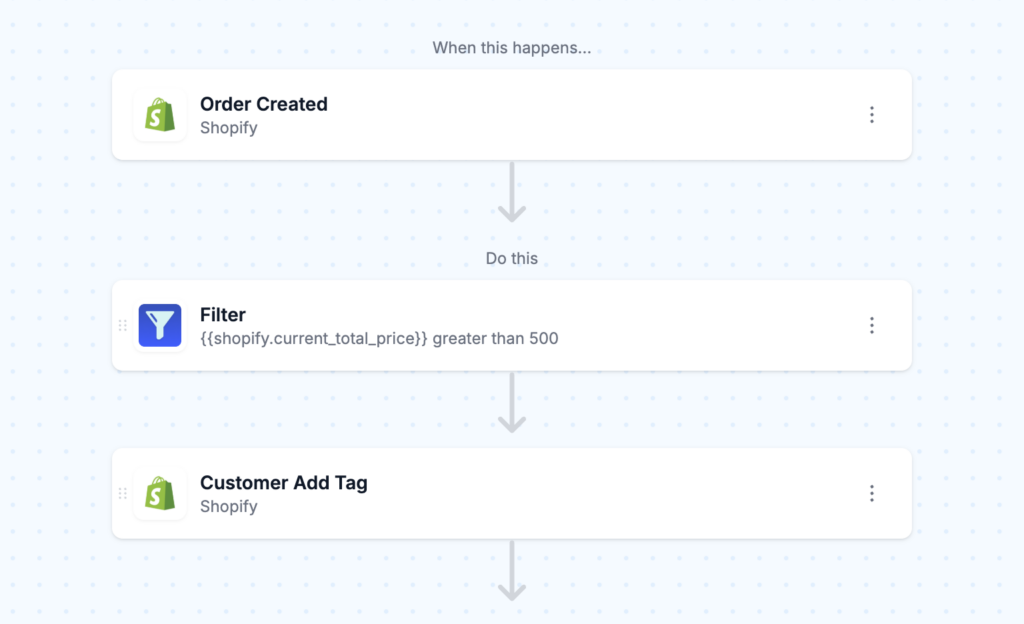
Simple and deterministic—until you encounter the customer who places one $600 order and never returns, versus the customer who places 50 orders at $75 each. By the rule, the first is “high value” and the second isn’t. But which actually matters to your business?
To fix this, you add more conditions. Then more. Each refinement creates new edge cases. The logic tree becomes unwieldy. And you still haven’t accounted for return rate, product margins, purchase frequency, or seasonal patterns.
Agentic AI approaches differently:
“Identify high-value customers considering lifetime value, purchase frequency, margin contribution, return behavior, and engagement trends.”
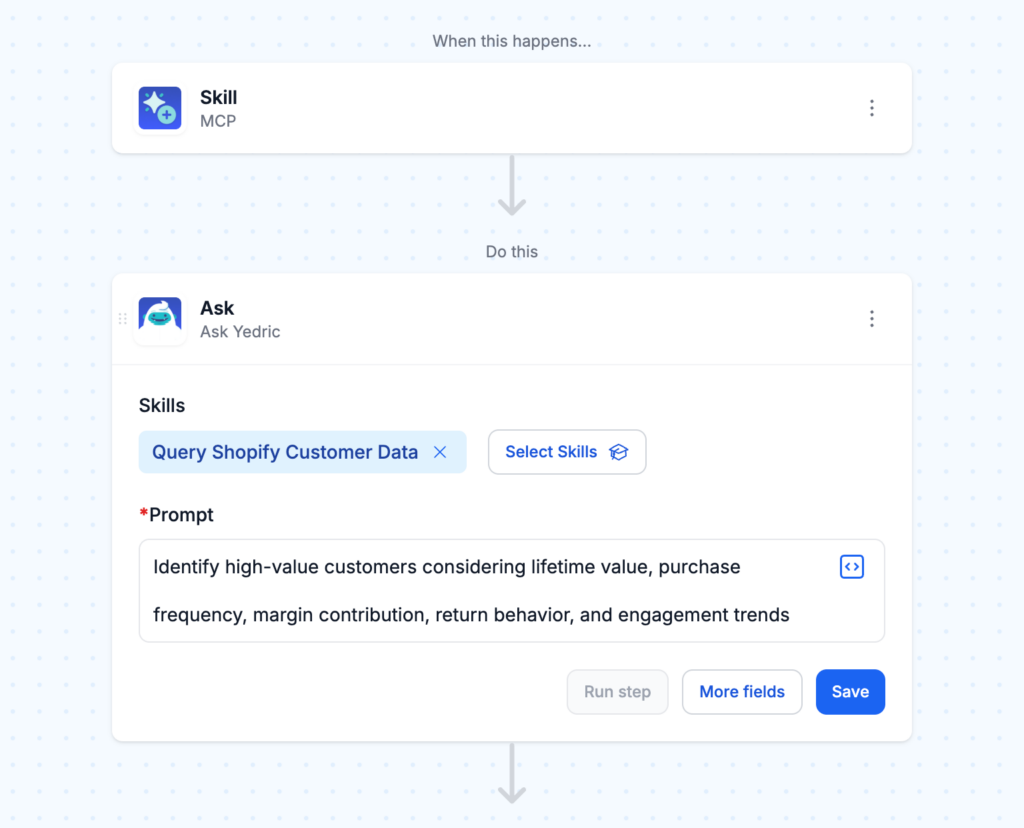
The AI agent fetches order history, calculates net lifetime value after returns, analyzes purchase frequency trends, evaluates margin contribution, checks return patterns, and considers engagement signals. Then it makes a contextual decision:
Customer A:
• $1,847 LTV across 12 orders
• 4% return rate
• strong margins
• increasing frequency

Classification: High Value, confidence: 94%.
Customer B:
• $2,100 LTV across 3 orders
• 35% return rate
• only buys on sale
• declining engagement.
Classification: Monitor, confidence: 78%.
Reason: Problematic behavior pattern suggests returns abuse.Same goal. The AI agent understands what “high value” means in context rather than matching rigid conditions.
Why merchants need AI agents, not just more workflows
If you’re running a growing Shopify store, you’ve likely hit these walls:
The complexity ceiling: The average merchant runs 15-30 active workflows. Each addresses specific scenarios, but they interact unpredictably. One workflow tags an order “Priority” while another tags it “Review.” You might spend 8-12 hours weekly troubleshooting conflicts and exceptions. Adding more workflows increases fragility, not capability.
The exception problem: Real commerce doesn’t follow predictable rules. Static workflows handle 80% of cases that fit neatly into rules. The other 20% get routed to your team for manual handling. Consider fraud prevention: a static rule flags orders whose billing country doesn’t match their shipping country. That catches some fraud but blocks legitimate international orders—gifts, travelers, B2B buyers.
The scaling challenge: As volume grows, exceptions grow faster than your team can keep up. You’re hiring people not to execute tasks but to handle automation breakdowns. Merchants using intelligent automation can reduce manual intervention by 60-75% while improving decision accuracy by 35-45%.
The maintenance burden: Every business change—new product category, supplier, fulfillment center, seasonal shift—requires workflow updates. AI agents adapt automatically. When seasonal patterns shift, they adjust thresholds. When fraud patterns evolve, they incorporate new signals. When customer behavior changes, they recalibrate classifications.
MESA’s agentic AI approach
MESA gives you flexibility in how you build and deploy AI-powered automation. Choose the approach that matches your workflow complexity, team expertise, and business needs.
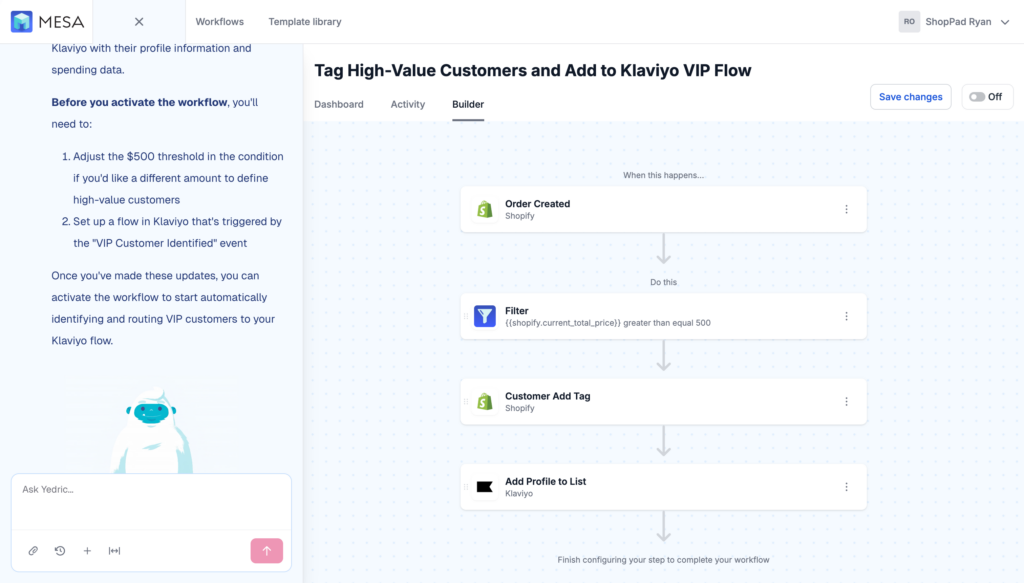
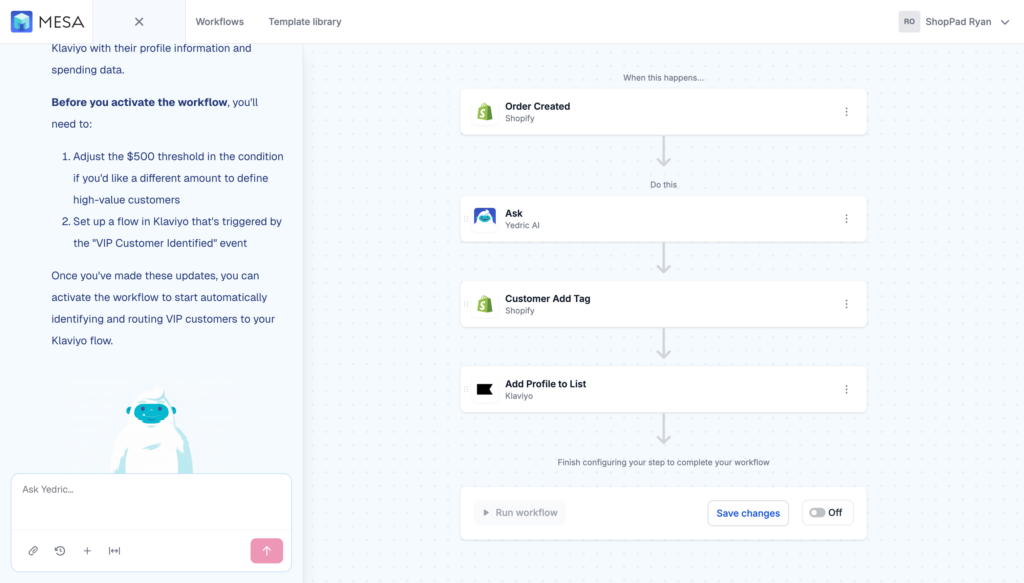
Method 1: Conversational workflow creation
Talk to Yedric in natural language to build complete workflows from scratch. “Yedric, create a workflow that tags high-value customers and sends them to Klaviyo VIP flow.” Yedric interprets your intent, asks clarifying questions about your business (“How do you define high-value? Should I consider return rate?”), builds the complete workflow structure and deploys it ready to run.
Best for: New workflows, getting started quickly, teams without technical workflow expertise, and iterating through conversation rather than manual configuration.
Method 2: Use skilled AI for added intelligence (MESA’s unique advantage)
Build your workflow structure using MESA’s visual workflow builder—the traditional approach you’re familiar with. Then insert Yedric as an intelligent step wherever complex decisions are required. Enable specific MCP skills for that Yedric step. Yedric fetches external data, reasons across all inputs, and returns structured decisions. Your workflow continues using Yedric’s intelligent output to determine next actions.
Best for: Enhancing existing proven workflows without rebuilding from scratch, maintaining precise control over workflow structure, applying AI exactly where it adds value while keeping deterministic execution elsewhere, and teams who want visibility into every step.
Method 3: Hybrid approach
Start with Yedric building an initial workflow structure conversationally. Then refine it in MESA’s visual builder for precise control. Add additional Yedric intelligence steps at multiple decision points throughout the workflow.
Best for: Complex workflows requiring both structure and multiple reasoning steps, teams that want AI assistance in setup but manual control over refinement, workflows that evolve over time.
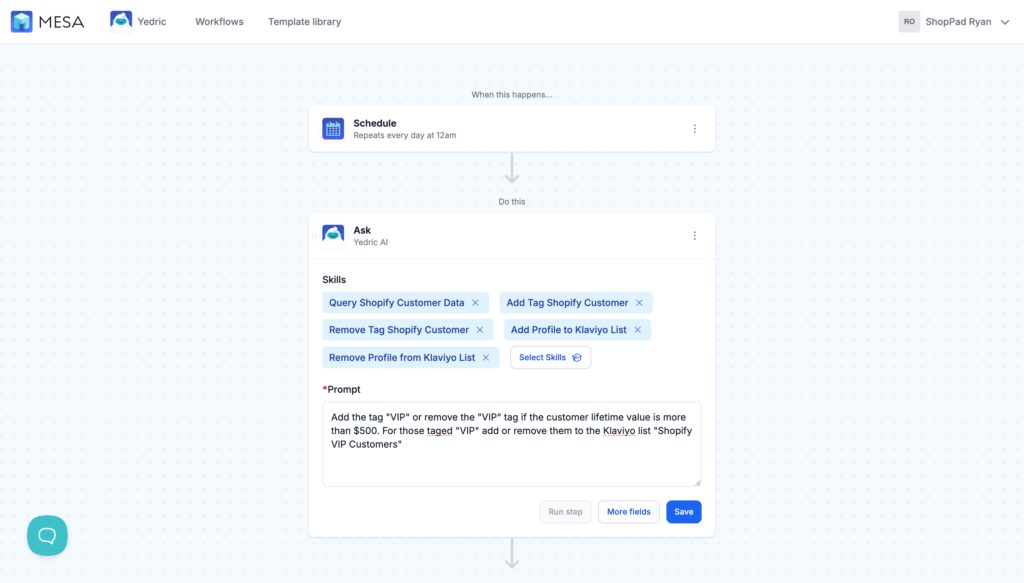
This way, you maintain your proven workflow structure—the trigger logic, the action sequence, the error handling you’ve perfected over the years. You simply add intelligence at decision points where complexity demands it.
Yedric accesses data from unlimited external systems at the moment of decision. Whether you want to fetch customer support history, query external databases, or access custom APIs mid-workflow, with MESA and Yedric, you can.
Yedric reasons across multiple data sources simultaneously—evaluating customer history from Shopify, support sentiment from Help Scout, fraud patterns from your database, and VIP criteria from Google Sheets—then returns a nuanced decision. Static rules would require you to program every possible combination of conditions.
You maintain complete workflow visibility. Every step is visible in MESA’s workflow builder. You can see exactly where Yedric’s intelligence applies and what happens with the output. No black box.
The MCP (Model Context Protocol) advantage
Model Context Protocol (MCP) enables Yedric to access any system or data source at any point in your workflows. Understanding MCP is key to understanding MESA’s competitive advantage.
When you add a Yedric intelligence step to your workflow, you enable specific MCP skills for that step. These skills enable Yedric to fetch data from connected systems. The skills are scoped to that specific workflow step—Yedric only accesses what you explicitly enable.
Pre-built MCP skills available in MESA:
- Shopify (extended data beyond standard triggers)
- Help Scout (conversation history, sentiment analysis)
- Zendesk (ticket history, customer interactions)
- Google Sheets (custom data tables, pricing, supplier info)
- Klaviyo (campaign data, segment information)
- Gmail (email communication)
- Slack (team notifications, data)
Custom MCP skill creation: Beyond pre-built skills, you can manually define new skills or describe them to Yedric and create custom skills on demand. “Yedric, I need to fetch data from our custom ERP system at https://erp.company.com/api.” Yedric requests authentication details, tests the connection, creates the custom MCP skill, and the skill becomes available in any future workflow. No coding required from you.
Security and control: MCP skills are enabled per-workflow, per-step. You explicitly choose which workflows can access which systems. Yedric only has access to the data you enable for that specific decision point. You maintain complete control over data permissions.
The unlimited extensibility advantage: This architecture means you’re never limited by pre-built integrations. Any system with an API can become a data source for Yedric’s decision-making. Internal systems, legacy databases, proprietary tools, custom applications—all accessible through MCP.
Your automation can truly consider all relevant context when making decisions, not just the limited data available from native Shopify triggers or pre-built app integrations.
Why this makes MESA the agentic automation leader
No other automation app offers MESA’s combination of capabilities. Here’s the direct comparison with Shopify Flow:
| Capability | Shopify Flow | MESA + Yedric AI |
|---|---|---|
| Visual workflow builder | ✅ Yes | ✅ Yes |
| Conversational workflow creation | ✅ Yes, via Sidekick | ✅ Yes, via Yedric |
| Intelligence injection mid-workflow | ❌ No | ✅ Yes, unique to MESA |
| Access external data sources | ❌ Very limited | ✅ Unlimited via MCP |
| Reasoning across multiple data sources | ❌ No | ✅ Yes, contextual AI decisions |
| Graduated responses (risk scoring) | ❌ Binary pass/fail | ✅ Nuanced scoring and routing |
| Customer history awareness | ⚠️ Limited to Shopify data | ✅ Complete LTV, behavior, support history across systems |
| Reasoning transparency | ❌ No explanation | ✅ AI provides reasoning for every decision |
MESA combines:
- Traditional workflow reliability (visual builder, deterministic execution)
- Conversational AI creation (natural language workflow building)
- Intelligent middleware (inject AI reasoning at any workflow step)
- Unlimited data access (MCP-powered connections to any system)
- Selective intelligence application (AI where needed, deterministic where sufficient)
Other automation apps give you workflows but no intelligence. Pure AI automation platforms give you intelligence but limited control and Shopify expertise. MESA gives you both, plus the unique ability to inject intelligence exactly where your workflows need it most.
This hybrid agentic architecture is why MESA can enhance your existing proven workflows without forcing you to rebuild from scratch, why you can start with simple automation and add intelligence progressively, and why your automation can truly scale with business complexity rather than breaking under it.
Agentic AI vs. static automation: Direct comparison
Understanding the difference between static automation and agentic AI requires seeing them side by side. For each scenario below, we’ll show three approaches: manual handling, static rule automation, and MESA with Yedric intelligence. This progression reveals not just what AI can do, but why it fundamentally changes operational capability.
10 scenarios where AI agents outperform static workflows:
1. High-value customer identification
Review orders weekly and manually tag customers who exceed certain lifetime value thresholds. Time-consuming: 2-3 hours per week for moderate-volume stores. Problems: Data is outdated by the time of review, criteria are inconsistently applied, and nuance is missed during high-volume scanning.
Static workflow:
If order_total > $200
Then: Add customer tag "High Value"
Limitations:
- A single large purchase doesn’t indicate true customer value
- Ignores purchase frequency, return rate, and product margins
- No consideration of lifetime value trends or trajectory
- Can’t remove the tag when customer behavior changes
- Binary classification with no nuance
MESA + Yedric intelligence approach:
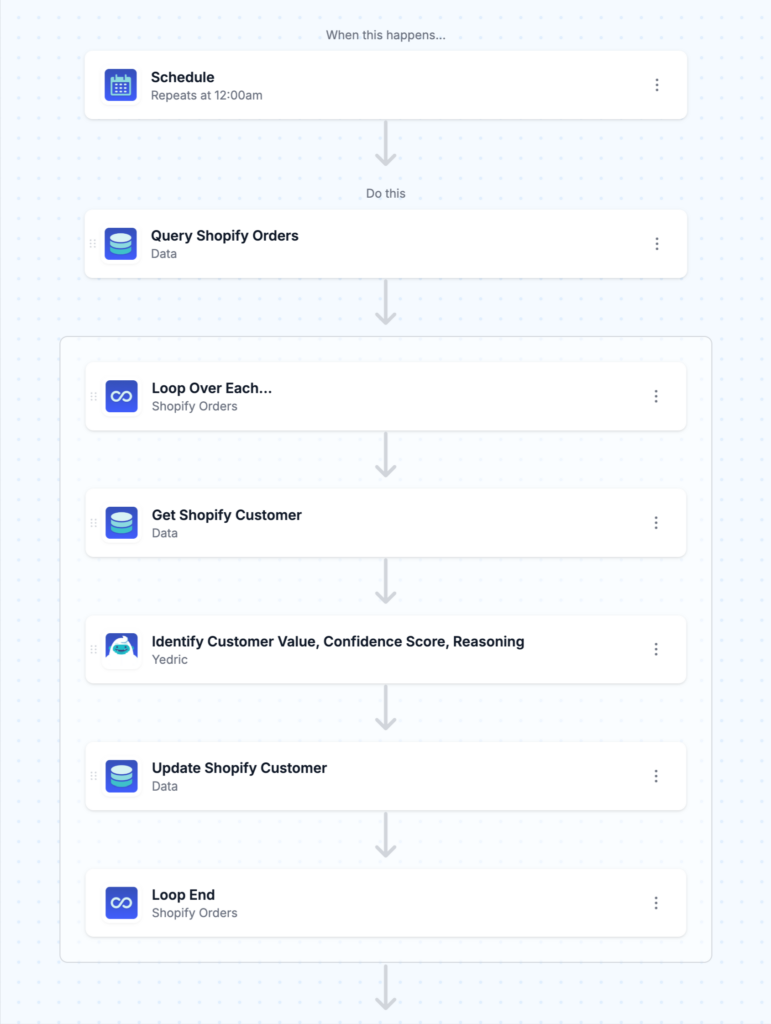
The workflow runs daily, evaluating all customers. Yedric’s intelligence step:
- Fetches complete order history
- Calculates net lifetime value (revenue minus returns, weighted by margins)
- Analyzes purchase frequency and trend direction (improving or declining)
- Evaluates return rate and reasons
- Considers engagement signals (email opens, site visits)
Returns structured decision: Customer tier (VIP, loyal, standard, at-risk), confidence score, reasoning for classification.
MESA can use this intelligence to dynamically apply/remove tags as behavior changes, sync to email platforms, trigger appropriate communication flows, and alert the team when high-value customers show at-risk signals.
🚀 Contact us – MESA is supported by human experts who will help you build this solution.
2. Intelligent inventory alerts
Check inventory reports daily, decide which products need reordering based on experience and gut feel. Time: 1-2 hours daily for 500+ SKU catalogs. Problems: Reactive rather than proactive, no velocity consideration, and inconsistent between team members.
Static workflow:
If inventory_quantity < 10
Then: Send email alert
Limitations:
- Same threshold for all products regardless of velocity
- Fast-moving products (20 units/day) alert too late
- Slow-moving products (1 unit/month) alert too early, creating noise
- No consideration of supplier lead time
- No seasonal pattern adjustment
- Alert fatigue from irrelevant notifications
MESA + Yedric intelligence approach:
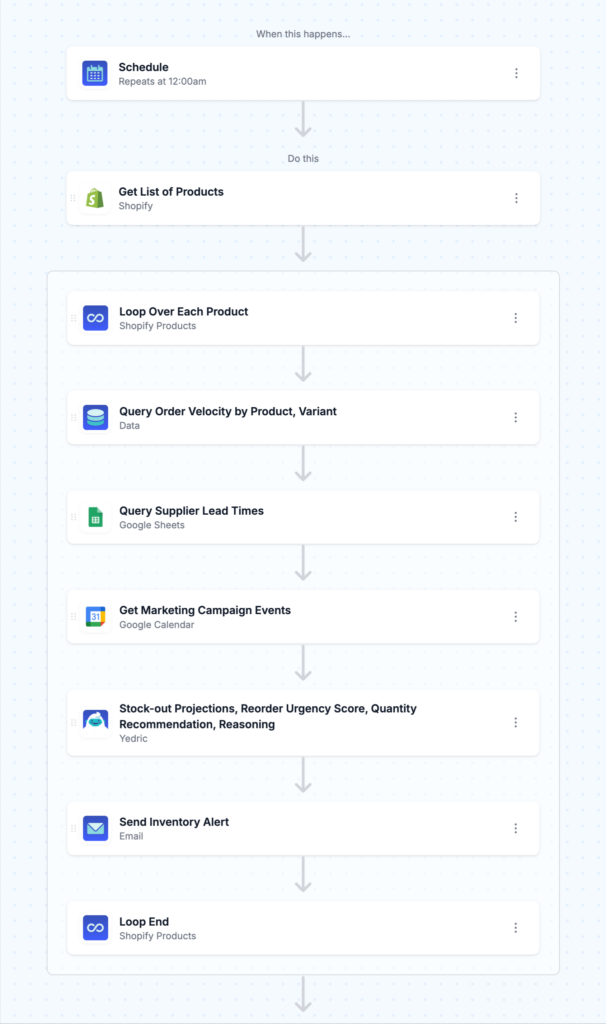
Daily scheduled workflow loops through all products. Yedric’s intelligence step per product:
- Calculates 30-day velocity with trend analysis
- Factors in supplier-specific lead times from Google Sheets
- Considers historical seasonal patterns
- Checks the calendar for upcoming marketing campaigns
- Evaluates safety stock buffer requirements
Returns: Days until stock-out projection, reorder urgency score (0-100), recommended order quantity with reasoning.
Workflow sends contextualized alerts only when action is needed, via appropriate channels (email for standard, Slack for urgent, SMS for critical). Each alert includes current stock, velocity, days until stock-out, and a specific reorder recommendation.
🚀 Contact us – MESA is supported by human experts who will help you build this solution.
3. Fraud risk assessment
Review flagged orders individually, research customer background, order patterns, and location data. Time: 10-15 minutes per suspicious order. Problems: Subjective decisions, inconsistent between reviewers, doesn’t scale, high-value legitimate customers occasionally blocked due to over-caution.
Static workflow:
If (billing_country ≠ shipping_country) AND order_total > $300
Then: Cancel fulfillment, add tag "Review"
Limitations:
- High false positive rate (legitimate international orders, gifts, travelers, expats, B2B buyers all flagged)
- Misses sophisticated fraud that matches basic rules
- No learning from fraud team decisions over time
- Binary hold/pass decision with no risk scoring or graduated response
- Can’t distinguish new customers from returning customers with established trust
MESA + Yedric intelligence approach:
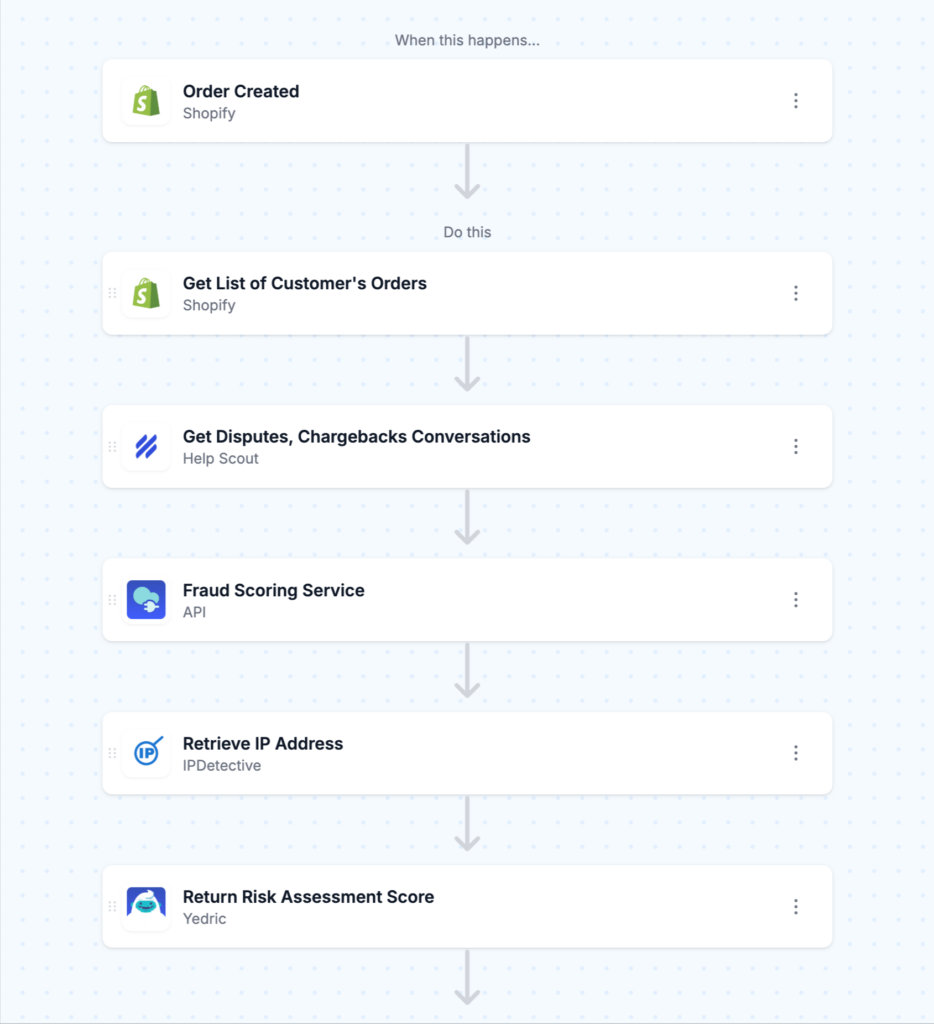
Order created triggers the workflow. Yedric’s intelligence step is enabled with multiple MCP skills:
- Shopify: Customer order history, account age, previous addresses
- Help Scout: Any previous disputes or chargeback history
- Custom API: Third-party fraud scoring service
- IP Intelligence: Geolocation verification
Yedric analyzes:
- Customer history pattern (new vs. established, order frequency)
- Order velocity and timing patterns
- Email domain age and verification status
- Billing/shipping address logic (gift pattern vs. suspicious mismatch)
- Device fingerprinting and IP alignment
- Historical patterns for similar order profiles
Returns graduated risk assessment: Risk score (0-100), confidence level, specific risk factors identified, mitigating factors present, recommendation (approve/monitor/review/decline), and detailed reasoning.
Workflow executes a graduated response based on score ranges:
- Low risk (0-30): Auto-approve, standard fulfillment
- Medium risk (31-60): Approve with delivery confirmation requirement
- Medium-high risk (61-85): Route to fraud team with full context
- High risk (86-100): Auto-decline, immediate refund
🚀 Contact us – MESA is supported by human experts who will help you build this solution.
4. Customer support routing
The support team reads each ticket, assigns based on subject keywords, and available capacity. Time: 2-3 minutes per ticket. Problems: Inconsistent routing, doesn’t account for customer value, urgent issues are missed in the queue, and complex problems are routed to junior agents.
Static workflow:
If ticket_subject contains "refund"
Then: Assign to returns team
Limitations:
- Keyword matching misses context and nuance
- Doesn’t differentiate VIP customer refunds from serial returner refunds
- No sentiment analysis (frustrated vs. neutral tone)
- No consideration of customer history or relationship
- Can’t evaluate issue complexity vs. team capacity and expertise
MESA + Yedric intelligence approach:
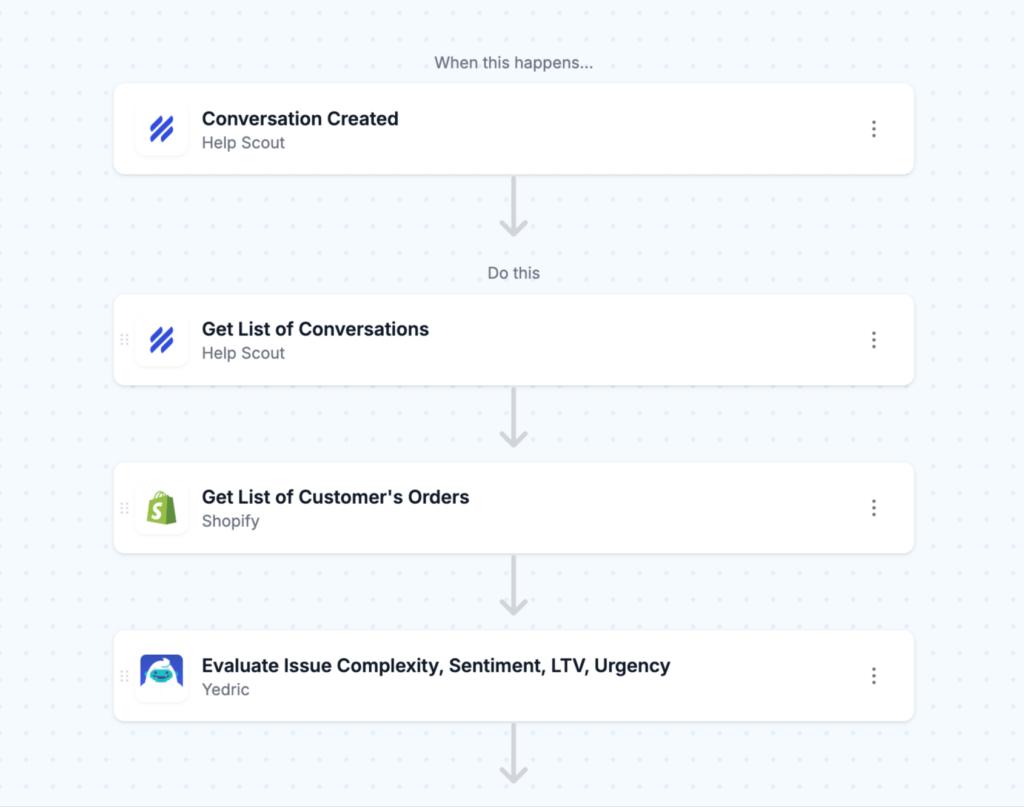
New ticket triggers workflow. Yedric intelligence step with MCP skills:
- Zendesk/Help Scout: Previous ticket history and resolution patterns
- Shopify: Customer order history, lifetime value, tier status
- Sentiment analysis on ticket text content
Yedric evaluates:
- Issue complexity (simple question vs. requires investigation)
- Customer sentiment and emotional tone
- Customer lifetime value and relationship status
- Previous support interaction patterns
- Urgency indicators in language and context
- Team capacity and expertise matching
Returns routing decision: Assigned team/agent, priority level (standard/high/urgent), suggested resolution actions, context summary for agent, and estimated resolution time.
Workflow routes the ticket appropriately, sets the priority, adds an internal note with Yedric’s context for faster agent resolution, and prepares suggested responses or compensation offers, if applicable.
🚀 Contact us – MESA is supported by human experts who will help you build this solution.
5. Dynamic discount optimization
Set fixed discount rules quarterly, review performance, and adjust based on gut feel and competitive pressure. Problems: One-size-fits-all approach, can’t respond to real-time inventory or competitive situations, and significant margin erosion from unnecessary discounts.
Static workflow:
If cart_total > $100
Then: Apply 10% discount
Limitations:
- Same discount regardless of inventory levels (discounting products you can’t keep in stock)
- Doesn’t consider the customer segment (discounting to customers who would buy at full price)
- No margin protection (discounting already low-margin products)
- Can’t adjust for competitive pricing or market conditions
- No learning about discount elasticity per customer type
MESA + Yedric intelligence approach:
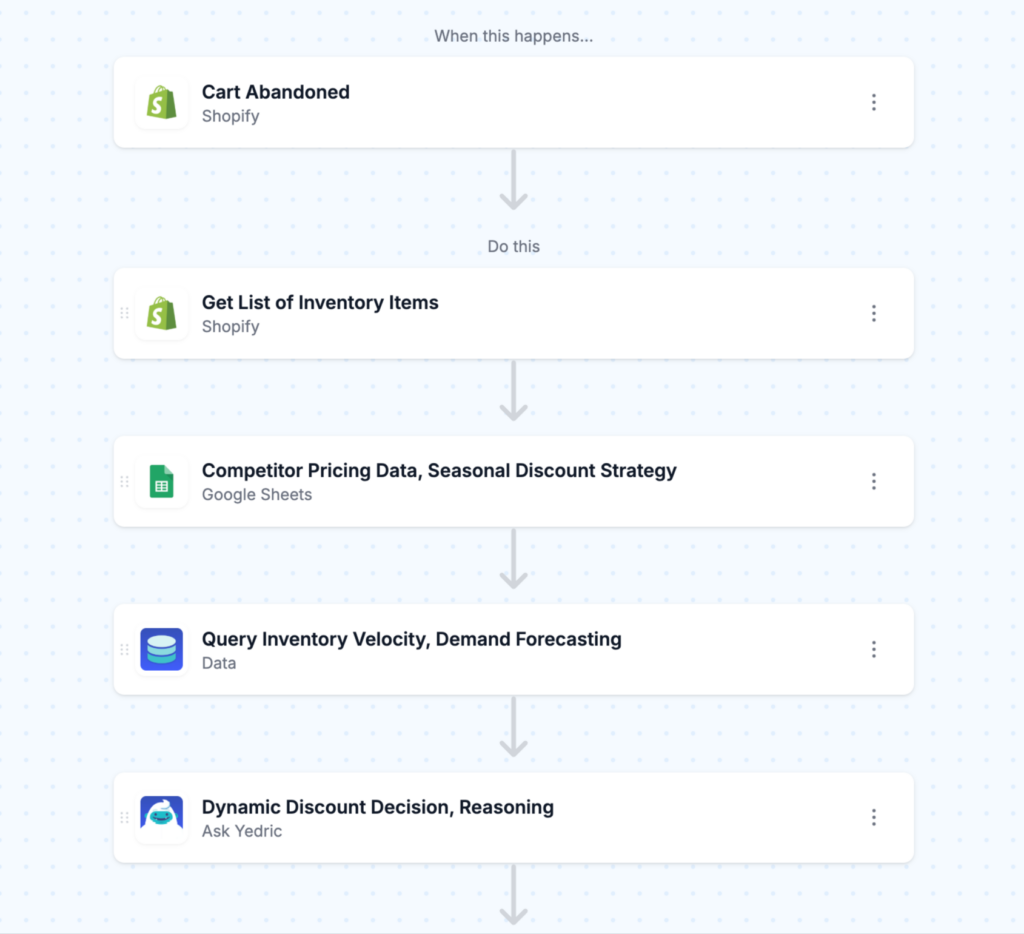
Customer adds a product to the cart, triggering an evaluation. Yedric’s intelligence step with MCP skills:
- Shopify: Current inventory levels, product margins, customer history
- Google Sheets: Competitor pricing data, seasonal discount strategy
- Klaviyo: Customer segment and price sensitivity indicators
- Custom API: Inventory velocity and demand forecasting
Yedric evaluates:
- Current inventory position (overstocked enables higher discount, low stock reduces/eliminates)
- Product margin (high margin products have discount room, protect low margin)
- Customer segment (VIP needs no incentive, price-sensitive benefits from the offer, first-time gets an acquisition discount)
- Competitive context and current market positioning
- Abandonment risk for this customer profile
- Historical conversion rates at different discount levels for this segment
Returns dynamic decision: Apply discount (yes/no), discount percentage, reasoning, expected conversion lift, and margin after discount.
Workflow could also apply appropriate discounts via Shopify Scripts/Functions for immediate cart discounts rather than waiting for an abandoned cart event. Track performance in a Data table and adjust future recommendations based on conversion outcomes.
🚀 Contact us – MESA is supported by human experts who will help you build this solution.
6. Order priority and fulfillment routing
The fulfillment team prioritizes based on the selected shipping method and visual cues in the order details. Problems: VIP customers are not recognized, inefficient routing decisions are made, delivery promises are missed, and the workload is unbalanced across facilities.
Static workflow:
If (shipping_method contains "Express") OR (order_total > $500)
Then: Add tag "Priority"
Limitations:
- Only considers two factors (shipping method and order value)
- Can’t balance fulfillment center workloads dynamically
- Doesn’t account for inventory location and split shipment costs
- No consideration of customer relationship value beyond order total
- Can’t re-prioritize based on changing conditions or new information
MESA + Yedric intelligence approach:
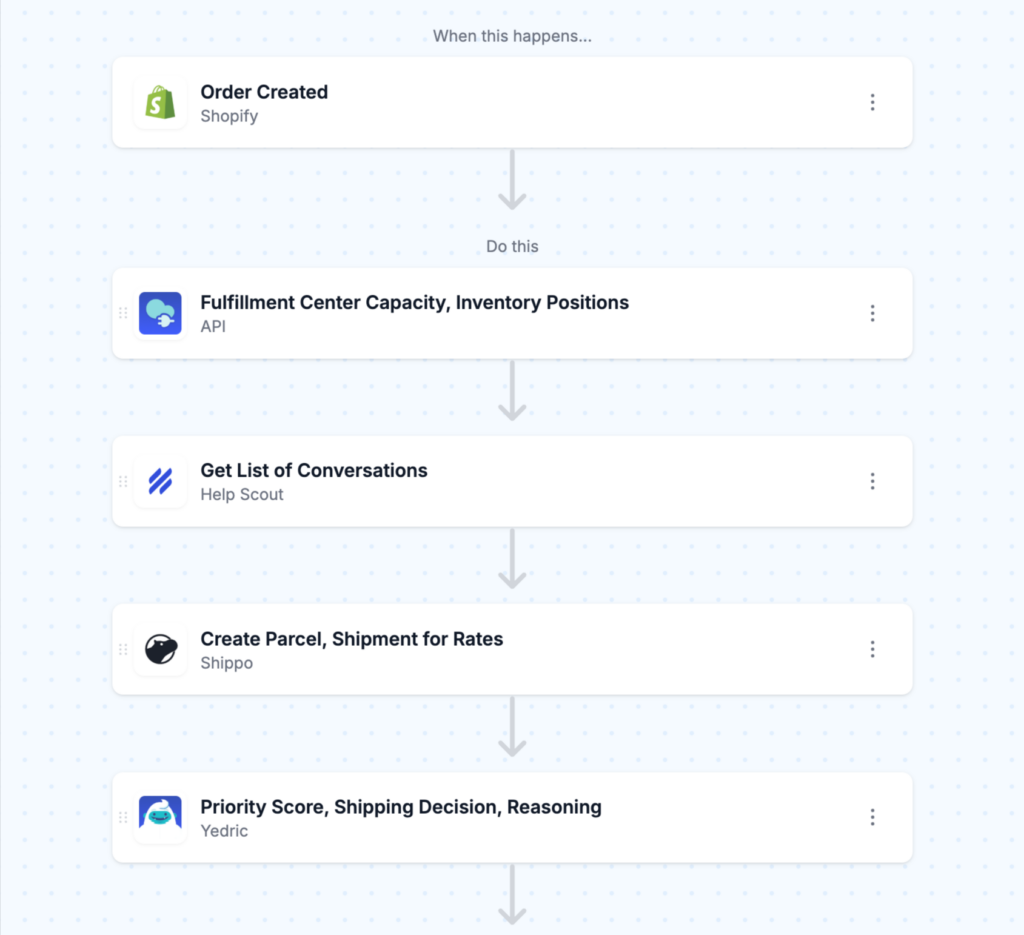
Order created triggers workflow. Yedric’s intelligence step with MCP skills:
- Shopify: Customer tier, complete order details, product locations
- Custom API: Real-time fulfillment center capacity and inventory positions
- Help Scout: Recent customer experience issues
- Shipping API: Carrier performance data by destination zone
Yedric evaluates:
- Shipping method and delivery promise date
- Customer lifetime value and tier status
- Recent customer experience (support issues, previous delays that need recovery)
- Product inventory location across the fulfillment network
- Current fulfillment center capacity and backlog
- Carrier performance to the destination zone
- Order profitability and margin
Returns comprehensive decision: Priority score (0-100), optimal fulfillment center, recommended shipping carrier, special handling instructions, and reasoning for decisions.
Workflow routes to the designated fulfillment center, applies priority tags, adds special handling notes to the pick list, notifies customer service if a VIP needs attention, and selects the optimal carrier for the destination.
🚀 Contact us – MESA is supported by human experts who will help you build this solution.
7. Abandoned cart recovery optimization
Generic abandoned cart emails are sent on a fixed schedule to all customers with the same messaging and offer. Problems: Wrong timing for different customer types, discount abuse from serial abandoners, and ineffective messaging for varying abandonment reasons.
Static workflow:
Trigger: Cart abandoned
Wait: 2 hours
Action: Send recovery email with 10% discount
Limitations:
- Same timing for all customers (impulse buyers need immediate contact, researchers need a delay)
- Fixed discount offer (VIPs don’t need an incentive, serial abandoners abuse it, some need a larger offer)
- No channel optimization (email vs. SMS effectiveness varies by customer)
- Can’t detect serial abandoners who never convert despite the discount
- A one-size-fits-all message doesn’t address specific abandonment reasons
MESA + Yedric intelligence approach:
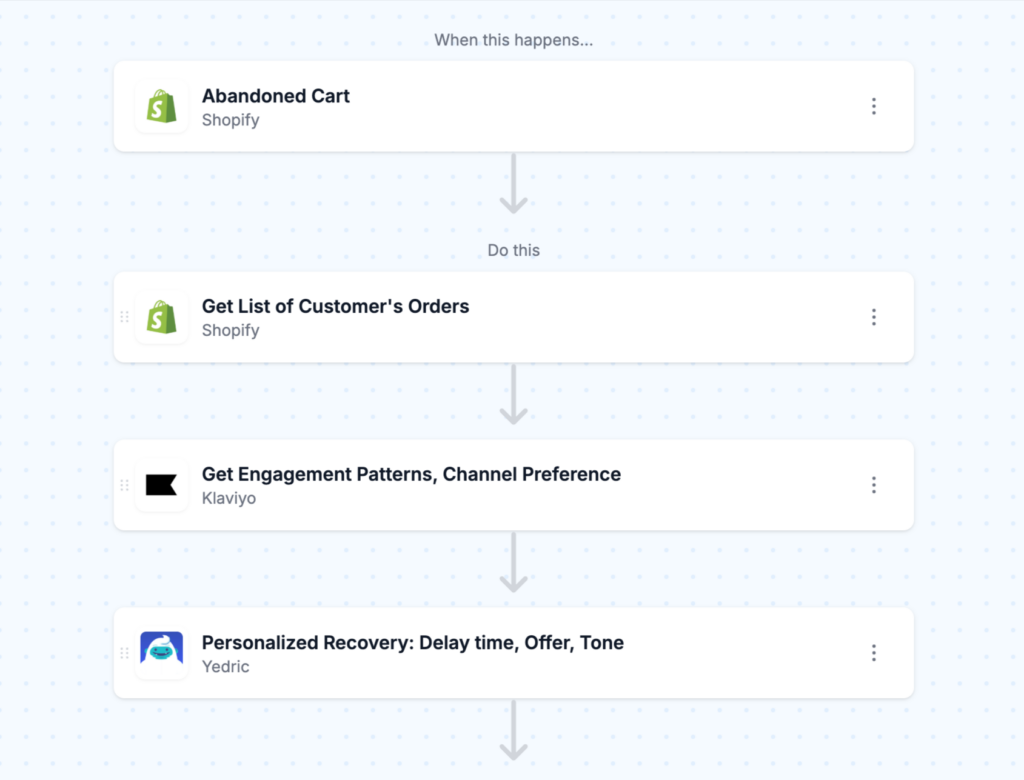
Cart abandonment triggers workflow. Yedric’s intelligence step with MCP skills:
- Shopify: Customer history, previous cart abandonment behavior, purchase patterns
- Klaviyo: Engagement patterns, channel preference (email vs. SMS open/response rates)
- Google Sheets: A/B test results and conversion data by segment
Yedric evaluates:
- Customer type (first-time vs. returning, VIP vs. standard)
- Cart value and product contents
- Historical abandonment behavior and conversion patterns
- Optimal contact timing based on time-of-day and day-of-week patterns
- Channel engagement preferences
- Previous discount response (does discount drive conversion for this customer?)
- Product urgency factors (limited stock, time-sensitive offer, seasonal relevance)
Returns a personalized recovery strategy: wait time before contact, channel (email/SMS/both), offer discount (yes/no), amount if yes, message tone (urgency vs. reminder vs. value proposition), and expected conversion probability.
Workflow waits for an optimal duration, sends via the preferred channel with a personalized message and an appropriate incentive, and tracks conversions for continuous learning and strategy refinement.
🚀 Contact us – MESA is supported by human experts who will help you build this solution.
8. Returns and refund approvals
The customer service team reviews each return request individually and approves or denies them. Time: 5-10 minutes per return. Problems: Inconsistent decisions between team members, serial returners not detected until the pattern becomes obvious, VIPs treated the same as problematic customers.
Static workflow:
If (return_reason = "Defective") AND (order_age < 30 days)
Then: Auto-approve refund
Limitations:
- Can’t detect abuse patterns or wardrobing behavior
- Same policy for $20 and $500 items, regardless of risk
- Ignores customer lifetime value in decision-making
- No alternative offers (exchange, store credit) before full refund
- Binary approve/reject with no graduated response based on risk
MESA + Yedric intelligence approach:
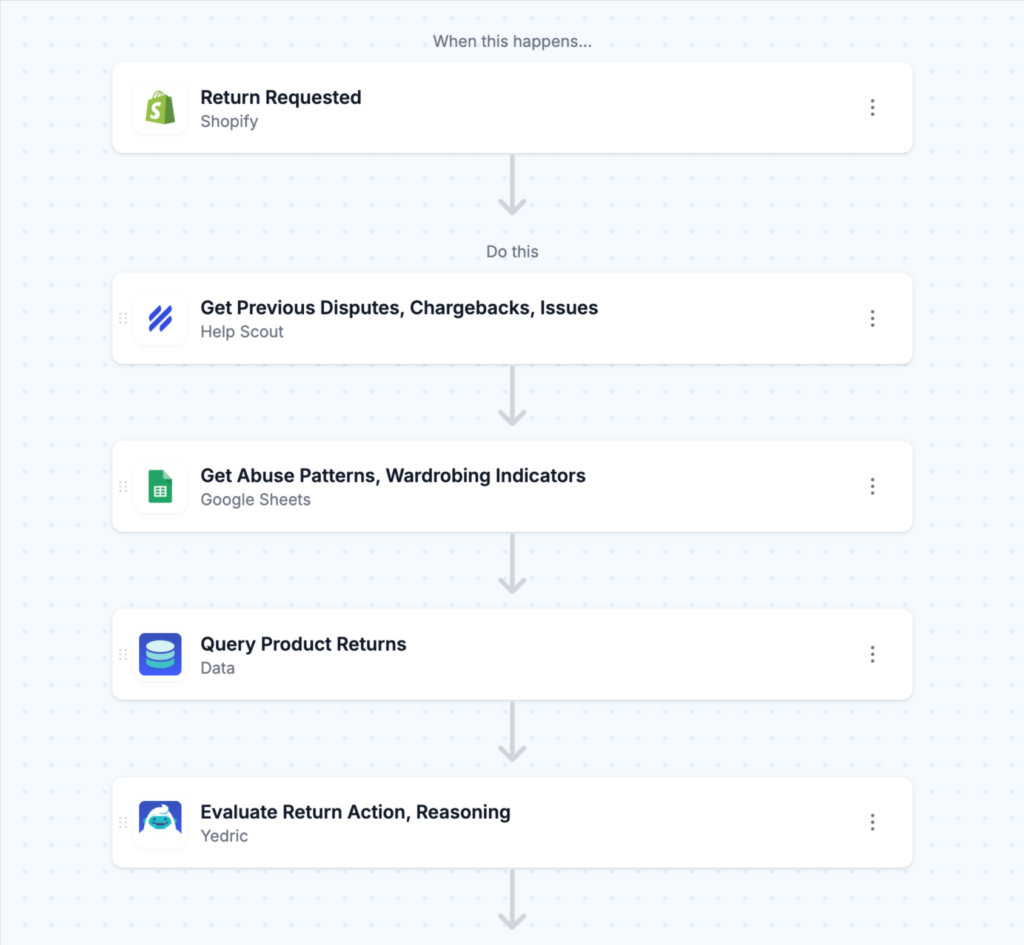
Return request triggers workflow. Yedric’s intelligence step with MCP skills:
- Shopify: Customer complete return history, lifetime value, order patterns
- Help Scout: Previous disputes, chargebacks, or satisfaction issues
- Google Sheets: Known return abuse patterns and wardrobing indicators
- Product data: Category, value, margin, typical return rate
Yedric evaluates:
- Customer return frequency, value, and stated reasons over time
- Customer lifetime value and tier status
- Return reason credibility given product category and timing
- Product category risk (apparel has a higher legitimate return rate than electronics)
- Order value and margin impact
- Time since purchase and usage indicators
- Previous positive interactions and relationship strength
Returns graduated decision: Primary action (auto-approve, offer exchange first, route to review, deny), secondary action if primary declined, reasoning for decision, red flags if present, customer experience priority level.
Workflow executes graduated response: High-value loyal customers get instant approval, standard customers receive exchange offer first (approve refund if declined), problematic patterns route to manual review with full context, serial abuse cases get policy enforcement.
🚀 Contact us – MESA is supported by human experts who will help you build this solution.
9. Product collection organization
Manually tag products and assign to collections based on product attributes. Time: Multiple hours weekly for large catalogs. Problems: Inconsistent tagging, collections become outdated, misses cross-sell opportunities, and doesn’t scale with catalog growth.
Static workflow:
If (product_tag contains "Summer") AND (product_type = "Dress")
Then: Add to "Summer Dresses" collection
Limitations:
- Requires manual tagging first (doesn’t reduce work, just moves it)
- Can’t detect collection fit from product attributes alone
- No automatic seasonal rotation (summer products stay in summer collections year-round)
- Misses multi-collection placement opportunities
- Can’t suggest a better organization based on performance data
MESA + Yedric intelligence approach:
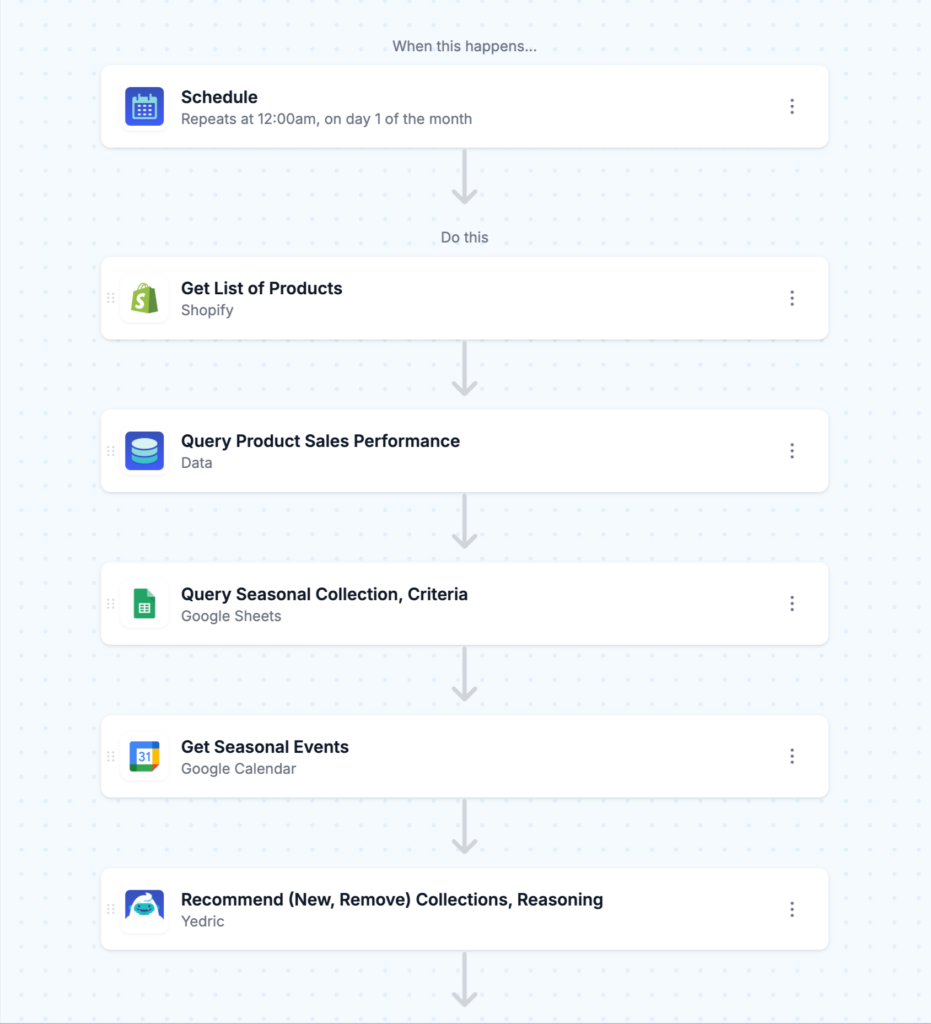
Scheduled daily or triggered by product creation/update. Yedric’s intelligence step with MCP skills:
- Shopify: Product attributes (title, description, tags, type, vendor), existing collections, sales performance data
- Google Sheets: Seasonal collection calendar and criteria
- Google Calendar: Current date for seasonal awareness
Yedric analyzes:
- Product title, description content, tags, type, vendor
- Existing store collection organization patterns
- Seasonal relevance based on attributes and calendar
- Cross-sell opportunities (products that fit multiple collections)
- Sales performance qualifying for performance-based collections (bestsellers, trending)
- Collection assignment patterns from similar products
Returns collection recommendations: collections to add, collections to remove, a confidence score for each recommendation, reasoning, and scheduled future actions (seasonal removal dates).
Workflow applies collection assignments automatically, schedules seasonal rotation, removes from outdated collections, logs assignments for pattern learning, and future improvement.
🚀 Contact us – MESA is supported by human experts who will help you build this solution.
10. Supplier communication automation
Check inventory levels, decide when to reorder, and manually compose emails to suppliers with order requests. Time: 1-2 hours per week reviewing inventory and coordinating with multiple suppliers. Problems: Reactive ordering leads to stock-outs, generic emails lack the context suppliers need, there is no communication of urgency or upcoming business needs, and follow-up is inconsistent.
Static workflow:
If inventory_quantity < 10
Then: Send template email to supplier
Limitations:
- Same generic message regardless of urgency or lead time requirements
- No consideration of upcoming promotions or seasonal demand
- Can’t communicate the business context suppliers need for prioritization
- Sends the same reorder quantity every time, regardless of velocity changes
- Doesn’t account for supplier-specific lead times or minimum order quantities
MESA + Yedric intelligence approach:
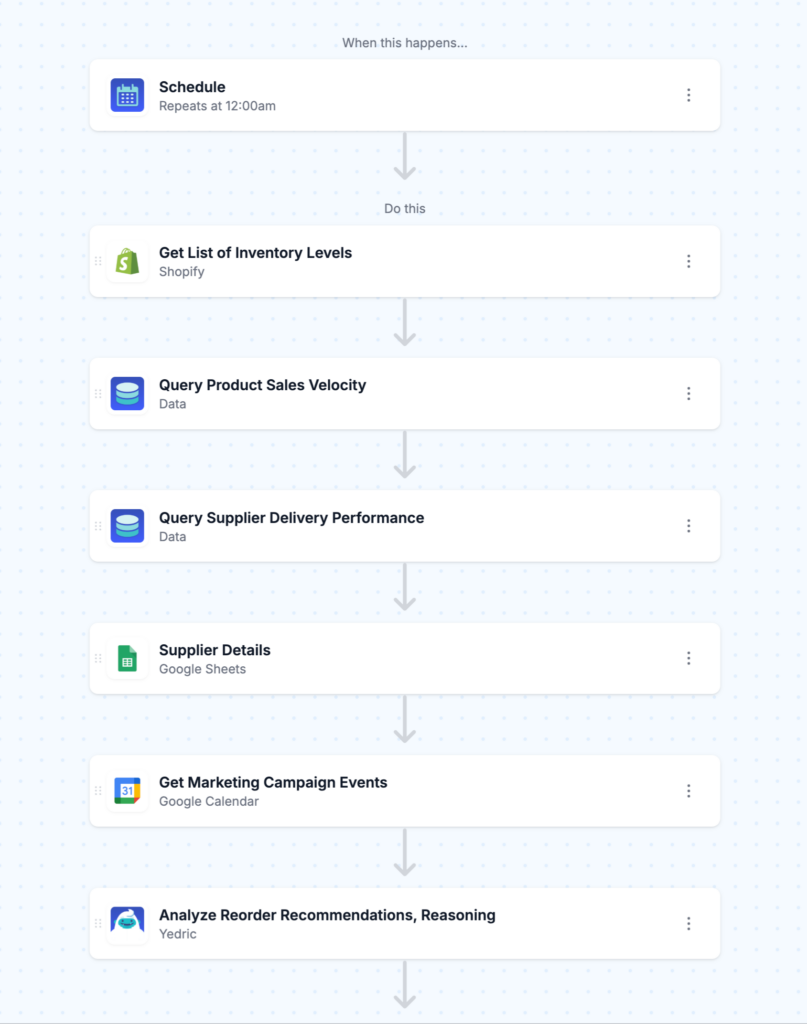
Scheduled daily workflow checks inventory levels. Yedric intelligence step with MCP skills:
- Shopify: Current inventory levels, sales velocity data, product margins
- Google Sheets: Supplier contact information, lead times, minimum order quantities, past order history
- Google Calendar: Upcoming marketing campaigns and promotional calendar
- Custom Data: Supplier performance data (on-time delivery rates)
Yedric analyzes per product needing a reorder:
- Current velocity trend (selling faster or slower than the historical average)
- Supplier-specific lead time and delivery reliability
- Upcoming promotional campaigns that will increase demand
- Seasonal patterns and anticipated volume changes
- Optimal order quantity considering MOQ, storage capacity, and cash flow
- Urgency level based on projected stock-out date vs. lead time
Returns reorder recommendation: Supplier to contact, recommended order quantity with reasoning, urgency level, delivery date needed, draft email with business context.
Yedric drafts contextual supplier email:
Subject: Reorder Request - Product X - Delivery Needed by [Date]

Hi [Supplier Name],

We need to reorder Product X based on increased demand:

Current Inventory: 12 units
Daily Velocity: 4.2 units/day (up 35% from last month)
Projected Stock-out: January 15th
Requested Delivery: January 12th

Order Quantity: 200 units
Reasoning: We're launching a Valentine's promotion on January 20th
and expect 50% velocity increase during the campaign period.

Please confirm availability and delivery timeline.

Thanks,
[Your Store Name]
Workflow either sends an email automatically (for routine reorders) or creates a draft for approval (for large orders or new suppliers). Expand the workflow to track responses, send a follow-up if no reply within 48 hours, and log communication for future reference.
🚀 Contact us – MESA is supported by human experts who will help you build this solution.
The future of Shopify operations with agentic AI
The merchant’s new role
As AI agents handle more operational decisions, your role as a merchant fundamentally transforms. This isn’t about being replaced—it’s about being freed from operational firefighting to focus on what actually grows your business.
From operator to orchestrator:
Today, you’re deep in the weeds: reviewing flagged orders, managing exception cases, adjusting workflow rules, responding to inventory alerts, and routing complex support tickets. You’re operating the business, handling the constant stream of decisions that automation can’t.
Tomorrow, you’re setting direction: defining business goals, establishing guardrails, reviewing AI recommendations on strategic decisions, handling true exceptions that require human judgment, and focusing on growth initiatives.
What you’ll spend less time on:
- Repetitive operational decisions that follow patterns
- Exception handling for edge cases AI can resolve
- Troubleshooting and maintaining fragile workflow rules
- Manual intervention when automation breaks
- Firefighting urgent operational issues
What you’ll spend more time on:
- Strategic planning and business vision
- Creative direction and brand development
- High-value customer relationship building
- Product development and market expansion
- Team development and culture building
Limitations and guardrails
AI agents are powerful, but they’re not omnipotent. Understanding limitations helps you deploy them effectively and maintain appropriate oversight.
What AI agents won’t do (at least not yet):
Creative strategy and brand building: AI can optimize campaigns and personalize messaging, but it can’t create your brand identity, develop emotional positioning, or craft breakthrough creative concepts. These require human creativity, cultural understanding, and intuitive leaps that AI doesn’t replicate.
Highly nuanced interpersonal situations: When a long-time VIP customer has a complex complaint that requires empathy, reading between the lines of relationship history, and creative problem-solving, human judgment remains essential. AI can route these situations appropriately and provide context, but resolution requires human touch.
Major financial commitments: AI can recommend inventory orders, but merchants should approve large purchase orders that significantly impact cash flow. AI can suggest pricing strategy changes, but merchants should approve major repositioning decisions. The stakes matter.
Completely novel situations: AI agents excel at learning from historical data. Truly unprecedented situations—your product goes viral on TikTok, a competitor launches disruptive technology, a supply chain crisis hits—require human judgment to navigate because there’s no pattern to learn from.
Necessary guardrails for safe AI deployment:
Spending limits: Configure maximum values AI agents can commit without approval. Example: Auto-approve supplier orders under $1,000, require human approval above. This protects cash flow while enabling operational efficiency.
Communication review: High-stakes customer communications should have human review, especially for VIP customers, complex complaints, or situations involving dissatisfaction. AI can draft responses and suggest approaches, but human approval ensures an appropriate tone and preserves the relationship.
Action scope boundaries: Define clearly what AI agents can do autonomously vs. what requires confirmation. Example: AI can automatically tag orders and adjust fulfillment routing, but canceling orders requires human approval.
Data privacy controls: Establish clear boundaries on customer data usage. AI agents need access to make good decisions, but that access should be scoped appropriately and auditable. MESA’s MCP architecture enables per-workflow, per-step data access controls.
Confidence thresholds: Configure AI agents to flag low-confidence decisions for human review. When Yedric returns a decision with confidence below 70%, route to manual review rather than auto-executing. This catches edge cases where AI isn’t certain.
The human-AI partnership model:
Effective AI deployment isn’t about full automation—it’s about optimal collaboration between human judgment and AI capability.
AI handles:
- Scale: Processing thousands of decisions per day consistently
- Speed: Making decisions in seconds that would take humans minutes
- Pattern recognition: Identifying subtle signals across vast data
- Optimization: Continuously improving through outcome feedback
- Consistency: Applying criteria uniformly without fatigue or bias
Humans handle:
- Strategy: Setting business direction and priorities
- Creativity: Developing brand, campaigns, product concepts
- Judgment: Navigating unprecedented situations
- Relationships: Building deep customer connections
- Ethics: Ensuring AI operates within appropriate boundaries
The most successful AI deployments recognize this partnership. Merchants who try to automate everything lose important human elements. Merchants who resist AI miss efficiency gains. The sweet spot: AI handles operational scale, humans focus on strategic impact.
The competitive landscape shift
The adoption of agentic AI in ecommerce operations is creating two distinct merchant classes. The gap between them widens every month.
Two merchant categories are emerging:
AI-leveraged merchants: Running lean operations with AI agents handling routine decisions. Three-person teams managing operations that previously required ten. Responding to market changes in hours instead of days. Handling exceptions automatically. Scaling revenue without proportionally scaling operational headcount.
Traditional merchants: Competing with team size and manual processes. Hiring more people to handle the growing volume. Spending increasing time on workflow maintenance and exception handling. Slower to respond to market opportunities because operational overhead consumes bandwidth.
The difference isn’t just efficiency—it’s competitive capability. AI-leveraged merchants can:
- Test and iterate faster (launch new workflows in minutes, not days)
- Respond to market shifts in real-time (pricing, inventory, marketing all adaptive)
- Provide better customer experience (more personalized, faster response)
- Maintain higher margins (less operational overhead, smarter discounting)
- Scale without complexity breaking automation (AI adapts, rules break)
The economic reality:
According to industry research, AI-leveraged merchants operate at 40-60% lower operational cost per order while maintaining or improving customer satisfaction scores. That’s not a small efficiency gain—it’s a structural cost advantage that compounds over time.
When your competitor can process orders, manage inventory, route support, and optimize marketing with 1/3 the labor cost, they have more capital for product development, customer acquisition, and market expansion. Or they can offer better pricing and still maintain higher margins.
The timing advantage:
Early adopters gain a disproportionate advantage. While competitors struggle with workflow maintenance and manual processes, AI-leveraged merchants are:
- Building institutional knowledge into AI systems that improve over time
- Training their teams on AI collaboration rather than manual execution
- Establishing operational efficiency that compounds as they scale
- Freeing leadership time for strategic moves that create market differentiation
This isn’t hype—it’s visible in the market today. Merchants using MESA’s AI automation report they can launch new products, enter new markets, and test new strategies 3-5x faster than with manual or static automation, because operational overhead doesn’t constrain them.
Market consolidation implications:
Industries with significant operational overhead typically consolidate toward larger players who can spread fixed costs across higher volume. AI inverts this dynamic.
Small, AI-leveraged teams can now compete with large traditional operations on operational capability. A three-person direct-to-consumer brand with well-deployed AI agents can match the fulfillment speed, customer service quality, and inventory management of competitors with 20-person operations teams.
This democratization of operational capability means competitive advantage shifts back to brand, product, and market positioning—areas where creativity and judgment matter more than scale. Smaller brands can compete on equal operational footing.
The decision point:
Every merchant faces a choice: Lead this transition or get disrupted by competitors who do.
The merchants winning in 2026 and beyond will be those who:
- Learned to collaborate with AI agents effectively
- Delegated operational execution to intelligent automation
- Freed their teams to focus on strategic differentiation
- Built organizational capability around AI leverage rather than manual processes
The technology exists now. The question isn’t “Will AI transform ecommerce operations?” but “When will you adopt it—while you can lead, or after you’re forced to catch up?”
Starting doesn’t require a massive transformation. Install one AI agent template this week. Measure the impact over 30 days. Expand from there. The merchants who begin building AI operational capability today will have a 6-12 month institutional learning advantage over those who wait.
That advantage compounds. The longer you wait, the wider the gap becomes between you and competitors who are already leveraging AI to operate faster, leaner, and more adaptively than static automation ever enabled.
Getting started with agentic automations
This week:
- Browse the AI template library
- Install one template addressing your biggest pain point
- Have your first conversation with Yedric
- Start free 7-day trial
This month:
- Measure the impact of your first AI agent
- Identify the next business function for AI coverage
- Migrate one Shopify Flow rule to Yedric, your MESA AI agent
- Share results with team, build organizational buy-in
This quarter:
- Deploy AI agents across 2-3 major business functions
- Document time savings and operational improvements
- Train team on AI collaboration workflows
- Plan a path to fully AI-leveraged operations
The reality of AI in ecommerce
This isn’t hype. This isn’t theoretical. This isn’t the distant future.
AI agents are running real stores, making real decisions, driving real results today. The question is whether you’ll lead this transition or be disrupted by competitors who do.
The merchants winning in 2026 and beyond will be those who learned to collaborate with AI, who delegated operations to intelligent agents, and who freed themselves to focus on what AI can’t do: creativity, strategy, and genuine human connection with customers.
Your AI automation journey starts with one conversation with Yedric.
What will you ask him to automate first?
Frequently asked questions
Agentic AI automation uses AI agents that act autonomously to achieve goals, rather than following predefined rules. Unlike static workflows that execute “if-this-then-that” logic, agentic AI reasons across multiple data sources, adapts to exceptions, and learns from outcomes. For Shopify merchants, this means automation that handles edge cases intelligently instead of breaking when conditions don’t match rigid rules.
Regular automation follows static rules and breaks when encountering exceptions. Agentic AI evaluates context, reasons across multiple factors, and adapts decisions based on specific situations. Example: A static rule might flag all international orders as fraud risks, while agentic AI distinguishes between a legitimate gift order and actual fraud by analyzing customer history, order patterns, and multiple risk signals simultaneously.
Shopify Flow provides static workflow automation within Shopify’s ecosystem. MESA offers agentic AI automation with three key differences:
(1) Intelligence injection – add AI reasoning at any workflow step,
(2) MCP-powered data access – fetch data from unlimited external systems mid-workflow, and
(3) Conversational creation – build workflows by talking to Yedric in natural language. MESA also connects to 100+ apps beyond Shopify.
Simple AI workflows take 5-10 minutes to deploy using MESA’s template library. For example, installing the “Intelligent Fraud Detection” template requires one click, then Yedric asks 2-3 configuration questions, and the AI agent begins working immediately. More complex custom workflows typically take 30-60 minutes to build conversationally with Yedric.
No. MESA offers two no-code approaches: (1) Install pre-built AI templates with one click, or (2) Talk to Yedric in plain English to build custom workflows. Example: “Yedric, tag customers who haven’t ordered in 60 days and send them to a win-back flow” – Yedric builds the workflow by asking clarifying questions. Technical users can also use MESA’s visual workflow builder for precise control.
Yes. AI-powered fraud detection analyzes multiple risk signals simultaneously—customer history, order velocity, email verification, device fingerprinting, IP geolocation—rather than simple rules like “billing country ≠ shipping country.” This reduces false positives by 60-70% (fewer legitimate orders blocked) while catching sophisticated fraud that matches basic rules. MESA’s fraud detection template includes graduated risk scoring (0-100) instead of binary hold/approve decisions.
MCP (Model Context Protocol) is an open standard introduced by Anthropic in 2024 that allows AI assistants to securely connect to external tools and data sources. In MESA, MCP enables Yedric to fetch data from any system—like Help Scout, Google Sheets, or custom APIs—during workflow execution, allowing AI to make decisions based on complete context rather than limited trigger data.
MESA’s AI agents operate within guardrails you set. You can configure: (1) Confidence thresholds – decisions below certain confidence levels route to human review, (2) Action scope – define what AI can do autonomously vs. what requires confirmation. (3) Add MESA’s built-in Approval tool before the AI agent acts on your behalf for complete control. AI agents also provide reasoning for every decision, making it easy to identify and correct issues.