If you’ve seen a red or yellow warning in your Shopify admin, the immediate question is simple: should you ship the order or stop it? That’s the real intent behind searches for a Shopify high risk order. Merchants don’t want theory. They want a reliable way to protect revenue, avoid chargebacks, and keep legitimate customers moving.
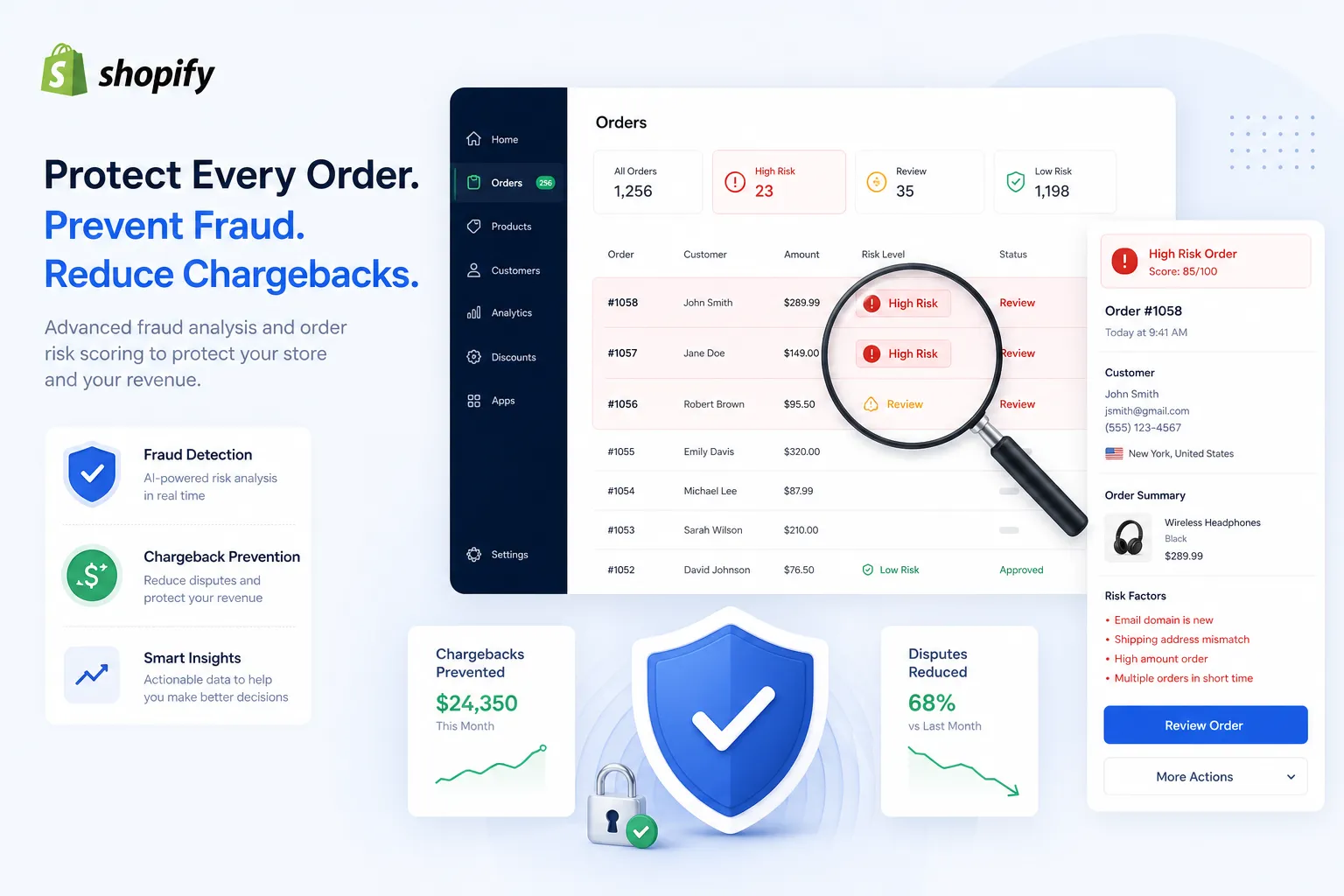
Here’s the short answer: a Shopify high risk order is an order Shopify’s fraud analysis believes has a higher chance of turning into fraud or a chargeback. It does not guarantee the order is fraudulent, but it does mean you should pause fulfillment, review the signals, and follow a repeatable verification process before you ship.
For growing brands, this becomes an operations problem fast. A few flagged orders a week is manageable. A few dozen across multiple channels, apps, and fulfillment tools becomes backlog, inconsistency, and avoidable loss. That’s why merchants eventually move from “manual review every time” to workflow-based handling using tools like Shopify order automation, where high-risk orders can be tagged, routed, held, and escalated without needing a developer.
TL;DR: there's a template for that
Why flagged orders matter more than most merchants realize
A risky order is not just a customer service issue. It can affect:
- revenue
- inventory loss
- fulfillment labor
- dispute fees
- payment processor standing
- team efficiency
According to Shopify Help Center’s fraud analysis documentation, Shopify explicitly warns that fulfilling high-risk orders can increase chargebacks and may even contribute to payment processing being disabled or removal from Shopify Payments.
"Fulfilling high-risk orders can result in a higher number of chargebacks, which can lead to disabling payment processing and removal from Shopify Payments... Shopify does not cover charge reversals from banks."Shopify Help Center | Fraud analysis
That last point matters. Many merchants assume that because Shopify flagged an order, Shopify will absorb the loss if they fulfill it anyway. That is not how it works.
What Shopify is actually looking at
Shopify’s fraud analysis uses indicators and, on eligible plans or when using Shopify Payments, fraud recommendations. These are designed to help you estimate whether an order has a low, medium, or high likelihood of fraud-related chargeback risk.
Common signals behind a high risk Shopify order
Shopify may flag an order because of one or more of the following:
Signal | Why it matters | Typical risk implication |
|---|---|---|
Billing and shipping addresses don’t match | Could be a gift, but also a classic stolen card pattern | Medium to high |
IP address is far from billing country | Can indicate VPN use, proxying, or reshipping | Medium |
CVV or AVS mismatch | Verification details didn’t align cleanly | Medium to high |
Multiple payment attempts | Can suggest card testing or fraud attempts | High |
Unusually large first-time order | Fraudsters often try to maximize value quickly | High |
Expedited shipping on expensive products | Fraudsters want goods shipped before detection | High |
Email or phone details look disposable or inconsistent | Harder to verify customer identity | Medium to high |
Post-purchase address change request | Common rerouting tactic | High |
Low, medium, and high risk: what the labels really mean
A lot of competing articles oversimplify these labels. In practice, the label is only the beginning.
Risk level | What it usually means | Recommended action |
|---|---|---|
Low | Few concerning indicators | Usually safe to fulfill |
Medium | Some inconsistency or uncertainty | Review manually before shipping |
High | Multiple signals commonly associated with fraud | Hold, verify, or cancel before fulfillment |
The important nuance: medium-risk orders deserve process too. Many chargebacks start with merchants ignoring “not quite bad enough to worry about” orders.
What competitors get wrong
Most articles ranking for this topic do a decent job explaining what a high-risk order is. Where they fall short is operational reality.
They explain fraud, but not workflow
Competitors often say “contact the customer” or “review the order manually,” but they rarely explain how a real team handles this at scale. If operations, CX, and fulfillment are all involved, you need a standard process, not ad hoc judgment.
They underplay medium-risk orders
A medium-risk order is often presented as less urgent. In reality, medium-risk orders can become expensive if your team treats the warning as background noise.
They don’t address review bottlenecks
Once you grow, fraud review becomes a throughput issue. Orders sit unreviewed, fulfillment teams ask for decisions, customer response times suffer, and Slack threads replace policy. This is exactly where MESA’s Shopify-first automation platform fits: not as a fraud scoring engine, but as the operational layer that helps your team react consistently.
They rarely connect fraud handling to the rest of your stack
Risk review often touches Shopify, email, SMS, Slack, spreadsheets, ERPs, shipping tools, and support systems. The problem is not just spotting risk. The problem is orchestrating next steps across the tools your team already uses.
How to review a flagged order without slowing down your whole team
A smart review process should be fast, consistent, and easy to train.
Step 1: Check the fraud indicators, not just the label
Open the order and review the underlying reasons. A high-risk warning caused by multiple failed cards is different from one caused by a ZIP mismatch plus overnight shipping.
Look for combinations, not isolated anomalies.
Step 2: Review customer context
Ask:
- Is this a returning customer?
- Has this address appeared successfully before?
- Does the order value fit normal behavior?
- Is the item easy to resell and therefore attractive to fraudsters?
- Did the customer immediately request address or shipping changes?
Step 3: Verify when the signals are mixed
Verification options can include:
- emailing the customer from the order email address
- calling the provided phone number
- asking the customer to confirm shipping and billing details
- requesting additional proof for high-value orders
- requiring signature confirmation for shipment
Be proportional. You don’t need the same level of friction for a $35 order as for a $1,200 electronics order.
Step 4: Decide quickly
Once reviewed, the order should move into one of four lanes:
Outcome | When to use it | Why |
|---|---|---|
Fulfill | Signals are explainable and customer verifies cleanly | Preserves revenue and customer experience |
Hold | More information is needed | Prevents premature fulfillment |
Cancel | Multiple fraud indicators and weak verification | Avoids product and payment loss |
Escalate | High value, unusual circumstances, repeat pattern | Gets human review where warranted |
A practical decision framework for ecommerce teams
If your team needs a clearer standard, use this simplified decision matrix:
Scenario | Best next step |
|---|---|
Billing and shipping match, low order value, returning customer | Fulfill |
Medium-risk label, small mismatch, responsive customer | Verify then fulfill |
High-risk label, rush shipping, expensive item, new customer | Hold and verify |
Multiple card attempts, suspicious email, unresponsive customer | Cancel |
Repeated pattern across multiple orders | Escalate and investigate broader fraud activity |
This is where automation helps most. Instead of relying on memory, you can build rules that tag orders, notify the right people, pause downstream actions, and keep an audit trail.
The business cost of getting it wrong
Fraud loss is rarely just the order value.
According to LexisNexis Risk Solutions’ 2026 retail and ecommerce fraud cost study, retail and ecommerce companies in North America incur more than five dollars in cost for every dollar lost to fraud.
"Retail and e-commerce companies in North America incur more than $5 in costs for every $1 lost to fraud."LexisNexis Risk Solutions
That multiplier includes labor, operations drag, replacement costs, fees, customer support time, and downstream recovery effort. For a merchant with lean operations, that hidden cost matters as much as the disputed payment.
When manual review stops working
Manual review is fine for occasional flags. It starts breaking when:
- orders spike during promotions or holiday periods
- multiple people touch the same order without a clear owner
- high-risk orders slip into fulfillment by mistake
- customer verification happens inconsistently
- data lives across different apps
- reporting on fraud patterns is manual or nonexistent
This is where MESA becomes useful for operators. Instead of stitching together brittle rules or waiting on custom development, you can describe what you need accomplished and turn that into a live workflow quickly.
For example, MESA can help merchants automate flows such as:
- tag any high-risk Shopify order for review
- send an internal Slack alert with the order value and risk context
- pause fulfillment until a manual approval tag is added
- log flagged orders to Google Sheets for tracking
- notify customer support to begin verification
- route high-risk orders above a threshold to a senior reviewer
- trigger post-review actions automatically once approved or canceled
If you’ve outgrown simpler tools, this is exactly the kind of operational gap MESA vs Shopify Flow helps clarify. The issue is not whether automation is useful. It’s whether your team can build the process they actually need without creating more technical debt.
How to automate high-risk order handling in a practical way
Automation should reduce friction, not create it. The best workflows are narrow, clear, and tied to decisions your team already makes.
Good automation candidates
1. Internal alerts
When an order is marked high risk, notify operations or CX immediately with the exact order details.
2. Fulfillment holds
Prevent accidental shipping by holding the order until a review status changes.
3. Review queues
Apply tags like fraud-review, awaiting-verification, or approved-to-ship so everyone sees the current state.
4. Customer verification prompts
Trigger a templated email or support task asking the buyer to confirm key details.
5. Reporting and pattern detection
Log every flagged order for weekly review so you can spot repeat addresses, products, or geographies.
Risk handling is one of several order steps that benefit from the same trigger-and-rule approach. For more examples, see these Shopify workflow ideas to simplify order ops.
Why this matters operationally
Without automation, one person’s “looks okay” becomes another person’s “why did we ship this?” With automation, your standard operating procedure becomes visible and repeatable.
That’s especially useful for brands managing risk alongside inventory, fulfillment, and customer follow-up. MESA’s strength is that it supports complex multi-step automation without requiring a developer, while still giving merchants human help when workflows need refinement.
Specific use cases MESA can support around risky orders
These are the kinds of practical workflows ecommerce teams actually care about:
Use case | Outcome |
|---|---|
Auto-tag high-risk orders in Shopify | Keeps review visible and searchable |
Send Slack alerts to operations | Speeds up response time |
Create a Google Sheet log of flagged orders | Improves reporting and auditability |
Hold shipment until review tag changes | Prevents costly accidental fulfillment |
Notify support to contact the customer | Standardizes verification |
Separate high-value flagged orders into a priority queue | Focuses attention where exposure is greatest |
Sync approved orders back into fulfillment workflows | Removes manual handoff friction |
If you want to move faster, MESA also offers templates and guided setup support so teams don’t have to invent every step from scratch.
Best practices that reduce fraud without punishing real customers
The goal is not to reject every suspicious order. The goal is to screen effectively while preserving conversion.
Keep your process proportional
Don’t treat every discrepancy like a criminal event. A missing apartment number is not the same as multiple failed cards and express shipping to a freight forwarder.
Train your team on patterns
Write down the signals that matter most for your product category and average order value.
Use signature confirmation selectively
For high-value items, delivery proof can help reduce downstream disputes.
After a reviewed order ships, tracking is your evidence that it arrived. This guide to Shopify order tracking explains what Shopify shows natively, when a tracking app helps, and how to automate delivery notifications.
Document every decision
If you cancel, hold, or verify an order, leave a clear internal note.
Review flagged-order trends monthly
Fraud patterns change. Your response process should too.
A smarter operating model for scaling merchants
The deeper issue behind a high risk shopify order is not just fraud detection. It’s operational maturity.
As stores grow, review work needs to fit into broader systems: fulfillment operations, support handoffs, reporting, inventory logic, and exception handling. That’s why merchants increasingly pair Shopify’s native fraud analysis with automation that coordinates what happens next.
MESA is well suited here because it is Shopify-first, supports 100+ app connections and 300+ ready-made templates, and lets non-technical teams launch workflows quickly. Instead of waiting on custom scripts or juggling brittle app chains, teams can describe what they need accomplished and turn it into a working process that reduces manual work, prevents missed steps, and scales with the business.
Final verdict
A shopify high risk order is not an automatic cancellation. It is a signal that the order deserves structured review before fulfillment. The merchants who handle these well do three things consistently: they review the underlying indicators, apply a repeatable policy, and automate the handoffs that would otherwise create delay or mistakes.
If your team is still managing high risk orders shopify flags through inboxes, spreadsheets, and manual tagging, that’s usually the sign you’ve outgrown a patchwork process. MESA gives you a cleaner next step: automate the repetitive parts, keep humans focused on judgment calls, and scale order review without scaling chaos.
If you want to operationalize this, explore MESA’s templates, workflow support, and Shopify automation capabilities at getmesa.com.
FAQ
What to do with high risk orders on Shopify?
Pause fulfillment first, then review the fraud indicators, customer details, order value, and shipping context. If the signals are explainable, verify the buyer and proceed; if the order looks suspicious or the customer is unresponsive, cancel or refund before shipping.
Will Shopify refund you if you get scammed?
No. Shopify does not cover charge reversals from banks. Shopify can help provide evidence for a dispute, but the issuing bank decides whether funds are reversed.
What is the risk analysis on Shopify orders?
Shopify’s risk analysis reviews signals such as AVS and CVV checks, IP details, address mismatches, and repeated card attempts to help estimate fraud risk. It may label orders as low, medium, or high risk so merchants can decide whether to fulfill, verify, or cancel.
How to handle medium risk orders on Shopify?
Treat medium-risk orders as review-required, not automatically safe. Check the specific indicators, compare the order to normal buying behavior, and verify the customer if anything feels inconsistent before shipping.
Will Shopify refund me if I get scammed?
No, not automatically. If a fraudulent order results in a chargeback, the bank controls the reversal decision, and Shopify does not reimburse merchants for that loss.
What does a high risk order mean?
A high risk order means Shopify’s systems found multiple signals associated with possible fraud or future chargeback risk. It does not prove fraud, but it does mean the order should be manually reviewed before fulfillment.