If your team is still copying order data between Shopify, your warehouse, your shipping platform, spreadsheets, and customer messages, fulfillment will eventually become the bottleneck. Orders pile up, tracking updates lag behind, inventory drifts out of sync, and small mistakes turn into expensive support tickets, reships, and lost trust.
Order fulfillment automation fixes that by turning repetitive fulfillment tasks into repeatable workflows. Instead of relying on manual clicks, you automate how orders are routed, how stock is updated, when alerts are sent, how shipping steps are triggered, and how post-purchase communication happens. For Shopify merchants, that means faster shipping, fewer fulfillment errors, and a store that can scale without adding the same amount of operational overhead.
A direct answer: what order fulfillment automation actually means
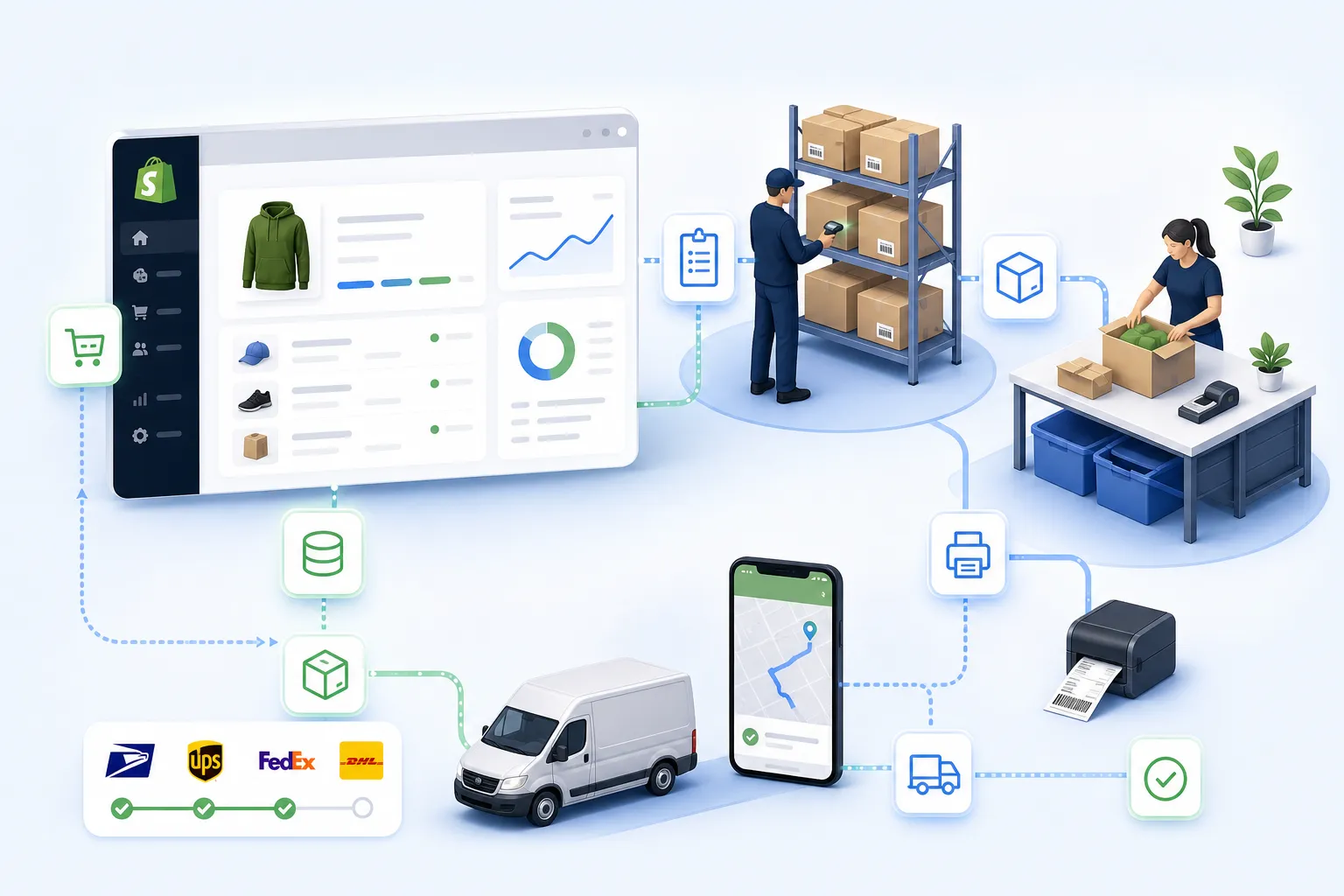
Order fulfillment automation is the use of software-driven workflows to handle the repetitive operational steps between checkout and delivery. In practice, that includes automatically routing orders, syncing inventory, triggering picking and packing tasks, updating shipping statuses, sending customer notifications, and flagging exceptions before they become costly problems.
For Shopify brands, the goal is simple: ship faster with less manual work. The best automation setup does not replace your team; it removes the repetitive coordination work that slows your team down.
Why faster shipping now depends on better operations, not just harder work
Many merchants assume slow shipping is mostly a carrier issue. Sometimes it is. But more often, delays start upstream:
- orders sit unassigned
- fulfillment tags are missing
- inventory counts are wrong
- warehouse teams lack clean pick instructions
- customer service has no visibility into shipment status
- staff manually reconcile data across apps
That is why fulfillment speed is increasingly an operations problem.
"Consumers now expect free delivery within an average of 2.7 days, down from over 3.5 days in previous years."AlixPartners 2026 Home Delivery Survey
When expectations tighten, manual fulfillment processes break first. The stores that keep up are the ones that automate decision-making and handoffs across the stack.
Where manual fulfillment breaks down first
Before you automate, it helps to know where the friction usually lives. In most growing ecommerce operations, the same failure points show up repeatedly.
1. Order routing depends on tribal knowledge
One team member knows which orders need expedited handling. Another knows which subscription orders need a special insert. Someone else knows which warehouse should fulfill fragile SKUs.
That works until someone is out, volume spikes, or you launch a new channel.
2. Inventory updates are delayed or inconsistent
If stock levels are not synced between Shopify, 3PLs, ERPs, and spreadsheets, you end up overselling or holding back inventory unnecessarily. Both outcomes cost revenue.
This is where strong inventory management automation becomes a fulfillment issue, not just a stock issue.
3. Picking and packing instructions live in too many places
Warehouse teams often work from a mix of notes, tags, printed sheets, emails, and Slack messages. That increases misses, split shipments, and special-handling mistakes.
4. Shipping updates lag behind reality
Customers ask where their order is because the systems that know the answer are not connected to the systems that should communicate it.
5. Exception handling is reactive
Out-of-stock items, invalid addresses, partial shipments, VIP handling, fraud holds, preorder logic, and subscription edge cases are usually discovered too late.
The core workflows worth automating first
Not every store needs warehouse robotics. But almost every growing Shopify business can benefit from automating the operational workflows around fulfillment.
Here are the highest-impact areas.
Automate order routing before the warehouse touches the order
The fastest way to improve fulfillment is to reduce decision-making at the point of execution.
What this looks like
When an order is created in Shopify, automation can instantly:
- tag the order based on SKU, destination, order value, shipping method, or customer type
- route the order to the right fulfillment partner or internal team
- assign special handling for bundles, fragile items, subscriptions, or VIP orders
- hold orders that need review
- split operational paths for preorder, backorder, or local delivery logic
This is exactly where order automation for Shopify creates leverage. Instead of asking your ops team to memorize rules, you define the logic once and let it run every time.
Why it matters
If routing is wrong, everything after it slows down. If routing is correct from the start, picking, packing, label creation, and communication all get easier.
Keep inventory synchronized across the systems that matter
Inventory is one of the most common causes of fulfillment friction because it lives in too many places at once.
What to automate
A practical inventory automation setup can:
- sync inventory counts between Shopify and external systems
- push low-stock alerts to Slack or email
- reserve inventory for priority channels or high-value orders
- update product availability when thresholds are reached
- write inventory snapshots to Google Sheets or reporting tools
- trigger replenishment workflows when stock dips below set levels
Why it matters
Inventory errors do not just hurt planning. They disrupt shipping speed, create partial shipments, and force customer support into cleanup mode.
"The global warehouse automation market is projected to grow from $27.4 billion in 2026 to $59.5 billion by 2030."Grand View Research warehouse automation market report
The big lesson is not that every brand needs robotics. It is that fulfillment complexity is growing, and automation is becoming standard infrastructure.
Turn warehouse instructions into structured, repeatable outputs
Most fulfillment issues are not caused by a lack of effort. They are caused by inconsistent inputs.
Examples of useful fulfillment workflows
You can automate workflows that:
- generate pick lists for specific product categories
- send daily fulfillment summaries to warehouse teams
- push tagged orders into separate handling queues
- add gift notes, inserts, or pack-slip variations based on order data
- create internal alerts for same-day shipping cutoff risks
- send exception reports for unfulfilled or aging orders
If your operation currently depends on humans checking several dashboards every hour, this is where automation pays off quickly.
Connect Shopify to the rest of your fulfillment stack
A strong fulfillment setup is rarely one tool. It is a set of systems that need to stay in sync: Shopify, shipping software, warehouse tools, spreadsheets, ERPs, help desks, and notification apps.
That is why a platform like MESA is valuable. It is built for merchants who need more than a simple one-trigger-one-action setup.
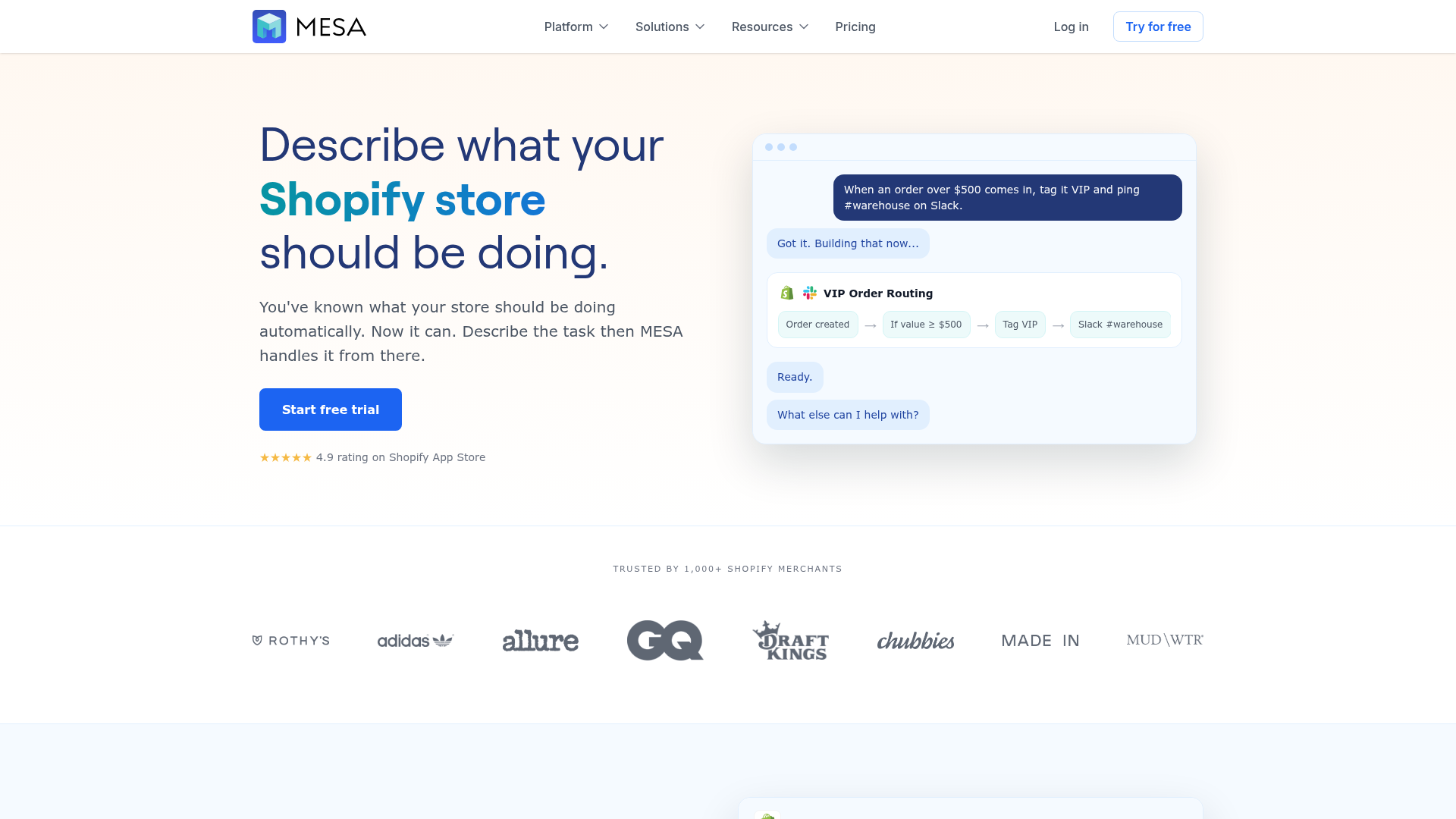
With MESA, teams can describe what they need accomplished in plain English, then turn that into live workflows quickly. That matters when your ops team knows the outcome they need, but does not want to wait on custom development or piece together brittle scripts.
What MESA helps automate in fulfillment operations
For Shopify merchants, MESA can help automate:
- order tagging and routing
- inventory sync and stock alerts
- fulfillment exception handling
- post-purchase notifications
- shipping status updates
- reporting to Google Sheets
- internal Slack alerts
- customer follow-up when delays or partial shipments occur
- complex multi-step workflows across multiple apps
Because MESA supports 100+ app integrations and 300+ templates, most merchants do not need to start from scratch. And when the workflow is more specific, MESA’s human support team helps tailor it to your actual operation.
A practical automation map for growing Shopify brands
The best fulfillment automation is usually staged. Start with the workflows that remove the most repetitive work and prevent the most expensive errors.
Stage | What to automate | Main benefit |
|---|---|---|
Early growth | order tags, low-stock alerts, shipping notifications | fewer manual checks |
Scaling operations | inventory sync, warehouse routing, exception alerts | faster throughput |
Multi-system complexity | ERP sync, multi-location logic, reporting automation | less operational drag |
Advanced optimization | cross-app orchestration, AI-assisted workflow creation, SLA monitoring | more scale without more headcount |
What competitors get wrong about fulfillment automation
The top-ranking articles on this topic usually do a decent job describing the benefits of automation. But they often miss what operators actually need to implement it successfully.
They focus on warehouse hardware more than workflow bottlenecks
Robotics, conveyors, and AS/RS systems matter for some businesses, but many Shopify merchants are struggling earlier in the process. Their real issue is operational coordination across apps, teams, and order states.
They speak to developers or enterprise buyers, not operators
A lot of content assumes you have an internal technical team ready to build custom logic. Many merchants do not. They need automation they can launch without custom development.
They underplay exception handling
Anyone can automate the happy path. Real fulfillment operations are defined by edge cases:
- partial shipments
- bundles
- subscriptions
- backorders
- address problems
- channel-specific rules
- VIP handling
- delayed carrier scans
The right automation platform has to support those realities.
They rarely explain how to start small
Merchants do not need a giant transformation project. They need the next 3 to 5 workflows that will reduce backlog this month.
That is one reason merchants outgrow simpler tools. They need something that can handle nuanced, multi-step logic without turning into a maintenance burden. MESA fits that middle ground well: more capable than lightweight automation tools, but still approachable for ecommerce teams.
Real-world use cases that create immediate operational wins
Here are a few realistic use cases that matter more than generic “save time” promises.
Auto-tag high-risk or time-sensitive orders
Create workflows that tag:
- express orders placed near cutoff time
- fragile or hazardous SKUs
- subscription renewals
- orders needing signature confirmation
- orders from VIP or wholesale customers
Those tags can then trigger downstream handling automatically.
Sync fulfillment events into shared reporting
If your ops team lives in spreadsheets, automate order and shipment data into Google Sheets so everyone sees the same numbers without manual exports. MESA supports Shopify to Google Sheets automation, which is useful for fulfillment reports, exception logs, and daily throughput tracking.
Send internal alerts before customers complain
When an order remains unfulfilled too long, when a stock threshold is hit, or when a fulfillment partner misses a step, notify the right team in Slack automatically.
Trigger customer communication based on real order status
Send accurate post-purchase updates only when the relevant event actually happens, rather than on a fixed timer. That improves trust and reduces support volume.
How to evaluate an automation platform for fulfillment
If you are comparing options, do not just look at whether a tool has “integrations.” Look at whether it can reliably support the workflows your operation actually needs.
Key questions to ask
Question | Why it matters |
|---|---|
Can non-developers build and update workflows? | Ops teams need control without engineering backlog |
Can it handle multi-step logic and branches? | Real fulfillment is full of exceptions |
Does it integrate with Shopify and your app stack? | Disconnected tools create more manual work |
Are there templates to speed up launch? | Faster time-to-value matters |
Is support available for workflow optimization? | Complex operations need guidance |
Can it prevent silent failures or broken flows? | Reliability matters more than flashy demos |
For many Shopify merchants, this is where MESA stands out. You can launch fast with templates, describe what you need accomplished in plain English, and still support more advanced logic as your operation grows. That makes it especially useful for teams that have outgrown entry-level automations but do not want a heavy custom build.
A simple rollout plan for your first 30 days
If your fulfillment process is messy today, do not automate everything at once. Start with a phased approach.
Week 1: identify operational drag
Audit:
- how orders move from Shopify to fulfillment
- where inventory gets updated
- where teams rely on spreadsheets or Slack follow-ups
- which exceptions happen most often
- what customers contact support about after purchase
Week 2: automate visibility
Start with low-risk workflows:
- low-stock alerts
- unfulfilled-order alerts
- daily fulfillment summaries
- shipment tracking notifications
Week 3: automate decision points
Add logic for:
- order tags
- warehouse assignment
- product-specific handling
- customer-type routing
- delay escalation
Week 4: automate cross-system sync
Connect Shopify to the tools that should reflect the same fulfillment state, including reporting, customer messaging, and operational dashboards.
The payoff: faster shipping without adding chaos
Automation does not make fulfillment perfect. It makes fulfillment more consistent. That consistency is what enables faster shipping at scale.
When the repetitive work is automated:
- your team stops rechecking the same data
- warehouse instructions become clearer
- customer communication becomes more accurate
- inventory errors are caught earlier
- exception handling becomes structured
- order volume can rise without overwhelming the team
That is the real promise of order fulfillment automation: not just speed, but operational control.
Why MESA is a strong next step for Shopify merchants
If your store is growing and your ops team is carrying too much manual fulfillment work, MESA is a practical way to move forward.
It helps merchants automate repetitive Shopify tasks without requiring a developer, supports complex multi-step workflows, and connects with 100+ ecommerce tools. You can start with ready-made templates, use AI-assisted setup through MESA's AI by simply describing what you need accomplished, and get real human help when your workflow needs fine-tuning.
For teams that want fewer fulfillment errors, better reporting, cleaner inventory sync, faster alerts, and more reliable customer follow-up, MESA is not just another connector. It is a Shopify-first automation layer built for operational scale.
If that sounds like where your business is headed, explore MESA’s fulfillment operations automation solutions or start with the template library to launch your first workflow faster.
FAQ
What is order fulfillment automation?
Order fulfillment automation uses software workflows to handle repetitive steps between checkout and delivery, such as routing orders, syncing inventory, triggering picking and packing actions, and sending shipping updates. It helps ecommerce teams ship faster, reduce mistakes, and scale without adding the same amount of manual work.
How to improve order fulfillment process?
Start by identifying where orders slow down: routing, inventory mismatches, warehouse instructions, and customer communication are common issues. Then automate the highest-friction steps first, such as order tagging, low-stock alerts, fulfillment exception handling, and post-purchase notifications.
What is the 3 3 3 rule for productivity?
The 3 3 3 rule is a general productivity method where you focus on three major tasks, three shorter tasks, and three maintenance activities in a day. In fulfillment operations, the idea is useful because automation should remove repetitive maintenance work so your team can focus on the few actions that actually require human judgment.
What is the 70/30 rule in sales?
The 70/30 rule in sales often refers to spending around 70% of time listening and 30% talking, though definitions vary by team. In ecommerce operations, the broader takeaway is similar: let systems and customer data guide actions, while your people focus on higher-value decisions instead of repetitive manual tasks.