

AI Automation Platform for Smarter Ecommerce
-
- •
- Jun. 20, 2026
- •
- 13 min read

If your Shopify team is still moving data by hand, checking inventory across tabs, or building one-off workarounds every time an app changes, you do not need “more hustle.” You need better systems.
An AI automation platform helps ecommerce teams reduce manual work by turning repeated operational tasks into dependable workflows. In practice, that means fewer order mistakes, faster follow-up, cleaner reporting, better inventory sync, and less time spent chasing exceptions across Shopify, email, spreadsheets, fulfillment tools, and support apps.
Here’s the simple version: an AI automation platform for ecommerce is software that lets you describe what you need accomplished, then helps translate that into working automations across your store systems. The best platforms do more than trigger one app from another. They understand store operations, support multi-step logic, prevent workflow breakage, and help teams scale without needing a developer for every process change.
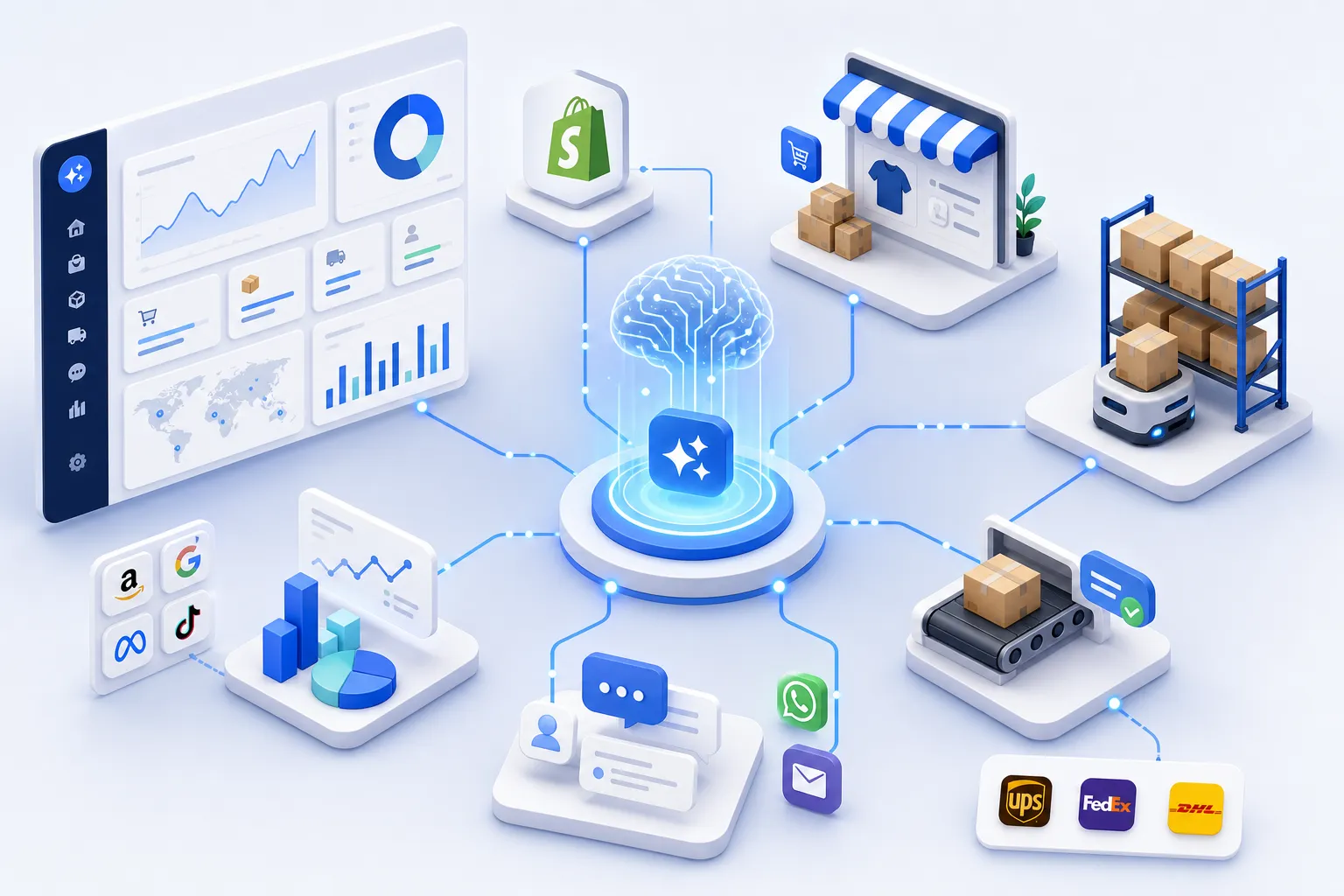
Table of Contents:
What an AI automation platform actually does
Most operations teams do not think in terms of “automation architecture.” They think in terms of daily friction:
-
“When a VIP customer places an order, alert the team and tag it correctly.”
-
“If inventory drops below a threshold, update the right systems before we oversell.”
-
“If an order contains a preorder item and an in-stock item, route it differently.”
-
“When support resolves a shipping issue, send the right internal alert and customer follow-up.”
-
“Push clean Shopify data into reporting tools without exporting CSVs every morning.”
That is where AI automation becomes useful.
A strong ecommerce automation platform handles three things at once:
|
Capability |
What it means in real operations |
Why it matters |
|---|---|---|
|
Workflow creation |
Turn store rules and requests into live automations |
Reduces setup time and dependence on technical teams |
|
Cross-app coordination |
Keep Shopify, fulfillment, support, and reporting tools in sync |
Prevents manual re-entry and broken handoffs |
|
Ongoing control |
Let teams refine logic, exceptions, alerts, and branching paths |
Keeps workflows useful as the business grows |
For Shopify merchants, the biggest benefit is not novelty. It is operational leverage. You stop solving the same problem over and over.
Why ecommerce teams are adopting AI automation now
The push toward automation is not just about saving time. It is about keeping operations reliable as complexity increases.
According to Statista’s 2025 chart on AI tools usage in ecommerce, approximately 20% of U.S. consumers used AI platforms to search for products while shopping in the previous 12 months.
“Approximately 20% of U.S. consumers used AI platforms to search for products while shopping in the previous 12 months.” – Statista
That consumer shift matters, but the bigger pressure is internal. More channels, more apps, more fulfillment rules, more post-purchase expectations, and more data all create more chances for things to break.
According to IBM’s explainer on e-commerce automation, one leading global retailer used real-time analytics to detect a PayPal checkout error and resolved it within minutes, preventing an estimated USD 3 million in lost sales.
“A leading global retailer detected a PayPal checkout error and resolved it within minutes, preventing an estimated USD 3 million in lost sales.” – IBM
The lesson is simple: modern ecommerce operations need systems that catch issues quickly and respond automatically when possible.
The difference between automation and AI automation
A lot of tools can automate a task. Fewer can help you build and manage workflows the way operators actually work.
Traditional automation
Traditional automation usually follows fixed rules:
-
When order is created, add tag
-
When form is submitted, send email
-
When inventory changes, update sheet
That is useful, but limited. As soon as the workflow needs conditions, branching, exception handling, retries, or coordination across multiple apps, simple automation starts to feel brittle.
AI automation
AI automation adds speed and adaptability to workflow creation and management. Instead of manually assembling everything from scratch, teams can describe what they need accomplished and let the platform generate or accelerate the workflow setup.
That is especially valuable when:
-
the logic is multi-step
-
several apps are involved
-
the workflow changes often
-
non-technical teams need to maintain it
-
the cost of mistakes is high
This is why merchants often outgrow lightweight tools. They are fine for single triggers, but they struggle when store operations become interconnected.
What an ecommerce AI automation platform should include
If you are evaluating options, look beyond “AI” as a buzzword. The real question is whether the platform helps your team run the business with less manual effort and less risk.
1. Shopify-first workflow intelligence
Generic automation tools often treat ecommerce like any other use case. That creates extra setup work for merchants, because order states, fulfillment holds, product data, customer tags, returns, subscriptions, and inventory rules all need special handling.
A Shopify-first platform understands those realities out of the box.
With MESA, merchants can use a platform built specifically for Shopify operations, which makes it far easier to automate tasks tied to orders, products, customers, inventory, fulfillment, and app events.
2. Plain-English workflow creation
Non-technical teams should not have to translate business needs into developer-style logic every time they want a process automated.
The best AI automation tools let you describe what you need accomplished in natural language, then convert that request into a working workflow.
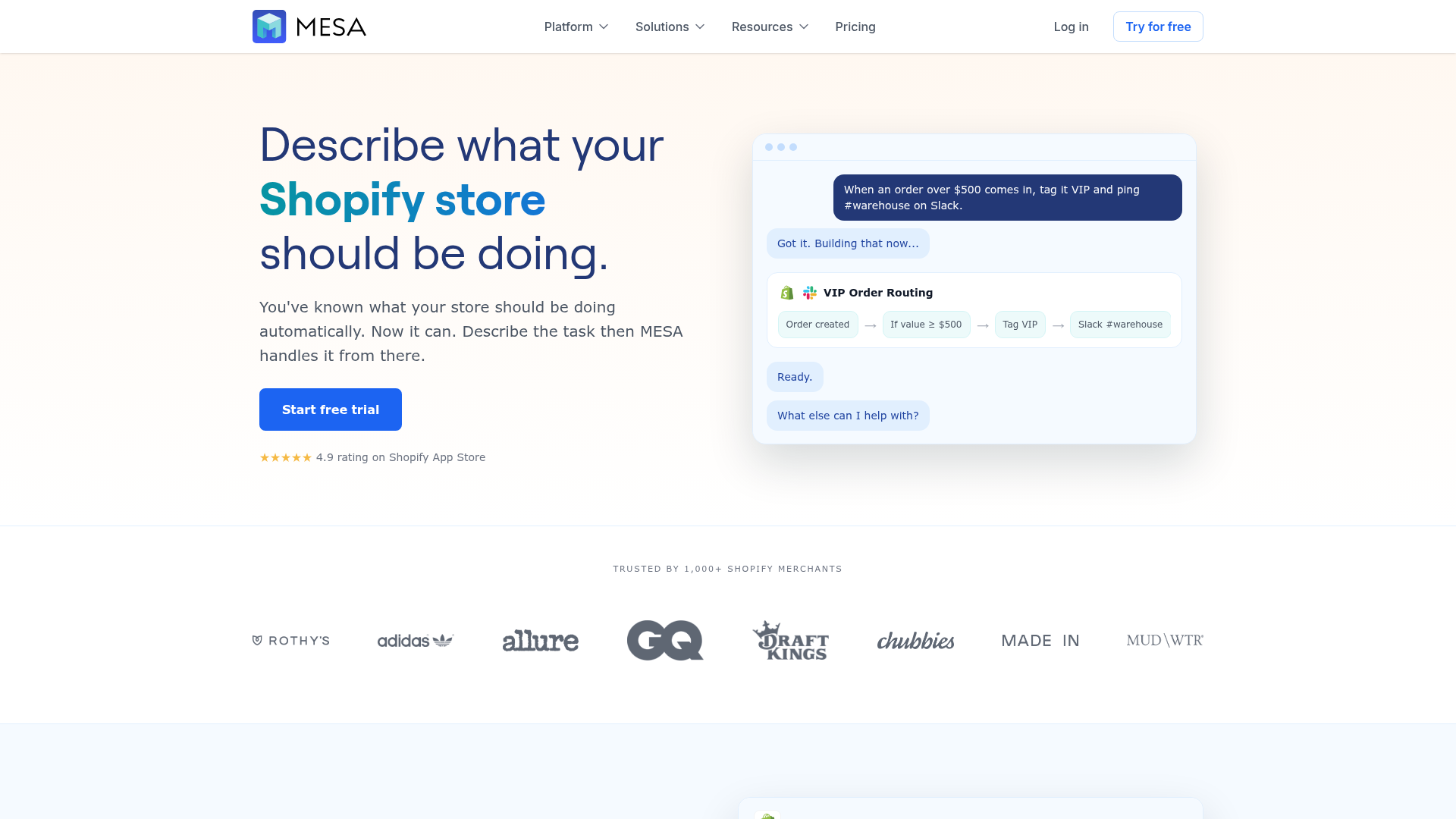
This is where Yedric, MESA’s AI workflow assistant stands out. Instead of forcing teams to map every step manually, Yedric helps turn plain-English requests into live, multi-step automations faster.
3. Multi-step logic and branching
Real store operations rarely follow one straight line. You need workflows that can handle:
-
if/then logic
-
delays and waits
-
retries after failed actions
-
multiple approval or notification paths
-
different actions based on SKU, order value, customer tag, or location
This is essential for use cases like split fulfillment, exception handling, fraud review, backorder routing, and post-purchase service.
4. Broad app integrations
Your automation platform is only as useful as the systems it can coordinate.
MESA connects Shopify with 100+ apps and ecommerce tools, helping merchants sync data and actions across systems like Slack, Google Sheets, HubSpot, email platforms, fulfillment tools, and ERPs. For teams evaluating their app ecosystem, MESA’s automation app integrations make it easier to connect the tools they already rely on.
5. Ready-made templates
A platform should not require you to reinvent common workflows from zero.
Templates matter because they shorten time to value, reduce setup friction, and give operators a proven starting point. MESA includes 300+ ready-made templates so merchants can launch automations for common Shopify use cases quickly, then customize from there.
6. Error prevention and visibility
Automation that silently fails is worse than manual work.
Look for features that help you avoid:
-
broken data flows
-
missed notifications
-
duplicate actions
-
inventory mismatches
-
overselling
-
workflows that stop after one app changes behavior
This is one of the less glamorous but most important parts of AI automation. Reliability beats novelty.
7. Human support
Many merchants do not need code help. They need workflow help.
That means real support from people who understand ecommerce operations and can help refine setup, troubleshoot edge cases, and improve performance over time. This is a major advantage for growing brands that have outgrown DIY experimentation but do not want to open a full dev project for every operational request.
The workflows that drive the biggest payoff
The best automation opportunities are not always flashy. They are the tasks your team repeats constantly, the handoffs that create delays, and the errors that keep showing up.
Order handling
Order automation is often the fastest place to start because the volume is high and the logic is repetitive.
Common examples include:
-
tagging orders by product type, destination, or risk criteria
-
routing wholesale orders differently from DTC orders
-
notifying internal teams about high-priority or high-value orders
-
splitting orders based on fulfillment rules
-
sending exception alerts when required data is missing
For merchants trying to streamline these processes, MESA’s Shopify order automation workflows can remove a surprising amount of operational drag.
Inventory sync
Inventory mistakes are expensive. They lead to overselling, poor customer experience, and firefighting between ops and support.
AI automation helps by:
-
syncing inventory between Shopify and connected systems
-
updating downstream tools when stock changes
-
flagging low-stock conditions
-
pausing or redirecting workflows based on availability
-
keeping bundles and component inventory aligned
Fulfillment operations
Fulfillment is full of edge cases, which is exactly why workflow automation helps.
Examples:
-
hold orders until required conditions are met
-
send packing or routing instructions to the right team
-
trigger different flows for preorder, local pickup, or subscription orders
-
alert staff when shipping exceptions occur
-
coordinate warehouse and customer communication automatically
Customer follow-up
Customer experience is not just marketing. Much of it is operational.
Useful automations include:
-
post-purchase check-ins
-
shipping delay notifications
-
loyalty or VIP alerts
-
review request timing
-
support escalation when certain order conditions are met
Reporting and data cleanup
Many teams still spend too much time exporting Shopify data into spreadsheets, sending status updates, or reconciling app data manually.
AI automation can push data where it needs to go in real time, reducing reporting backlog and making decisions faster.
What competitors get wrong
After reviewing common content on AI automation and ecommerce automation, several patterns show up again and again.
They stay too abstract
A lot of articles talk about “personalization,” “efficiency,” and “AI-driven experiences” without explaining what the ops team should actually automate on Monday morning.
That misses the real buying intent. Operators want specifics:
-
what process should I automate first?
-
what kind of workflow logic do I need?
-
how do I prevent errors?
-
which tool fits a Shopify-heavy stack?
They confuse AI with chatbots
Many competitor pieces focus heavily on customer-facing AI like recommendations, chat, or content generation. Those are useful, but they are only part of the story.
The operational side of AI automation matters just as much: order routing, inventory sync, alerts, approvals, exception handling, and data movement between apps.
They ignore maintenance
A workflow is not valuable if it breaks when your process changes. Many articles talk about setup, not durability.
The real question is whether your automation platform can support evolving business rules without turning every update into a technical project.
They overlook the non-technical buyer
Most ecommerce operations leads are not looking for a general-purpose builder with infinite complexity. They want something that helps them move faster without needing a developer in the loop for every change.
That is one reason MESA resonates with Shopify teams. It offers advanced workflow power, but the experience is grounded in real merchant operations rather than developer-centric tooling.
How to choose the right platform for your team
Here is a practical evaluation framework.
Ask these six questions
-
Can the platform handle Shopify workflows natively?
If not, your team will spend time translating normal store logic into generic automation structures. -
Can we describe what we need accomplished in plain English?
This matters for speed, adoption, and reducing bottlenecks. -
Can it manage complex multi-step workflows?
If the tool only handles simple triggers, you will outgrow it quickly. -
Does it integrate with the tools we already use?
A platform that cannot reach your support, fulfillment, reporting, or ERP stack creates more work than it removes. -
Does it include templates for common ecommerce use cases?
Templates reduce time to value and improve consistency. -
Will real humans help us get workflows right?
Good support shortens implementation time and helps teams avoid bad automation design.
A quick comparison table
|
Evaluation criteria |
Basic automation tool |
Generic AI workflow tool |
Shopify-first AI automation platform |
|---|---|---|---|
|
Easy for ops teams |
Sometimes |
Varies |
Yes |
|
Shopify context |
Limited |
Limited |
Strong |
|
Plain-English workflow creation |
Rare |
Sometimes |
Strong |
|
Multi-step ecommerce logic |
Basic |
Moderate |
Strong |
|
App ecosystem for merchants |
Moderate |
Broad but generic |
Broad and ecommerce-focused |
|
Templates for store operations |
Limited |
Limited |
Extensive |
|
Human workflow support |
Often minimal |
Varies |
High-value differentiator |
A practical rollout plan for busy ecommerce teams
You do not need to automate everything at once. In fact, that is usually the wrong approach.
Start with one painful workflow
Good first candidates:
-
manual order tagging
-
low-stock alerts
-
customer service escalations
-
shipment exception notifications
-
pushing Shopify data into spreadsheets or Slack
These workflows are repetitive, visible, and easy to measure.
Build around outcomes, not features
Do not start with “we want AI.” Start with:
-
reduce order handling time
-
prevent overselling
-
eliminate daily exports
-
shorten support response loops
-
reduce fulfillment exceptions
Then choose the workflow design that gets you there.
Expand into connected systems
Once one workflow proves value, move to adjacent processes. For example:
-
order tagging leads into fulfillment routing
-
inventory alerts lead into purchasing workflows
-
support events lead into customer follow-up automations
-
reporting flows lead into executive dashboards
This is where a platform approach beats isolated automations. The workflows begin reinforcing each other.
Why MESA is the logical next step for growing Shopify brands
If your team has outgrown basic trigger tools, but does not want the cost and delay of custom development, MESA sits in the right middle ground.
It is built for merchants who need to automate repetitive Shopify tasks without requiring a developer, support complex multi-step workflows, and connect the systems they already use.
What makes it particularly strong for ecommerce teams:
-
Shopify-first automation design
-
AI-assisted workflow creation through plain-English requests
-
100+ app and tool integrations
-
300+ templates for faster setup
-
strong support for order handling, reporting, inventory sync, fulfillment operations, and customer follow-up
-
real human support for workflow setup and optimization
-
a practical path to scale operations with fewer manual touchpoints
If your current process depends on tribal knowledge, spreadsheets, and “just remembering to do it,” that is exactly where automation pays off.
Final takeaway
An AI automation platform is not valuable because it sounds advanced. It is valuable because it helps your team run ecommerce operations with fewer mistakes, fewer delays, and less manual effort.
For Shopify merchants, the winning approach is not generic AI layered on top of disconnected tools. It is a platform that understands store operations, lets teams describe what they need accomplished, supports complex workflows, and keeps critical systems in sync.
That is the difference between experimenting with automation and actually operationalizing it.
If you want to move from ad hoc fixes to scalable workflows, explore MESA’s AI-powered ecommerce automation solutions and see how quickly your team can turn operational requests into working automations.
FAQ
Which AI is best for e-commerce?
The best AI for ecommerce is the one that solves a real operational problem, not just a flashy one. For many merchants, that means AI that improves workflows like order routing, inventory sync, fulfillment alerts, and customer follow-up rather than only content generation or chat.
Which platform is best for AI automation?
The best platform depends on your stack, but Shopify merchants usually benefit most from a Shopify-first AI automation platform that supports multi-step workflows, app integrations, templates, and human support. MESA is a strong fit for teams that want to automate operations without needing custom development.
Which AI agents are best for e-commerce?
The most useful AI agents in ecommerce are the ones that help teams describe what they need accomplished and turn that into live operational workflows. For Shopify stores, an assistant like Yedric is valuable because it helps create practical automations around orders, inventory, fulfillment, and support processes.
How can AI be used in ecommerce?
AI can be used in ecommerce for both customer-facing and operational tasks. On the operations side, it can automate order handling, inventory synchronization, alerts, reporting, fulfillment routing, and customer follow-up so teams spend less time on repetitive work and more time on growth.
Can AI build my ecommerce website?
AI can help generate content, layouts, and suggestions for an ecommerce site, but it usually does not replace the need for a commerce platform, design decisions, and operational setup. Where AI often creates faster ROI is in automating the store operations behind the website once your storefront is live.
What is the 30% rule for AI?
The “30% rule” is not a universal ecommerce standard, but people often use it informally to mean AI should remove a meaningful share of manual effort before it is worth adopting. In practice, the better test is whether AI automation reduces repetitive work, delays, and errors in high-volume workflows your team handles every day.