Roughly seven in ten carts never become orders, and that number has barely moved in twenty years. Baymard Institute puts it at 70.22%, averaged across 50 separate studies:
"70.22% – average documented online shopping cart abandonment rate"Baymard Institute
Every Shopify store has a recovery email running against that number whether the merchant set it up or not. Almost nobody touches it after launch. One send, ten hours after the fact, the same copy the store next door is using — and then the sequence is over.
Below are seven abandoned cart emails that actually earn their send: what each one is for, what data it needs, and which of them Shopify can send natively versus which need something else behind them. You will not send all seven to the same person. The point is to pick the three or four that match the reason your carts die.
TL;DR: there's a template for that
What Shopify already sends for you
Before building anything, know exactly where the native automation starts and stops, because a surprising amount of abandoned-cart advice on the internet describes rebuilding things Shopify does for free.
First, the vocabulary. Shopify does not recover abandoned carts. It recovers abandoned checkouts, and the difference is an email address:
"A checkout is considered abandoned if it remains incomplete for more than ten minutes after the customer has provided their email information."Shopify Help Center
Someone who fills a cart, opens checkout, and leaves before typing an email is invisible to this entire system. That shopper needs an on-site intervention — an exit-intent capture, a saved cart, a better shipping estimator — not an email, and it's covered in our guide to Shopify checkout optimization.
Shopify also declines to send the recovery email in seven specific situations, including when the shopper completed a different order first, when the store can't ship to their address, when every product in the cart is out of stock or free, when only a phone number was captured, and when Shopify Payments flagged the attempt as high risk. Those aren't failures to fix. They're your automation refusing to embarrass you.
Two more facts worth knowing before you budget for any of this. The current abandoned checkout automation is a Shopify Flow workflow under the hood — Flow is a free app on every plan, Basic included — so the ten-hour wait is editable rather than fixed:
"You can use Shopify flow to edit the workflow for your new abandoned checkout automation, including the wait time."Shopify Help Center
And the sends themselves are free, permanently, no matter how many you make:
"Abandoned checkout automations are always free and don't count towards the monthly limit."Shopify Help Center
That monthly limit is 10,000 free emails on Basic, Grow, Advanced and Plus. Abandoned checkout sends sit outside it entirely. So the cost argument against a longer sequence is weaker than most merchants assume — what you're really spending is attention, not money.
The shape of the sequence
Four sends across three days is the shape most stores land on. The first one goes out fast enough to catch a genuinely interrupted shopper, the last one lands before the cart is emotionally stale, and every send checks whether an order came in first.
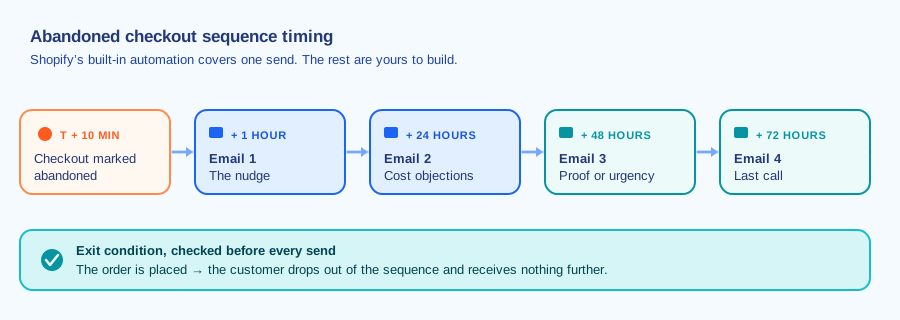
The exit condition on that bottom row is not optional garnish. It is the single most common way an abandoned cart program turns into a support ticket: someone buys, then keeps getting told they forgot something.
The seven emails
Emails one through four are the spine. Five through seven are situational — they replace a slot in the spine when the cart tells you something specific.
1. The one-hour nudge
No discount. No countdown. No "we noticed you left something behind!" This email exists for the shopper who got interrupted — a call came in, the toddler woke up, the train hit a tunnel — and it should read like a receipt they can act on: the item image, the price, one button, a support line, nothing else.
The ten-hour default is too late for this job. If a shopper abandoned at 9pm, ten hours puts your email in a 7am inbox alongside everything else that arrived overnight. Move it to somewhere between 30 and 90 minutes and the email arrives while the tab is arguably still open.
This is the one email nearly every store should send, and it's the one that needs the least work: change the wait time on the automation Shopify already gave you.
2. The 24-hour cost email
By a wide margin, the top removable reason people abandon during checkout is the total not matching the expectation the product page set:
"Extra costs too high (shipping, tax, fees)" — 40% of checkout abandonmentsBaymard Institute
Slow delivery (20%) is the next one down. Both are the same email: say the quiet part out loud. State the shipping cost and the delivery window in the body, name the free-shipping threshold and how far this specific cart is from it, and if you have a cheaper slower option, put it in the email rather than making them re-enter checkout to discover it.
Resist the urge to solve a cost objection with a discount here. You have two more emails before you need to pay for the order.
3. The 48-hour trust email
Nineteen percent of abandoners in Baymard's data didn't trust the site with their credit card information, and 17% hit a checkout that was too long or errored out. Neither of those people wants a coupon. They want evidence that the order will arrive and that a human exists on your end.
Reviews of the exact product in the cart beat generic store-wide ratings. The returns policy in one sentence beats a link to a policy page. A named support address beats a no-reply sender. If you sell something with a real failure mode — sizing, fit, compatibility, freshness — this is the email where you address it directly.
4. The 72-hour offer
Now you can discount, because now you know the cart survived three emails that didn't cost you margin. Keep it small, make it expire, and pre-apply it so the shopper never has to copy a code.
Shopify supports the pre-apply directly: you create the discount, then append it to the checkout URL in the email template so the cart loads with the discount already on it. There's one trap in the documentation worth reading twice before you ship this:
"If the customer manually entered any other discount code when beginning their checkout before they abandoned it, then the original discount code is replaced by the checkout recovery discount code."Shopify Help Center
If your recovery discount is 10% and the shopper had already applied a 25% loyalty code, your recovery email just made their cart more expensive. Either exclude carts that already carry a discount from this send, or make the recovery offer generous enough that it can't lose.
5. The guest checkout email
Eighteen percent of checkout abandonments in Baymard's data come from a site insisting on account creation. If your store requires accounts, or if your checkout merely looks like it does, that objection never shows up in your analytics — it shows up as a flat abandonment number you can't explain.
Swap this in for the trust email when the abandoning shopper has no existing customer record. One line: "You don't need an account — here's your cart." Then fix the checkout so the email becomes unnecessary.
6. The back-in-stock restart
This one isn't on the clock at all. When a cart is abandoned on an item that then sells out, the recovery sequence stops being useful and the inventory event becomes the trigger instead: the variant comes back, and the email goes out that same hour to everyone who had it in an abandoned checkout.
It's a different kind of workflow — you're joining an inventory event to a list of stale checkouts, which is not something the native abandoned checkout automation is built to do. It's also usually the highest-converting email in this whole list, because the objection was never price or trust. It was availability.
7. The plain-text "what stopped you?" email
Sent a week later, from a real person at your company, with no images, no branding, no button. The entire email is two sentences asking what got in the way, and it's the only one on this list whose primary output isn't revenue.
Run it for a month against high-value carts and you'll get an objection list you could not have guessed — a size chart nobody trusts, a delivery date that lands after a birthday, a payment method you don't accept. Then you go fix those and the other six emails start working better.
The part that decides whether any of it works
Emails one through four can live entirely inside Shopify's own automation, plus a second one for the later sends. Five through seven can't, because each of them needs to know something the abandoned checkout trigger doesn't carry on its own: whether this shopper has an existing customer record, whether a variant just came back in stock, whether this cart is worth a human's time.
That's the join. Something happens in Shopify, a workflow tool looks up the context that decides which of the seven emails is appropriate, and the send fires in whatever tool owns your email — Klaviyo, Omnisend, Shopify Email, Mandrill. The same pattern shows up all over Klaviyo automation work: the ESP is excellent at sending and mediocre at knowing, so you put the knowing somewhere else.
The unglamorous prerequisite is measurement. Shopify's abandoned checkouts report tells you how many there were; it does not keep a durable record you can slice by cart value, product, discount status or repeat-customer status three months from now. A scheduled workflow that appends every abandoned checkout to a spreadsheet does — a Schedule trigger, a filter for checkouts that are still abandoned at run time, and a row per cart with the products and customer details attached. Run it hourly and after a few weeks you can answer the only question that matters here: which carts are worth seven emails, and which are worth one.
What good looks like
Judge the program against real benchmarks rather than against zero. Omnisend's 2025 analysis of more than 20 billion campaign emails and 470 million automated sends across 27,000+ brands puts abandoned cart automation at a 37.12% open rate, a 4.13% click rate, a 1.72% conversion rate and $3.59 in revenue per email sent.
Abandoned cart emails earned "$3.59" per email sent in 2025, at a 1.72% conversion rate.Omnisend email marketing benchmarks
Two things to take from those numbers. A 1.72% conversion rate means the overwhelming majority of these emails do nothing, which is exactly why the free-forever pricing on Shopify's abandoned checkout sends matters. And $3.59 per email means the arithmetic works anyway: a store with 500 abandoned checkouts a month running four sends is looking at real money for a few hours of setup.
If your own numbers land far under those, the problem is almost never the copy. It's timing (the first email too late), targeting (all seven emails to everybody), or a broken exit condition quietly annoying people who already bought. For the on-site half of the problem — the shoppers who never reach checkout at all — start with the tactics for reducing abandoned carts before they happen.