If your ecommerce team is still copying order data between apps, manually tagging exceptions, chasing stock mismatches, and sending the same internal alerts every day, you do not have a staffing problem - you have a workflow problem. The right task automation tools help Shopify merchants remove repetitive work, reduce avoidable errors, and keep operations moving even as order volume, channels, and app complexity grow.
Here’s the short answer: task automation is software that handles repeatable operational work for you based on triggers, rules, and business context. In ecommerce, that usually means things like order tagging, fraud checks, fulfillment routing, inventory sync, customer follow-up, reporting, and app-to-app data movement. The best platforms do this without requiring custom development, and the strongest Shopify-first options let you simply describe what you need accomplished and turn that into a live workflow quickly.
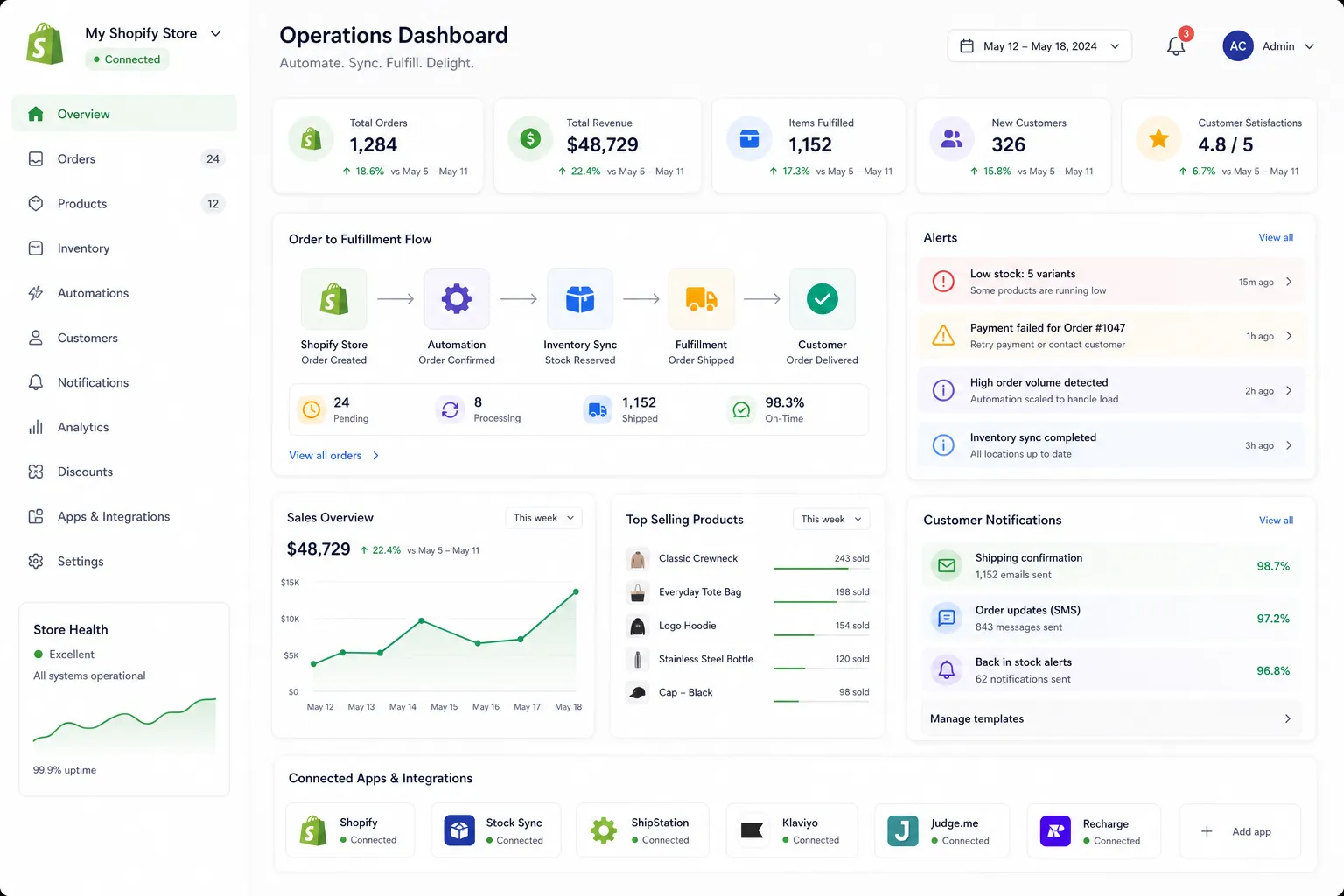
“Organizations implementing workflow automation achieve an average return on investment (ROI) of 400% within the first year.” - Forrester, as cited by ADAI’s workflow automation statistics roundup
“Manual reconciliation at 500+ orders per month leads to margin loss and operational bottlenecks.” - Webgility, according to Webgility’s 2026 Shopify statistics article
Why ecommerce teams look for automation in the first place
Most operators do not start shopping for task automation software because automation sounds exciting. They start because daily work becomes fragile:
- orders need different handling based on tags, SKUs, shipping method, or destination
- inventory data falls out of sync between Shopify and external systems
- customer service needs faster visibility into order issues
- finance wants cleaner exports and fewer reconciliation mistakes
- fulfillment teams need instant exception alerts instead of inbox chaos
- reporting lives in spreadsheets that nobody trusts by the end of the week
At small scale, a team can muscle through this manually. At growth scale, manual work creates backlog, inconsistency, and hidden costs.
That is where automation shifts from “nice to have” to operational infrastructure.
What good task automation looks like in ecommerce
The best task automation apps are not generic checklists dressed up as AI. They solve real store operations problems with clear triggers, reliable actions, and enough flexibility to support edge cases.
In practice, good ecommerce automation should help you:
- tag and route orders automatically
- sync data across Shopify and the rest of your stack
- notify the right team when something needs attention
- update spreadsheets, ERPs, CRMs, and support tools without rekeying
- prevent overselling and stale inventory
- trigger post-purchase and exception flows based on actual store events
- reduce “what happened?” moments when data breaks between systems
For Shopify merchants, the most useful tools are the ones built around how stores actually operate - not around abstract developer workflows.
What competitors get wrong
After reviewing leading articles on ecommerce automation and marketing automation tools, a pattern shows up: many competitors focus heavily on email journeys, generic app connectors, or AI buzzwords, but gloss over the operational layer that actually consumes an ecommerce team’s time.
Here’s the gap:
They over-focus on marketing, under-focus on operations
Email automation matters. So do cart recovery and segmentation. But many articles barely address the tasks that create the biggest operational drag:
- order exception handling
- inventory reconciliation
- fulfillment routing
- internal alerts
- returns workflows
- ERP and spreadsheet updates
- subscription edge cases
- multi-app data consistency
They assume technical resources are available
A lot of comparison posts quietly assume you have someone who can map fields, manage webhooks, debug failures, and maintain logic over time. Many ecommerce teams do not. Operations managers need tools they can own without a developer queue.
They talk about “connecting apps” instead of outcomes
Merchants do not wake up wanting to connect App A to App B. They want to solve problems like:
- “When a high-risk order is created, notify ops and hold fulfillment.”
- “When inventory drops below threshold, alert Slack and update a sheet.”
- “When a subscription renewal fails, tag the customer and create a support task.”
- “When an order contains a preorder SKU, split the routing logic automatically.”
That outcome-first framing is where Shopify-first automation platforms like MESA stand out.
What to evaluate before choosing a tool
Not every platform labeled as task automation software is a fit for ecommerce. Before comparing vendors, clarify what your team actually needs.
1. Shopify depth
If Shopify is your operating system, the tool should understand Shopify events natively and handle store logic cleanly.
2. Multi-step workflow support
Simple trigger-action automations break down fast in ecommerce. You often need conditions, branching, transformations, delays, notifications, and external actions in the same flow.
3. App ecosystem
Your store does not run on Shopify alone. You likely need connections to spreadsheets, support tools, fulfillment tools, finance systems, subscriptions, reviews, and messaging platforms.
4. Speed to launch
If a tool requires long implementation just to automate basic order flows, it will not help your team in time.
5. Support quality
When a workflow affects inventory, fulfillment, or customer communication, support matters. Real human help is not a bonus feature; it is risk reduction.
6. Failure visibility
Broken data flows can be expensive. You want visibility when something fails - not silent errors that surface three days later as customer complaints.
The best task automation tools for ecommerce teams
Below is a practical comparison of the leading options, with a bias toward real operational use inside ecommerce teams.
Quick comparison table
Tool | Best for | Strengths | Limits to know |
|---|---|---|---|
MESA | Shopify merchants needing operational automation without custom dev | Shopify-first, plain-English workflow creation, 300+ templates, 100+ integrations, strong support | Best fit when Shopify is central to operations |
Shopify Flow | Basic native Shopify automations | Built into Shopify ecosystem, easy for simple rules | More limited for complex multi-app workflows |
Zapier | Broad app-to-app automation | Huge app directory, familiar UI | Can get messy and expensive at operational scale |
Make | Visual multi-step workflows | Flexible scenarios, good branching | More technical setup and maintenance |
n8n | Technical teams wanting control | Highly customizable | Better for technical users than busy ops teams |
IFTTT | Very simple trigger-action tasks | Easy for lightweight automations | Not built for serious ecommerce operations |
1. MESA
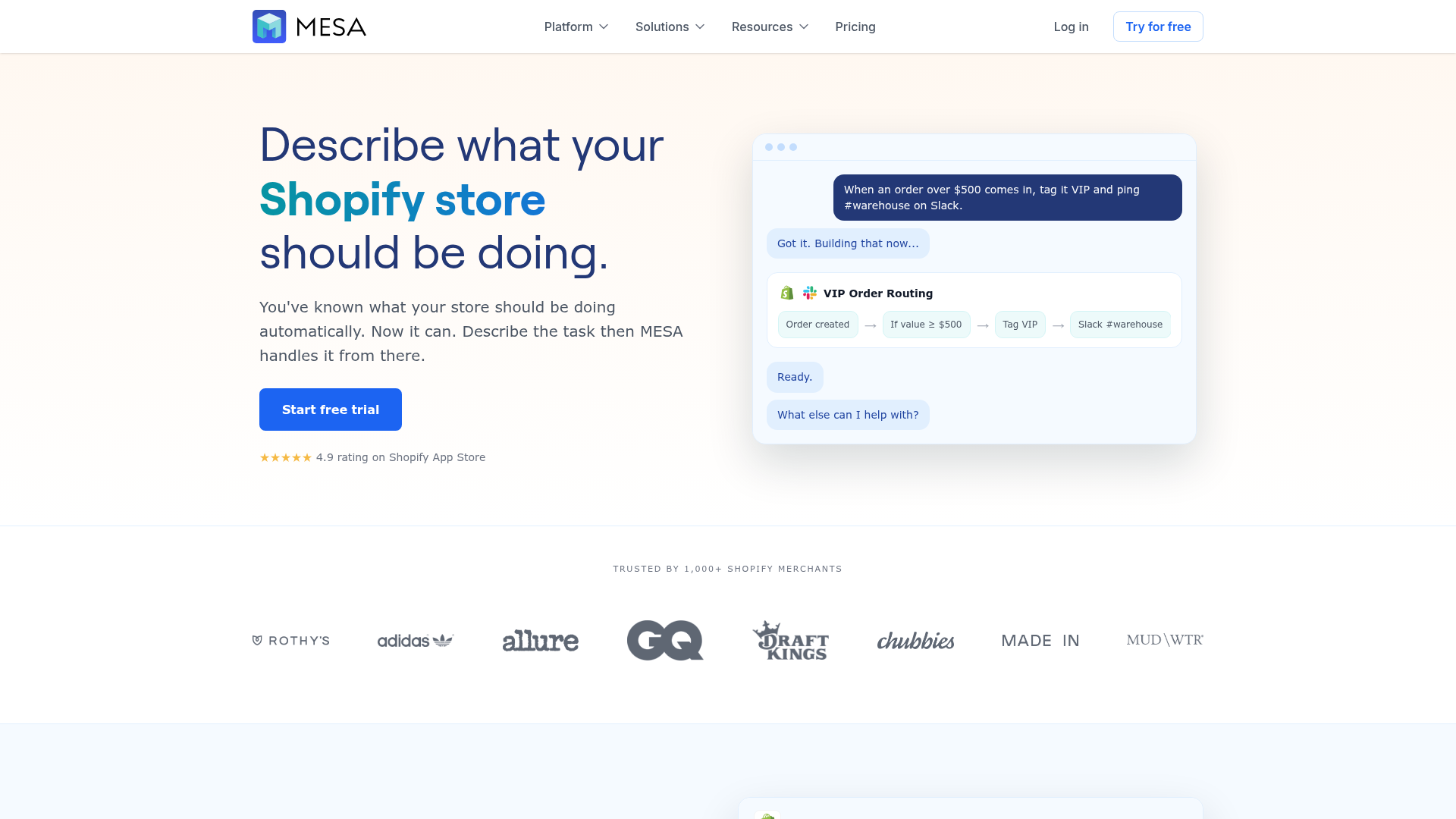
MESA is the strongest choice for Shopify merchants who want automation to reduce manual operational work - not just move data from one app to another. Its advantage is focus: it is built for Shopify workflows and for the people who run stores, not just the people who write code.
What makes MESA different is how quickly it turns operational intent into working automation. Instead of building everything from scratch, teams can describe what they need accomplished and use MESA’s AI assistant to generate live workflows quickly. That matters when your team is trying to solve a backlog problem this week, not architect a system this quarter.
MESA also supports complex multi-step automations well. That includes cases like:
- tagging orders based on line items, risk, location, or shipping method
- sending internal Slack alerts for high-priority exceptions
- syncing data into spreadsheets or external systems
- triggering post-purchase actions based on fulfillment status
- protecting against broken handoffs that lead to overselling or reporting gaps
For teams that want to go deeper, MESA offers dedicated solutions for order automation and broader AI-powered automation, plus 300+ templates that speed up setup considerably.
Why MESA stands out
- Shopify-first design
- supports complex, multi-step business logic
- 100+ app and ecommerce tool integrations
- 300+ ready-made templates
- real human support for setup and optimization
- plain-English workflow creation instead of developer-heavy setup
Best fit
Growing Shopify brands, ecommerce operations teams, fulfillment managers, and enterprise merchants who need reliable, scalable automation without adding custom development burden.
2. Shopify Flow
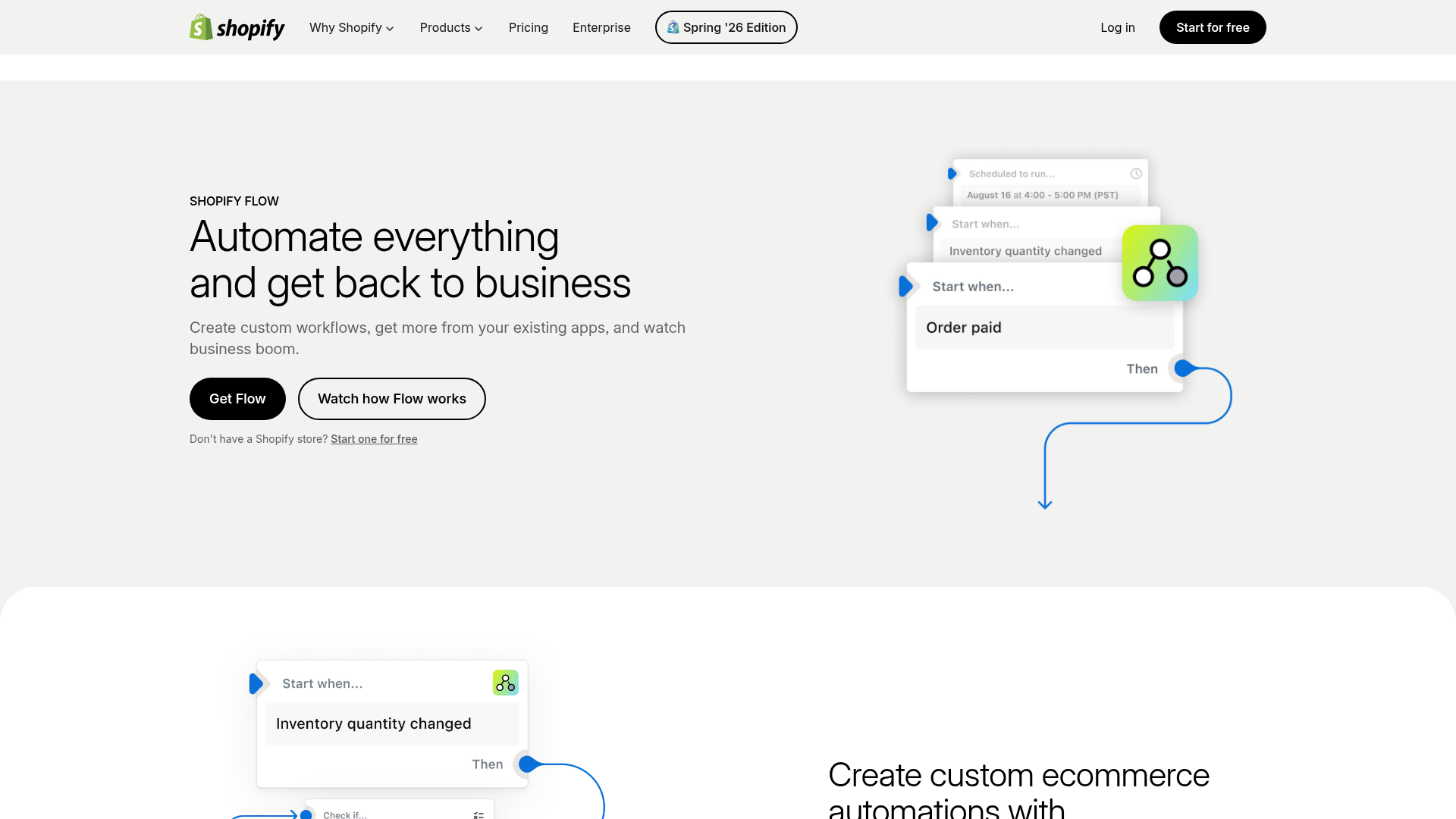
Shopify Flow is a good starting point for merchants who want basic native automation inside the Shopify ecosystem. It handles straightforward rule-based actions well, especially for stores with simpler operational needs.
Typical use cases include:
- tagging customers or orders
- sending internal notifications
- routing based on simple conditions
- basic fraud or inventory-adjacent rules
Where Shopify Flow tends to hit limits is in more advanced cross-system operations. If your workflows extend across multiple apps, require more flexible data handling, or need more operational nuance, teams often outgrow it.
That is why many merchants eventually compare MESA vs Shopify Flow when native rules stop being enough.
Best fit
Merchants wanting lightweight automation contained mostly inside Shopify.
3. Zapier
Zapier is one of the most familiar task automation tools on the market. Its biggest advantage is breadth: if you need to connect many common SaaS products, there is a good chance Zapier already supports them.
For ecommerce, Zapier can work well for lighter use cases such as:
- pushing order data into sheets or CRMs
- sending notifications
- updating records across simple systems
Its challenge is that ecommerce operations are rarely simple forever. As flows become more conditional and business-critical, teams can find themselves managing a patchwork of zaps that are harder to troubleshoot and govern at scale.
Best fit
General app-to-app automation across a broad SaaS stack.
4. Make
Make is powerful and visually flexible. It is popular with teams that want more control over workflow logic than simpler tools provide.
That flexibility can be useful for ecommerce scenarios involving:
- branching logic
- data transformation
- multi-step conditional flows
The tradeoff is complexity. Make often rewards users who are comfortable thinking through system design and debugging. For busy ecommerce operators, that can be more overhead than they want.
Check out our MESA vs Make comparison for a deeper look at how the two platforms stack up.
Best fit
Teams that want workflow flexibility and can handle a more technical build process.
5. n8n
n8n is a strong option for technical teams that want deeper control and customization. It is not the most natural choice for non-technical ecommerce operators, but it can be compelling when internal technical resources are available.
For operations-led ecommerce teams, the main question is not whether n8n is powerful. It is whether your team wants to own that level of complexity.
For a deeper feature-by-feature breakdown, see our MESA vs n8n comparison.
Best fit
Technical organizations with internal resources to maintain custom workflows.
6. IFTTT
IFTTT is best known for simple consumer and small-business automations. It can handle lightweight triggers well, but it is not built for the depth, reliability, or operational nuance that scaling ecommerce stores need.
Best fit
Very simple automations with low operational stakes.
Which tool is right for which ecommerce team?
If you are a growing Shopify brand
Choose a platform that helps your team move fast without relying on developers. MESA is especially strong here because it pairs a Shopify-first foundation with templates, AI-assisted workflow creation, and hands-on support.
If you are still early and mostly need native rules
Shopify Flow may be enough for now - particularly if your automations stay inside Shopify and do not require heavy app coordination.
If your stack is broad but your workflows are simple
Zapier can work if your main job is moving data between common SaaS tools and the logic is not too complex.
See our MESA vs Zapier comparison for a full breakdown of features and pricing.
If you have technical bandwidth and want maximum control
Make or n8n may appeal, but both ask more from your team in setup and maintenance.
Real ecommerce workflows worth automating first
The fastest wins usually come from automating work that is frequent, repetitive, and operationally sensitive.
Order management
- auto-tag wholesale, preorder, VIP, or risky orders
- hold fulfillment when conditions are not met
- route orders based on warehouse, shipping type, or SKU mix
- create internal alerts for exceptions
Inventory and merchandising
- sync inventory counts between systems
- alert teams when stock falls below threshold
- prevent overselling by updating external tools quickly
- log inventory changes for reporting
Customer experience
- trigger support follow-up when fulfillment is delayed
- notify customers about special shipping scenarios
- personalize post-purchase communication based on actual order data
- create recovery tasks when subscriptions or payments fail
Reporting and ops visibility
- export Shopify data to spreadsheets automatically
- update dashboards and finance tools without manual work
- notify teams in Slack when defined thresholds or anomalies occur
This is where a purpose-built Shopify automation platform tends to outperform generic task automation apps. The workflows are not theoretical - they are store operations.
How MESA helps teams scale without adding operational drag
The strongest operational argument for MESA is not just that it automates tasks. It is that it shortens the distance between “we need this fixed” and “this workflow is live.”
That matters because most ecommerce teams do not suffer from a lack of ideas. They suffer from a backlog of manual tasks and edge cases that nobody has time to solve cleanly.
MESA helps by offering:
- a template library with 300+ prebuilt automations
- support for 100+ app integrations and ecommerce tools
- a plain-English approach to building workflows
- human guidance for setup, testing, and optimization
- automation across order handling, reporting, alerts, sync, and follow-up
For example, if your team needs to push Shopify order data into Sheets, trigger Slack alerts for exceptions, or sync across operational tools, you can start with purpose-built integrations and templates instead of reinventing the process. That is especially useful when workflows affect fulfillment timing, inventory accuracy, or customer communication.
The biggest buying mistake to avoid
Do not choose a platform based only on how many apps it connects to.
That sounds counterintuitive, but app count is rarely the real bottleneck. The real bottleneck is whether the platform can handle your store’s logic reliably, at scale, without creating new maintenance work.
A broad connector tool with shallow ecommerce understanding can still leave your team doing manual cleanup. A Shopify-first tool with strong workflow depth often creates more value, even if the comparison sheet looks less flashy at first glance.
Final verdict
If you are looking for the best task automation software for ecommerce, start with the work that slows your team down every day: order exceptions, data sync, internal alerts, reporting, and post-purchase operations. Then choose a platform that fits the way ecommerce teams actually work.
For general-purpose automation, Zapier and Make remain useful. For lightweight native Shopify rules, Shopify Flow is a good entry point. But for Shopify merchants who have outgrown basic automations and need dependable, scalable workflows across real store operations, MESA is the most practical next step.
It removes repetitive work, supports complex multi-step logic, helps prevent avoidable operational errors, and lets non-developers launch useful automation quickly by simply describing what they need accomplished.
If you are ready to reduce manual work and scale store operations more efficiently, explore MESA’s template library or start with a workflow tailored to your store on getmesa.com.