
In June 2026, Shopify workflows that MESA's AI assistant built with a Logic step shipped to production at 31.8%, ahead of the 27.5% rate for workflows merchants built by hand. That is the first month AI-assisted building out-shipped manual building in MESA's data.
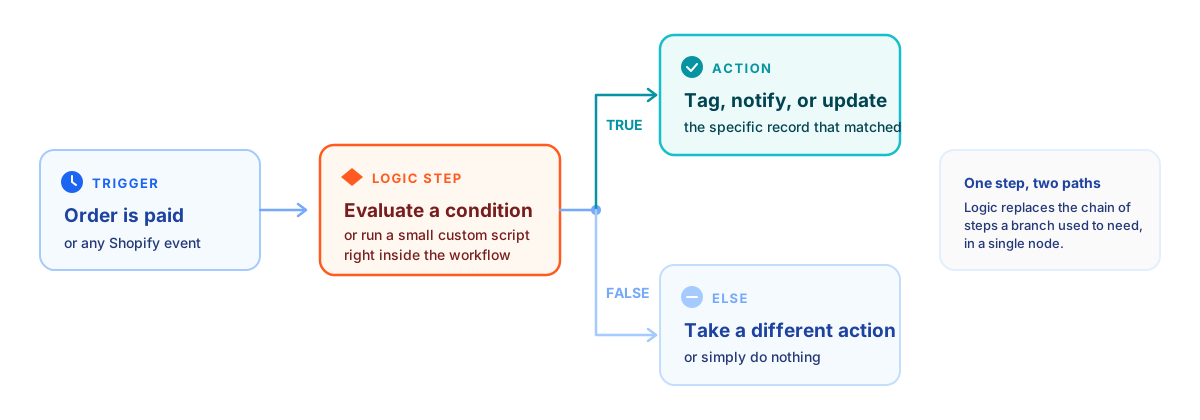
The Logic step is the reason. It launched in March 2026 and is available only to the assistant: one step where it can evaluate a condition and branch, or write a small custom script, in place of the chain of primitive if/then steps a merchant would otherwise wire together by hand. Two full quarters in, the assistant reaches for it on most of what it builds.
About this analysis. Based on real Shopify workflows built in MESA across Q1 and Q2 2026, the same dataset behind our Q1 2026 Shopify automation benchmark and AI assistant activation rate pieces, extended through the first full quarter the Logic step was live. Internal test builds are excluded throughout.
Adoption tripled in a single quarter
The assistant's share of all workflows built in MESA went from 11.6% in Q1 to 36.5% in Q2. Inside its own output, Logic-step usage climbed from 62.5% to 82.7% across the same two quarters. Merchants handed the assistant a much larger share of their building, and the assistant used Logic for the large majority of it.
One number held steady across both quarters: 0% of assistant-built workflows started from a template, against 23.9% of manually-built ones. The assistant writes bespoke logic every time rather than customizing a starter flow.
The AI assistant's share of workflows built in MESA tripled from 11.6% in Q1 2026 to 36.5% in Q2, and it used the Logic step on 82.7% of what it built.
Logic lifts the assistant's ship rate by about half
Activation rates climb on their own with age, because an older workflow has had more time to get enabled, so comparing whole quarters would just flatter the older cohort. The fair view is month by month inside Q2, where April, May, and June are all mature enough to sit next to each other:
| Month | Assistant + Logic (n) | Assistant + Logic activation rate |
|---|---|---|
| April | 55 | 30.9% |
| May | 49 | 34.7% |
| June | 107 | 31.8% |
The rate holds in the low 30s all quarter. The assistant's Q2 workflows built without Logic shipped at around 20.5%, so adding Logic ships roughly 1.5 times as many of the assistant's own workflows, and that lift did not fade as the quarter went on.
Adding the Logic step means the AI assistant ships about 1.5 times as many of its own workflows, a lift that holds steady across an entire quarter.
In June, the assistant passed manual building
Beating its own baseline is the easy test. The harder one is whether the assistant beats a merchant building the same thing by hand, and by the end of Q2 it did. Manual building fell from 38.9% in April to 28.1% in May to 27.5% in June, while the assistant's Logic-step workflows held roughly flat at 30.9%, 34.7%, and 31.8%. The gap did not sit still. It closed, and then it reversed.
Across the full sample manual building still ships at a higher rate, but that combined figure is dominated by older, more mature manual workflows, so it reads as a floor rather than a comparison.
Two things look like they account for most of what is left of the gap. Assistant-built workflows pull in a premium app noticeably more often, which likely puts billing friction between "built" and "enabled"; controlling for it narrows the gap without closing it. And not every Logic step is the same size of job, which the next section takes apart.
By June 2026, Shopify workflows the AI assistant built with a Logic step shipped at 31.8%, ahead of the 27.5% rate for manually-built workflows, the first time AI-assisted building out-shipped manual building in MESA's data.
The Logic step is really two tools sharing one name
A workflow's app list shows which apps it touches, not what a Logic step inside it actually does. Reading the steps themselves splits them cleanly in two.
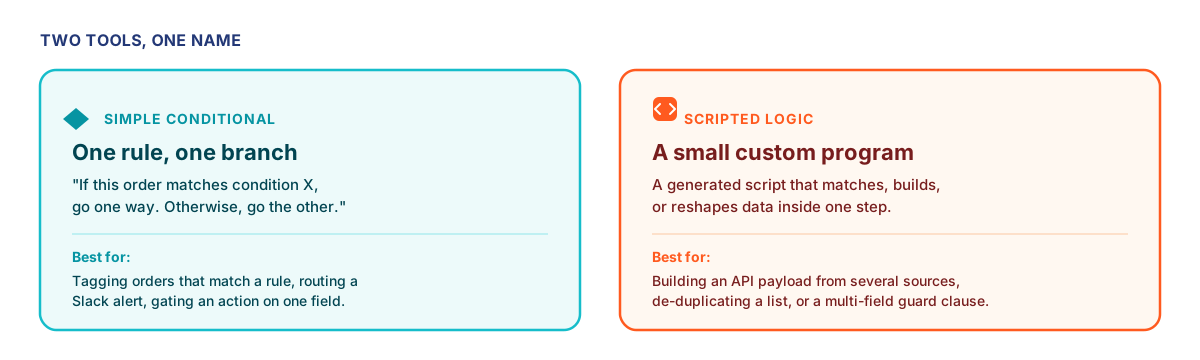
Roughly 85% are a simple conditional: one branch check, "if this order matches condition X, go one way, otherwise another." That is the shape merchants already know from Shopify's own native tools, with email, spreadsheets, and Slack the most common destinations after the check.
The other 15% is what we are calling scripted logic, where the assistant writes a small custom program inside one step instead of a plain branch. Paraphrased examples, with no merchant specifics: matching a normalized order number against a list of Shopify orders and confirming exactly one match; building a fulfillment payload from several prior responses and stopping early if a required field is missing; de-duplicating a list before a loop processes each entry; recomputing which store locations are eligible and alerting a team only when something changed. This is the connective data-wrangling between apps that no pre-built integration step covers, and the reason the Logic step exists.
The split shows up in activation, too. Workflows with a scripted logic step carry noticeably more steps on average and ship at a meaningfully lower rate than workflows with only a simple conditional. Complexity is its own drag on shipping, separate from premium-app friction.
Scripted logic gives the AI assistant a way to write bespoke, one-off logic exactly suited to a merchant's specific situation, the kind of custom script that would otherwise take a developer to hand-code.
Workflows that chain multiple Logic steps are deliberate, not noise
A meaningful share of Logic-step workflows use it more than once, and those chains are not scattered. They cluster around two recognizable builds: a scheduled spreadsheet import, looped per row and checked against Shopify with a Logic gate at each stage; and a multi-system chain with two or three sequential Logic gates for validation. Both are sophisticated on purpose. Both also ship somewhat below the single-Logic average, which fits the pattern that more moving parts are harder to get across the finish line.
Why we think the Logic step worked
Before March, an assistant expressing conditional logic had to do it the way a person does: pull out several primitive if/then steps and wire them together on a canvas built for human hands. The Logic step let it write the same logic once, as code, in one place. Nothing about the model changed over Q2. What changed is that it stopped working through an interface designed for someone else.
That is the broader read, and we would hold it loosely: AI may do better work when it is given tools shaped for how it actually works than when it is made to operate the ones we built for ourselves. The same change would have been a no-op for a human builder, who was never slowed down by the canvas in the first place.
None of this replaces the builder. The assistant is absorbing the conditional complexity merchants used to hand-build, so they can stay on the outcome, and premium-app friction looks like the next addressable lever. If you are deciding whether to hand a conditional build to the assistant or wire it up yourself, a single branch check with one clear rule is the safer bet either way, and the assistant ships those at a meaningfully higher rate than a scripted, multi-step Logic build. If the automation genuinely needs custom data-wrangling in the middle, expect a longer path to "enabled."
For a wider look at what ships and what does not, see the full Shopify automation benchmark, and for the AI-specific activation gap this piece builds on, see Shopify AI workflow activation rate: 70% vs. 45%.
The Logic step changed the tool, not the model: giving MESA's AI assistant a single code step in place of a chain of visual if/then steps is what moved its ship rate past manual building.
FAQs
What does the Logic step do in MESA's AI assistant?
The Logic step lets MESA's AI assistant evaluate a condition and branch a Shopify workflow into different paths, or run a small custom script, inside a single step. It replaces the multi-step chain merchants used to build by hand to express "if this, then that" logic.
Do Shopify workflows built with AI ship more often than manually-built ones?
By June 2026, Shopify workflows MESA's AI assistant built using its Logic step shipped to production at 31.8%, ahead of the 27.5% rate for manually-built workflows that same month, the first time AI-assisted building out-shipped manual building in MESA's data.
What's the difference between a simple conditional and scripted logic?
A simple conditional is a single branch check, "if X, go one way, otherwise another," and makes up the large majority of Logic steps. Scripted logic is a full custom-written script for more complex data-wrangling, like building an API payload or de-duplicating a list, and it ships at a meaningfully lower rate because it's handling harder problems.
How much does the Logic step improve a workflow's chance of shipping?
Within MESA's AI assistant's own workflows, adding the Logic step lets it ship about 1.5 times as many workflows compared to building without it, a lift that held steady across the entire second quarter of 2026.
Do manually-built Shopify workflows ever use the Logic step?
No. This step is exclusive to the AI assistant, letting it combine primitive steps into a single, custom code step.