

Klaviyo Integration Shopify for Smarter Retention
-
- •
- Last updated: Jun. 16, 2026
- •
- 11 min read

If you run a Shopify store and want better retention, a Klaviyo integration with Shopify gives you a live connection between store behavior and customer messaging. In practical terms, that means product views, cart activity, purchases, and subscription events can trigger more relevant emails and SMS automatically instead of relying on generic batch campaigns.
That sounds straightforward, but most brands stop at the default setup. They connect Klaviyo for Shopify, turn on a few core flows, and assume the system is done. The real opportunity is using that data across operations and lifecycle marketing together, so the right message goes out at the right moment and your backend workflows keep pace as volume grows.
For lean ecommerce teams, that matters. Manual exports, delayed tagging, inconsistent customer data, and disconnected tools often cause retention problems that look like “marketing issues” but are really workflow issues. This is where pairing Klaviyo with Shopify-native automation becomes powerful: Klaviyo handles messaging brilliantly, while MESA helps orchestrate the operational logic around it without requiring a developer.
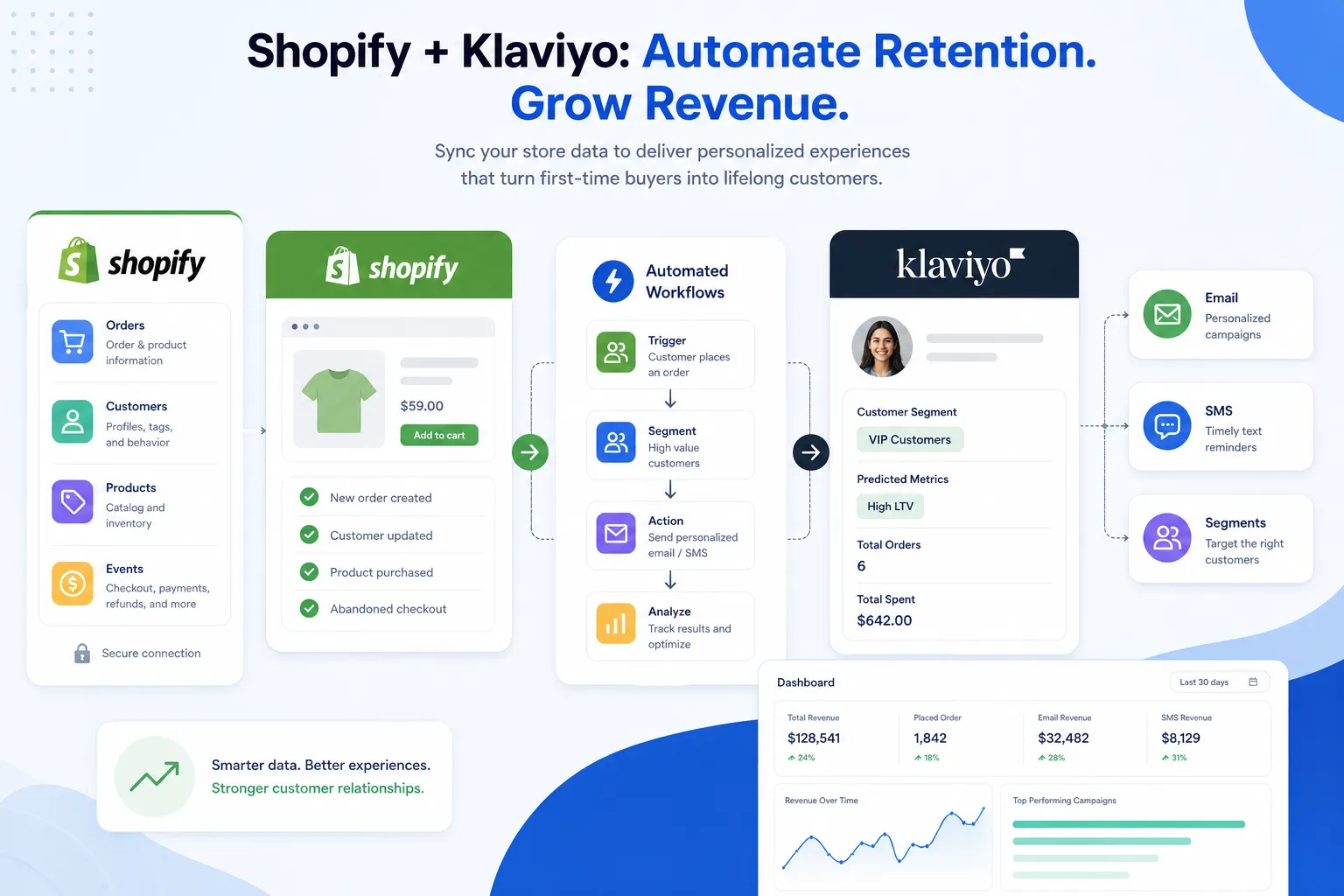
Table of Contents:
What a Klaviyo Shopify integration actually enables
A strong klaviyo integration shopify setup does more than sync contacts. It connects customer actions in Shopify to segmentation, timing, and messaging in Klaviyo so retention efforts reflect what is happening in the store right now.
That typically includes:
-
Syncing customer profiles, order history, and catalog data
-
Triggering flows from browse, cart, checkout, and purchase behavior
-
Personalizing campaigns with products, collections, tags, and lifecycle stage
-
Coordinating email and SMS around replenishment, winback, VIP, and post-purchase journeys
-
Feeding downstream operational workflows so your team is not patching gaps manually
Quick answer: what is Klaviyo for Shopify?
Klaviyo for Shopify is the integration that allows Shopify store data to power automated customer communications inside Klaviyo. It helps merchants send more relevant lifecycle messages based on real customer behavior, while also improving segmentation, reporting, and repeat-purchase marketing.
Why this matters for retention, not just email setup
Competitor articles consistently get one thing right: Klaviyo is strong because it uses first-party Shopify data for segmentation and automation. They also correctly emphasize the big foundational flows like welcome, cart abandonment, browse abandonment, and post-purchase.
But they often treat retention like a messaging problem alone.
In reality, retention is also an operations problem. If product data is delayed, orders are tagged inconsistently, loyalty or subscription status is missing, or internal alerts never fire, your “personalized” lifecycle marketing quickly becomes generic, late, or wrong.
According to Statista’s global cart abandonment data,:
“In 2026, the global online shopping cart abandonment rate reached 70.22%, indicating that over two-thirds of online shopping carts were abandoned before purchase.” – Statista
That is exactly why timing matters so much. A cart flow that triggers quickly with accurate product and customer context can recover revenue. A delayed or incomplete trigger often cannot.
What the top-ranking content gets right
After reviewing the leading competitor content, the common winning themes are clear:
|
Theme competitors cover well |
Why it matters |
|---|---|
|
Real-time Shopify data sync |
Powers better segmentation and automation |
|
Core lifecycle flows |
Welcome, cart, browse, and post-purchase are foundational |
|
Personalization |
Relevant products and content improve conversion |
|
SMS plus email |
Multi-channel retention works when timing is right |
|
Revenue-based reporting |
Better than relying on open rates alone |
Those are all valid. If you are just getting started, they are the basics you need.
What competitors get wrong
Here is the gap: most articles stop at campaign strategy and barely address the operational layer that makes retention scalable.
They overlook backend workflow dependencies
A strong Klaviyo program depends on clean inputs. If tags are wrong, products are misclassified, subscriptions are not synced, or support flags never reach marketing, the messaging quality drops.
They assume default flows are enough
Default flows are a starting point, not a strategy. Growing brands need logic based on order value, reorder windows, product type, inventory status, fulfillment delays, and subscription changes.
They underplay cross-system automation
Modern retention rarely lives in one app. Shopify merchants often need Klaviyo to reflect what is happening in support tools, subscription apps, loyalty systems, spreadsheets, ERPs, and internal communication channels.
That is where a Shopify-first automation platform becomes useful. Instead of duct-taping processes together, teams can describe what they need accomplished with MESA’s AI workflow assistant and turn that into live automation much faster.
The best use cases for Klaviyo with Shopify
The most effective klaviyo shopify setups combine customer-facing messaging with operational triggers behind the scenes.
1. Welcome and first-purchase journeys
When a shopper subscribes, Klaviyo can start a welcome flow immediately. But strong execution often requires more than a simple coupon email.
Useful supporting logic includes:
-
Tagging acquisition source for future segmentation
-
Sending different offers by product category or collection interest
-
Suppressing overlapping promotional flows for recent buyers
-
Alerting your team if a high-value lead subscribes but does not purchase
2. Cart and browse abandonment
This is the obvious use case, and it still matters.
A smart setup can segment abandonment flows by:
-
Cart value
-
New vs repeat customer
-
Product category
-
Discount eligibility
-
Inventory status
-
Geographic region or shipping constraints
For example, if a product is low in stock, your follow-up can create urgency. If the abandoned item has a long consideration cycle, the message can emphasize education or reviews instead of a fast discount.
3. Post-purchase retention
This is where repeat revenue is won.
Good post-purchase flows can include:
-
Order confirmation and expectation-setting
-
Usage tips and onboarding content
-
Product education by SKU or category
-
Review requests
-
Cross-sell recommendations
-
Replenishment reminders
-
Winback offers if reorder windows pass
4. Subscription and replenishment messaging
Many brands now rely on recurring revenue. If you sell consumables, skincare, supplements, pet products, coffee, or household goods, replenishment timing matters.
A merchant may need Klaviyo to respond when:
-
A subscription is skipped
-
A renewal is approaching
-
Inventory for the next renewal is at risk
-
A subscriber has not engaged in a set period
-
A customer buys once but does not convert to subscription
For merchants managing recurring revenue workflows, MESA can help connect operational logic to the rest of your stack through integrations like Recharge and Shopify automation workflows.
5. VIP and loyalty journeys
The best retention programs treat top customers differently.
That can mean:
-
Early-access product launches
-
Point-threshold triggers
-
Reward reminders
-
Tier-based customer experiences
-
Personalized cross-sell offers based on purchase history
How Klaviyo and MESA work better together
Klaviyo is excellent at messaging and customer data activation. MESA extends what your Shopify operation can do around that messaging.
Instead of forcing operations staff to depend on development resources, MESA helps merchants automate repetitive tasks, connect Shopify with the rest of the app stack, and reduce manual work that slows lifecycle marketing down.
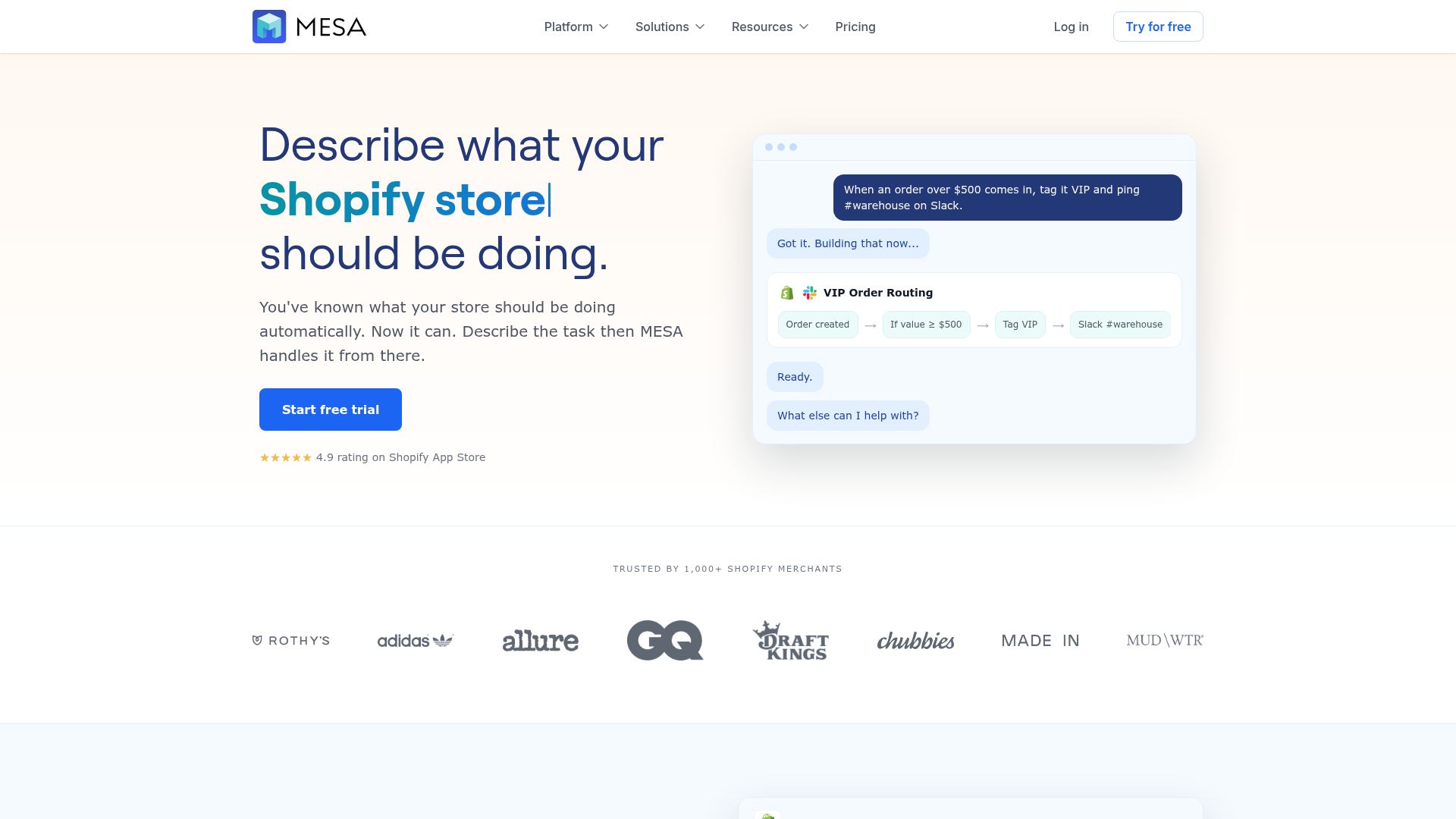
Examples of operational automations around Klaviyo
|
Workflow need |
What Klaviyo handles |
What MESA can help automate |
|---|---|---|
|
Abandoned cart recovery |
Triggering email/SMS |
Add order/customer tags, notify team, log data externally |
|
Post-purchase education |
Sending lifecycle content |
Route product-specific data, update sheets, trigger internal tasks |
|
VIP segmentation |
Messaging and campaigns |
Sync loyalty or order-value conditions across systems |
|
Replenishment logic |
Reminder flows |
Calculate timing from order patterns, sync subscription events |
|
Inventory-aware retention |
Personalized messaging |
Prevent overselling, trigger alerts, sync stock logic |
|
Support-informed winback |
Outreach flows |
Pull support or return-related signals into workflow decisions |
This is especially useful for brands that have outgrown one-dimensional app connections and need multi-step logic that spans marketing, operations, reporting, and customer experience.
If you are managing more than just email triggers, MESA’s broader Shopify automation platform gives your team a way to automate those dependencies without building custom middleware.
The retention metrics that actually matter
Competitor articles are right to say opens are not enough. The better question is whether your Klaviyo setup is increasing profitable repeat behavior.
Track these first:
|
Metric |
Why it matters |
|---|---|
|
Repeat purchase rate |
Direct measure of retention health |
|
Revenue per recipient |
Helps compare campaigns and flows fairly |
|
Flow-attributed revenue |
Shows whether automation is pulling its weight |
|
Time to second purchase |
Reveals how quickly new customers convert again |
|
Unsubscribe rate |
Indicates message fatigue or poor targeting |
|
SMS opt-out rate |
Important for channel quality |
|
Suppression growth |
Signals list hygiene or engagement issues |
|
Inventory-related cancellation rate |
Shows if marketing is outrunning operations |
A note on personalization performance
Many articles mention personalization but stay vague about what it should actually look like.
Useful personalization in klaviyo for shopify usually means:
-
Recommending related products based on actual purchase behavior
-
Changing timing based on replenishment windows
-
Adapting content based on first-time vs repeat buyer status
-
Excluding customers from irrelevant offers
-
Adjusting flows for high-AOV vs low-AOV cohorts
-
Coordinating post-purchase education by product type
The goal is not to look “smart.” The goal is to reduce irrelevance.
Practical setup checklist for Shopify teams
If you want the fastest path to a smarter Klaviyo-Shopify setup, start here.
Core integration setup
-
Connect Shopify and Klaviyo properly
-
Confirm product, order, and customer events are syncing
-
Verify on-site tracking is live
-
Check that consent collection is configured correctly
-
Review catalog data quality and product naming consistency
Lifecycle flow setup
-
Welcome series
-
Browse abandonment
-
Cart abandonment
-
Checkout abandonment where applicable
-
Post-purchase follow-up
-
Replenishment reminders
-
Winback campaigns
-
VIP or loyalty sequences
Operational support layer
-
Auto-tag customers and orders for segmentation
-
Sync key data to spreadsheets or ops tools
-
Create low-inventory alerts tied to active promotions
-
Trigger internal Slack or email notifications for edge cases
-
Route exceptions like failed orders, skipped subscriptions, or return-risk customers
Reporting and optimization
-
Measure repeat purchase rate by segment
-
Compare new vs returning customer performance
-
Audit flow overlap and message fatigue
-
Review suppression and unsubscribe trends
-
Test timing, offers, and send windows continuously
Common mistakes merchants make
Even experienced teams make these mistakes with klaviyo shopify integrations:
Treating the install as the strategy
Installing the app is not the outcome. The value comes from lifecycle design, segmentation logic, and ongoing testing.
Sending the same message to everyone
If subscribers, first-time buyers, repeat buyers, and lapsed customers all get similar emails, retention will plateau.
Ignoring operational bottlenecks
When inventory, support, subscription, or fulfillment systems are disconnected, customer messaging becomes less trustworthy.
Using too many manual workarounds
CSV exports, ad hoc tags, and “we’ll remember to update that later” processes always break at scale.
Waiting on developers for every workflow change
Retention should not be blocked by engineering queues. Ecommerce operators need a way to describe what they need accomplished and launch the workflow quickly.
That is one reason MESA resonates with growing teams: it supports complex multi-step automation, integrates with 100+ ecommerce tools, offers 300+ ready-made templates, and includes real human support to help optimize workflows over time.
When you need more than standard Klaviyo flows
There is a clear point where “basic Klaviyo setup” stops being enough. You are likely there if:
-
Your retention strategy depends on multiple apps
-
You need inventory-aware or subscription-aware messaging
-
Your ops team spends time cleaning data manually
-
You need internal alerts tied to customer lifecycle events
-
You want reliable reporting across systems
-
Your team is scaling faster than your process quality
At that stage, the answer is not necessarily replacing Klaviyo. It is making the system around it more reliable.
For ecommerce brands dealing with multi-app complexity, this is where MESA’s data integration workflows become a practical next step. You keep Klaviyo as the retention engine, while MESA helps keep the surrounding data and process logic in sync.
Final verdict
A klaviyo integration shopify setup is absolutely worth it for merchants who want better segmentation, smarter lifecycle marketing, and stronger repeat purchase performance. But the best results come when you treat Klaviyo as part of a larger retention system, not a standalone fix.
Klaviyo gives Shopify brands the messaging power. MESA helps operationalize everything around it: order handling, data sync, internal alerts, reporting, inventory coordination, and the multi-step workflows that keep customer experiences consistent as you scale.
If your team is tired of manual tasks, broken handoffs, and retention workflows that depend on duct tape, MESA is the logical next step. You can describe what you need accomplished, launch automations faster, and reduce the backlog that slows growth down.
Explore MESA’s platform, browse templates, or start a workflow that connects Shopify, Klaviyo, and the rest of your stack without custom development.
FAQ
Can you integrate Klaviyo with Shopify?
Yes. Klaviyo integrates directly with Shopify so customer, product, and order data can power automated email and SMS flows. For more advanced use cases, merchants often pair that setup with workflow automation to keep tags, inventory signals, and internal processes aligned.
Is Klaviyo better than Shopify emails?
For most growing brands, Klaviyo offers deeper segmentation, stronger automation, and more flexible lifecycle marketing than basic email tools. Shopify Email can be simpler for lighter use, but Klaviyo is usually better for retention-focused stores that want more personalization and reporting.
Is Klaviyo better than Shopify emails?
If your goal is serious retention marketing, Klaviyo is typically the stronger option because it supports more advanced flows, targeting, and multi-channel messaging. The biggest gains happen when the surrounding Shopify workflows are also automated so data stays clean and timely.
Is Klaviyo still relevant?
Yes. Klaviyo is still highly relevant for Shopify brands because it remains one of the most effective tools for behavior-based email and SMS marketing. Its value increases even more when paired with automation that handles the operational work behind retention.