

How to translate “automate my Shopify store” into something that ships
-
- •
- Last updated: Jun. 16, 2026
- •
- 6 min read

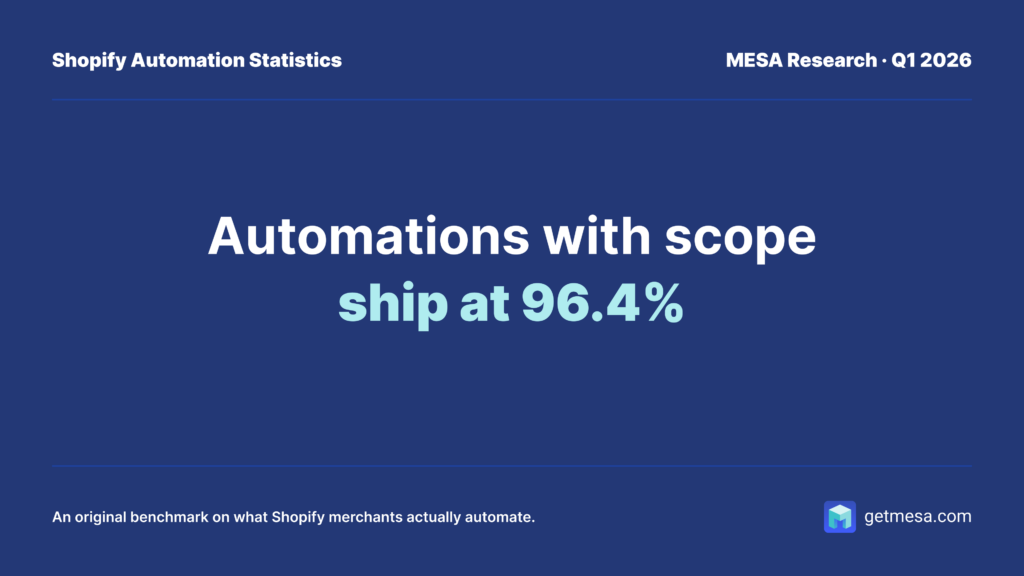
The Shopify workflows that ran most reliably in Q1 2026 share one trait: they’re specific. One trigger, one step, one destination. The most activated workflow pattern in the dataset, an AI step writing its result directly back to a Shopify field, ran at nearly three times the rate of broad, open-ended requests. Scope is the variable that predicts whether a Shopify automation ships; and it’s the variable most merchants don’t think about when they start building.
About this analysis. Based on workflow data from MESA, Shopify's leading no-code automation platform, between January 1 and March 31, 2026, across hundreds of merchant stores. For the full methodology and dataset, see our Q1 2026 Shopify automation benchmark.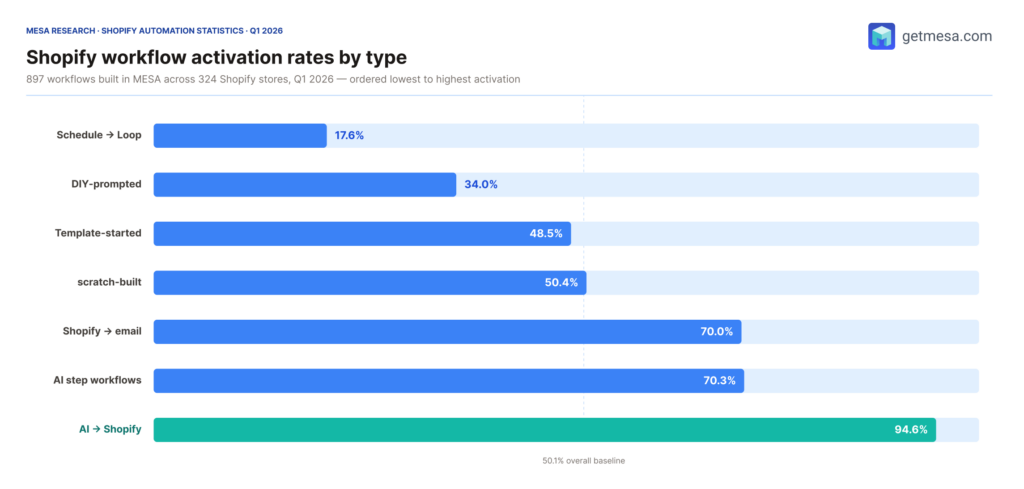
Table of Contents:
The shape of a Shopify workflow that ships
Across every workflow type in Q1, the ones that shipped reliably share three traits.
A single, named trigger. Not “when something happens in my store” but “when a Shopify order is paid” or “when a Shopify product is created” or “every day at 8am.” One event, described precisely.
One thing happening in the middle. A tag gets written. A product description gets generated. An inventory count gets checked against a threshold. The middle step is narrow enough that you can describe it in a sentence.
One destination for the result. A specific Google Sheet. A specific Slack channel. A specific field in the Shopify product record. Not “my stack” or “my tools.”
The AI → Shopify pair, the highest-activation workflow type in Q1 at 94.6%, fits this shape exactly. An AI step reads something (a product title, a customer name, a variant description) and writes one output to one Shopify field. There’s no routing decision, no intermediate system, no configuration detour. The workflow either works end-to-end or it doesn’t, and when it works there’s nothing left to second-guess.
Compare that to the lowest-activation pattern in the dataset, Schedule → Loop at 17.6%: a scheduled trigger that fans out across multiple records, each of which might route differently depending on conditions, landing in multiple possible destinations. More flexible, more powerful, and far more likely to sit in a draft state indefinitely.
One trigger, one step, one destination: that’s the shape of a Shopify automation that ships.
What changed in March
On March 12, MESA introduced the Logic step: a way for a workflow to evaluate a condition and act on it in code rather than through a chain of intermediate steps. In the 19 days that followed, 61 workflows used it, already more than long-established steps like Delay, API, and the HubSpot integration had seen across the full quarter.
The reason adoption moved quickly is structural. Before the Logic step, expressing “if this, then that” inside a workflow required multiple individual steps wired together, each one a configuration decision and each one a place to stall. The Logic step collapses that into a single step where the conditional logic runs as code. Fewer decisions to make during setup, fewer places for a build to get complicated and sit unfinished.
Whether the Logic step’s introduction changed activation rates in a measurable way is a question the Q2 data will answer more clearly. What the Q1 data shows is that it arrived and was adopted immediately by merchants building specific, bounded automations.
The Logic step was adopted faster than almost any other MESA integration in Q1, by merchants who wanted a specific condition handled reliably without a sprawling step chain to configure.
Why “automate my store” stalls
MESA’s builder lets merchants describe what they want in their own words and get a working workflow back. When the description is specific, that works well. When it’s broad, the gap between what the merchant typed and what they actually needed tends to surface mid-build, and the workflow sits unfinished.
Merchants who described something open-ended (“help me automate my store,” “make things more efficient,” “connect everything together”) started workflows that shipped at 34% in Q1. That’s not a failure of the tool or of the merchant’s intent. It’s a scoping problem. The merchant knows what they want; they just haven’t broken it into a specific enough unit yet.
The merchants who submitted four or five versions of the same request in a row weren’t stuck because their idea was bad. They knew exactly what they wanted. The iteration happened because the output didn’t yet match the specific thing in their head, and they kept refining until it did. That persistence is the right instinct. The faster path is to start with the specific thing.
The workflows that didn’t ship in Q1 weren’t more ambitious than the ones that did. They were less specific.
How to translate “automate my store” into something that ships
The merchants in Q1 with the highest activation rates (the ones running every workflow they built) weren’t building fewer automations. They were building more specific ones.
A useful test before starting any workflow: can you describe it in one sentence with a subject, a trigger, and a result? “When a new order is paid with discount code LOCAL26, tag it ‘local-pickup’ and add it to the local fulfillment queue.” That sentence contains a trigger, a condition, and a destination. It will ship.
“Automate my fulfillment process” does not contain any of those things. It might become ten different workflows, or it might sit in draft. The data says it’ll probably sit in draft.
The practical reframe is to treat “automate my store” as a category, not a workflow. Inside that category are specific things: the order that needs a tag, the product that needs a description, the customer who needs an email when a variant comes back in stock. Each of those is one workflow. Each one is buildable in an afternoon. Each one, in the Q1 data, has a better-than-even chance of shipping.
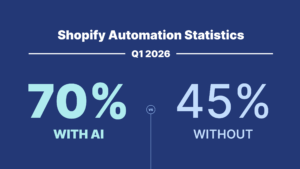
AI-powered workflows shipped at 70.3% in Q1, and tagging ranked as the most-built automation type for the same reason: both are inherently narrow. An AI step that writes a product description has one input and one output. A tagging workflow has one trigger and one action. The merchants who build those aren’t more disciplined. They’re just starting with something specific enough to finish.
The full Q1 2026 benchmark has the complete activation data across all workflow types, plus what merchants asked for and what they actually built.