
Shopify admin AI has evolved rapidly, with tools like Sidekick handling in-platform tasks and content generation. But what if you need AI that connects your Shopify admin to external apps, builds custom workflows, or automates cross-platform processes? That's where the Model Context Protocol (MCP) comes in.
The Model Context Protocol (MCP) steps in to help centralize these admin tasks through AI, giving you one place to connect your store’s data with intelligent tools. By allowing AI systems to access and manage your Shopify admin securely, MCP opens the door to streamlined workflows and smarter decision-making.
This article will give you hands-on, practical guidance for integrating MCP into your Shopify admin. You’ll learn exactly how to set up MCP, why it matters, and how it can make your day-to-day operations easier and more efficient.
TL;DR: there's a template for that
Shopify Admin AI: Your Options in 2025
When looking for Shopify admin AI solutions, most merchants start with Sidekick. But Sidekick focuses primarily on in-platform tasks and content generation.
For cross-app automation, external integrations, and workflow building, MCP (Model Context Protocol) offers capabilities that extend beyond what Sidekick can do—especially when paired with AI assistants like Claude.
What is Shopify Admin AI?
Shopify admin AI refers to artificial intelligence tools that help you manage, automate, and optimize your Shopify store operations. These AI assistants can understand natural language requests, analyze store data, automate repetitive tasks, and make intelligent recommendations—all while working directly with your store's admin panel.
The AI revolution in ecommerce isn't about replacing human decision-making. It's about eliminating tedious manual work so you can focus on strategy, creativity, and growth.
Modern Shopify admin AI can:
- Understand context: Know your products, customers, and business patterns
- Execute tasks: Make changes, create content, and manage workflows
- Provide insights: Analyze data and surface opportunities
- Learn patterns: Adapt to your specific business needs over time
- Connect systems: Bridge Shopify with your broader tech stack
The Evolution of AI for Shopify Admin
First Generation: Rules-based Automation Early Shopify automation required explicit rules: "If this happens, do that." Useful, but rigid and requiring technical setup.
Second Generation: Native AI (Sidekick) Shopify integrated AI directly into the admin with Sidekick, bringing conversational interfaces and intelligent content generation to every merchant.
Third Generation: Extensible AI (MCP) The Model Context Protocol enables AI assistants to work across platforms, creating workflows that span your entire business ecosystem—not just Shopify.
MCP vs Shopify Sidekick: Which AI is Right for You?
Shopify admin AI has become essential for modern ecommerce operations. Sidekick, Shopify's built-in AI assistant, handles many day-to-day store management tasks brilliantly. But what happens when you need to automate workflows across multiple platforms or build custom integrations that go beyond Shopify's walls?
That's the key distinction between Sidekick and MCP-powered AI tools like MESA's AI.
When to Use Shopify Sidekick
Sidekick excels at tasks contained within your Shopify admin:
- Generating product descriptions and marketing copy
- Creating customer segments for targeted campaigns
- Analyzing sales data and building reports
- Making theme adjustments and design changes
- Setting up discounts and promotional campaigns
- Answering questions about your store's performance
Sidekick is your go-to AI for understanding Shopify's platform and executing tasks that live entirely within your store's ecosystem.
When to Use MCP with AI Assistants
MCP-enabled AI (like ChatGPT with MESA's AI) handles scenarios Sidekick can't:
- Cross-platform automation: "Tag orders in Shopify when a support ticket closes in Zendesk"
- External data enrichment: "Update product descriptions based on competitor pricing from a Google Sheet"
- Multi-app workflows: "When inventory hits 5 units, create a Slack alert and generate a restock order in my ERP"
- Custom business logic: "Analyze order patterns and automatically adjust shipping rules based on regional trends"
- Third-party integrations: Connecting your Shopify admin to WordPress, Help Scout, Google Sheets, or hundreds of other tools
| Feature | Shopify Sidekick | MCP + AI (MESA AI/Claude) |
| Best for | In-platform tasks | Cross-platform automation |
| Setup | Built-in, no setup | 5-minute connection |
| Data access | Shopify data only | Shopify + external apps |
| Content generation | ✅ Excellent | ✅ Via external AI |
| Analytics | ✅ Shopify data | ✅ Multi-source data |
| Theme editing | ✅ Direct changes | ❌ Not applicable |
| Workflow automation | ⚠️ Limited | ✅ Extensive |
| Third-party apps | ❌ Not supported | ✅ Core strength |
| Custom logic | ⚠️ Basic | ✅ Advanced |
| API integration | ❌ Not available | ✅ Full access |
Using Both Together
The most powerful approach? Use both. Sidekick handles your daily Shopify admin tasks—checking sales, updating products, creating segments. Meanwhile, MCP-enabled AI assistants orchestrate the complex, multi-system workflows that scale your operations.
Think of Sidekick as your Shopify specialist and MCP as your operations architect. Together, they create a complete AI-powered commerce operation.
Why your Shopify store needs MCP
Your Shopify admin is the hub for all the critical elements that keep your store running: product listings, customer profiles, and every order processed. For AI tools to deliver meaningful automation and insights, they need a direct, reliable path to interact with this core data. MCP provides a dedicated channel for secure communication, so you never have to deal with manual data transfers or complicated setups.
When you rely on manual exports or incomplete integrations, you introduce delays and risk outdated information guiding your next move. MCP resolves these issues by setting up a protected, always-on connection to your Shopify admin. This gives approved AI assistants and automation tools immediate access to inventory updates, new orders, and customer changes as they happen.
How to use MESA MCP with your Shopify Admin
Time needed: 5 minutes.
Connecting to the Shopify Admin with MCP is simple in MESA.
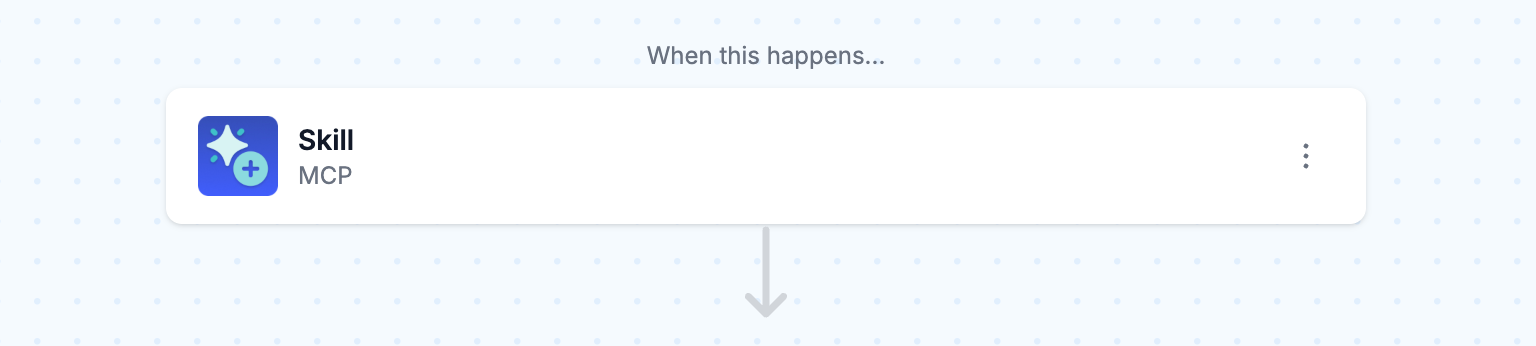
- Set up the MCP trigger
First, create a workflow by starting with the MCP trigger.
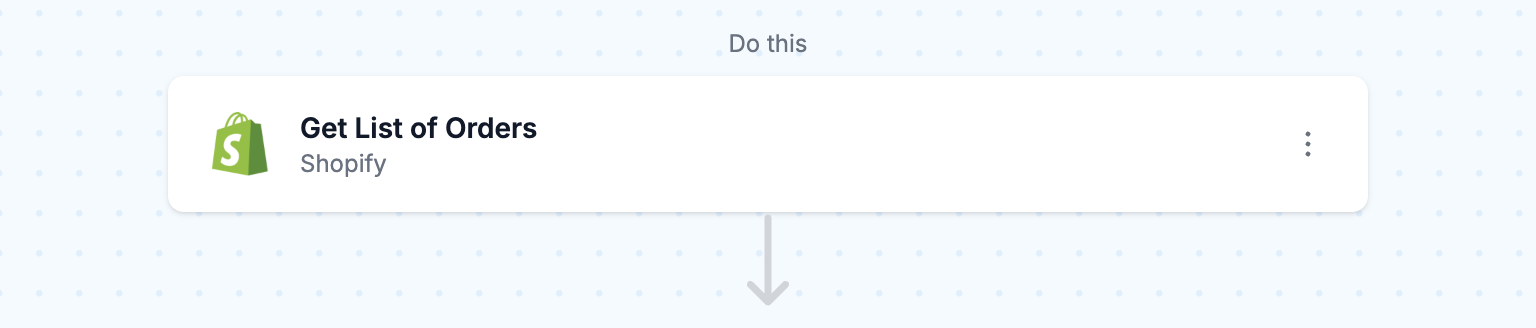
- Add an action step
Next, add a Shopify action like Get list of orders, products or customers.
- Locate your MCP Server URL
Note: You only do this once, regardless of how many MCP skills you set up in MESA.
Connect your AI client to MESA's MCP server once, and new skills will appear automatically. To do so, click “More fields” from the MCP trigger and choose the MCP Server URL.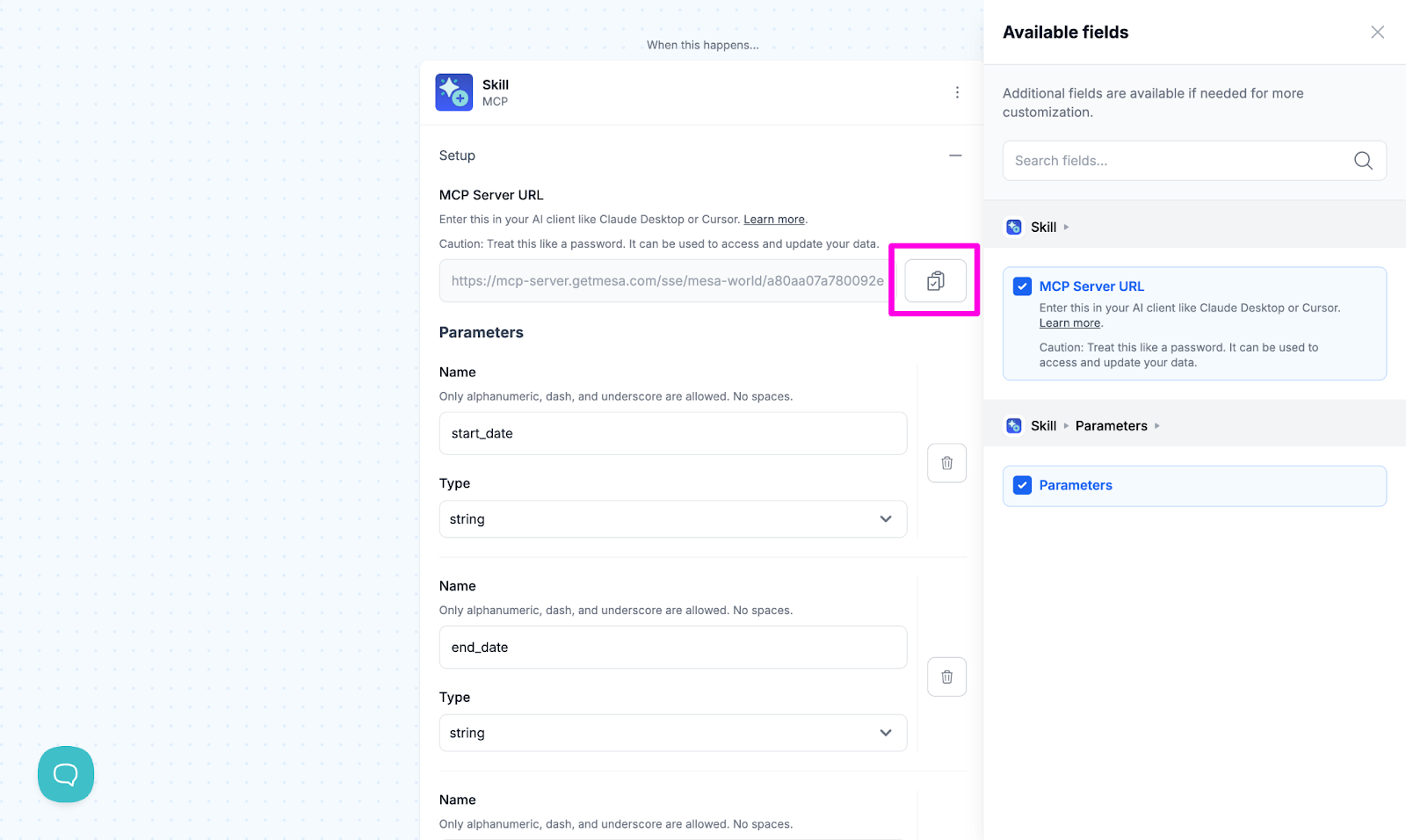
- Add your MCP server to Claude
Copy the URL (treat this like a password) and paste it into Claude (Settings > Developer > Edit Config).
Paste the copied URL into the local JSON file Claude Desktop will have selected after clicking that “Edit config” button.
If your file is empty, you’ll want to first paste this:{
"mcpServers": {
"mesa": {
"command": "npx",
"args": [
"mcp-remote",
"https://mcp-server.getmesa.com/sse/ID/KEY"
],
"env": {}
}
}
}
Then replace the URL within with your copied MESA MCP Server URL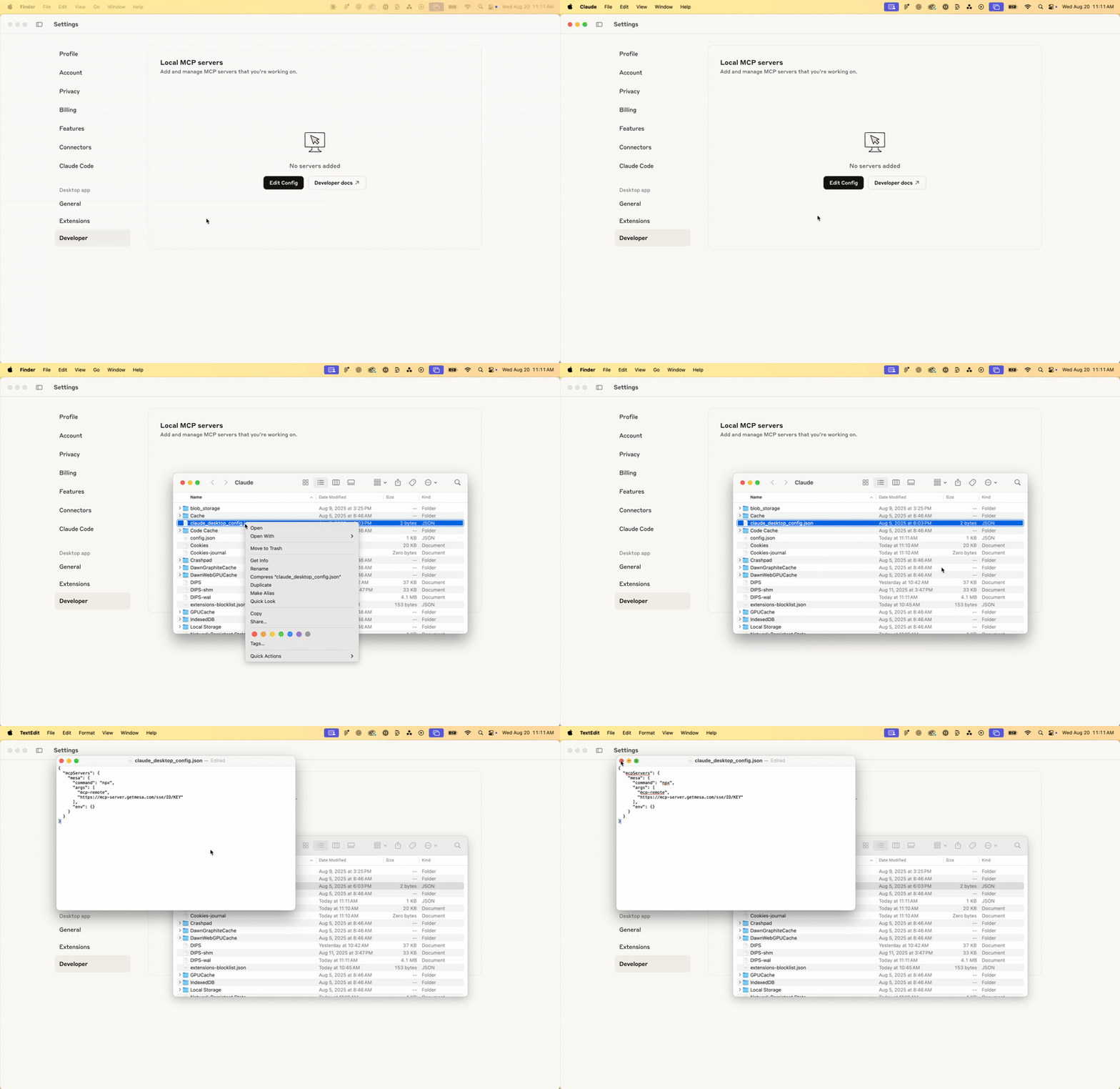
How AI Transforms Shopify Admin Workflows with MCP
The real power of Shopify admin AI through MCP isn't just that it can perform tasks—it's that you can describe what you want in plain language, and the AI figures out how to make it happen.
Instead of manually configuring triggers, conditions, and actions, you simply tell your AI assistant what you need:
Traditional approach:
- Log into MESA
- Select "New Workflow"
- Choose trigger: "Shopify Order Created"
- Add condition: "If order total > $500"
- Add action: "Add tag"
- Configure tag value
- Test and enable
MCP + AI approach:
You: "Tag all orders over $500 as VIP"
MESA's AI: Creates the entire workflow, tests it, and enables it
Here's how natural the interaction becomes:
Inventory Management:
You: "Let me know when any product drops below 10 units"

AI: Creating an inventory monitoring workflow that sends you
     a Slack message when stock levels hit your threshold.
     Should I also include the product name and current quantity?
Customer Experience:
You: "Find all customers who ordered in the last 30 days
     but haven't ordered in the past week"

AI: Retrieved 47 customers matching that criteria.
     Would you like me to:
     1. Create a customer segment for targeting
     2. Draft a re-engagement email
     3. Both
Order Fulfillment:
You: "When an order ships, send the tracking number to
     Help Scout so support has it"

AI: I'll create a workflow that triggers on fulfillment creation,
     extracts the tracking data, and creates a Help Scout note
     on the customer's profile. Want to test it first?
Meet MESA's AI: Shopify Admin AI superpowers without the setup
MESA's AI simplifies Shopify store management by interpreting your requests and turning them into actions that align precisely with your needs. Instead of toggling between dashboards or learning complex processes, you can rely on it to understand and respond to your specific business goals using clear, natural language.
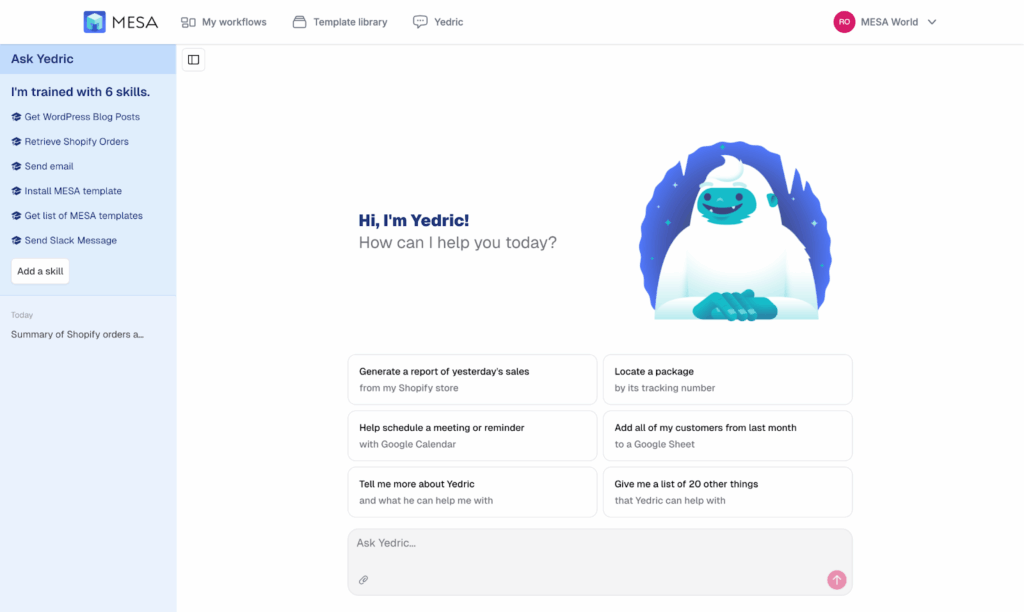
MESA's AI helps you unlock new capabilities as your business evolves, with no setup required. Ask for historical sales trends, top-selling products, or your highest-value customers, and it delivers.
Whether you're launching a new campaign or preparing for peak season, MESA's AI adapts in real time. It understands your store's context and responds with relevant actions or insights, so every interaction moves you closer to a decision or outcome.
Frequently asked questions
What is Shopify admin AI?
Shopify admin AI uses artificial intelligence to help merchants manage their stores through natural language commands. Instead of manually navigating menus, you describe tasks like "tag high-value orders" or "analyze sales trends," and the AI executes them. Options include Shopify's built-in Sidekick, MCP-enabled assistants like Claude with MESA, and specialized AI apps.
How does MCP differ from Shopify Sidekick?
MCP differs from Shopify Sidekick by enabling cross-platform automation beyond Shopify. While Sidekick handles in-store tasks like content generation and analytics within your Shopify admin, MCP connects AI assistants to multiple platforms simultaneously. This allows workflows like "tag Shopify orders when Zendesk tickets close" or "update products from Google Sheets"—tasks Sidekick cannot perform.
Can I use MCP and Sidekick together?
Yes, you can use MCP and Sidekick together, and it's the most powerful approach. Use Sidekick for daily Shopify tasks like content creation, analytics, and quick questions. Use MCP-enabled AI for cross-platform automation, custom workflows, and external integrations. They complement each other—Sidekick handles immediate interactive tasks while MCP builds automated infrastructure across your entire tech stack.
What AI assistant works best with Shopify admin MCP?
Claude by Anthropic works best with Shopify admin MCP. It has native MCP protocol support built into Claude Desktop, connects to MESA in 5 minutes, and includes MESA's AI assistant, trained specifically on ecommerce workflows. Claude excels at understanding business intent and translating natural language into working Shopify automations across multiple platforms.