AI-powered Shopify workflows ship at 70% vs 45% for non-AI workflows: a Q1 2026 benchmark
-
- •
- Last updated: Jun. 2, 2026
- •
- 8 min read

Shopify merchants who added an AI step to a workflow shipped it to production 70.3% of the time in Q1 2026, compared to 45.2% for workflows without AI. The difference held across 897 built workflows and 324 Shopify stores, and a specific AI integration pattern (AI → Shopify) shipped at 94.6%, the highest activation rate of any meaningful source-destination pair in the dataset.
About this analysis. Based on every workflow built in MESA, Shopify's leading no-code automation platform, between January 1 and March 31, 2026: 1,374 workflows created, 897 built (≥1 step, not deleted), 455 shipped (enabled in production), across 324 merchant stores. A workflow is classified as "with AI" when it includes at least one MESA AI action: generation, classification, extraction, or summarization. For the full picture, see our Q1 2026 Shopify automation benchmark.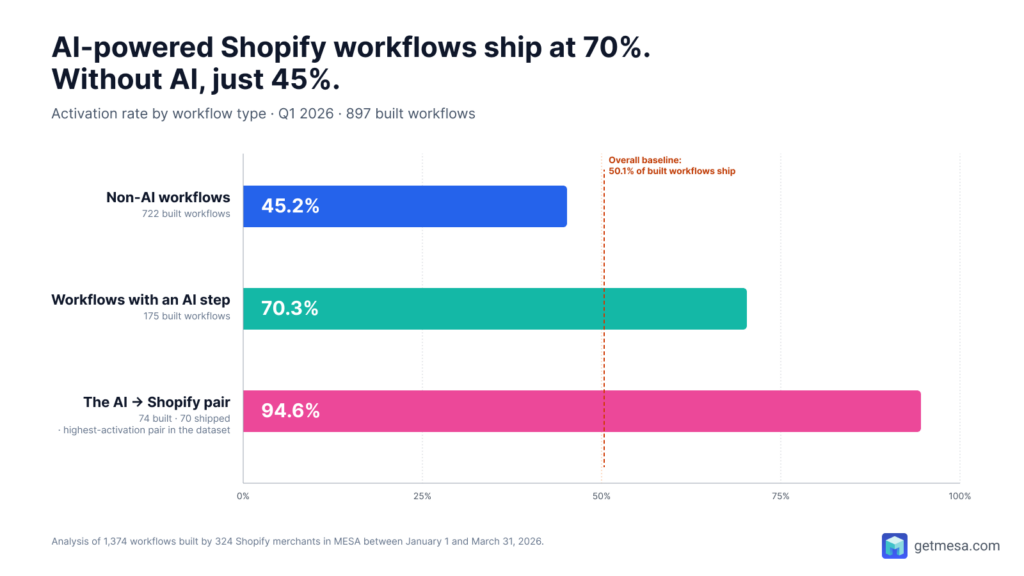
Table of Contents:
What does it mean to add an AI step to a Shopify workflow?
In MESA, an AI step is a workflow action that calls a large language model with a structured prompt. Merchants use it to do four broad jobs: generate text (a product description, a follow-up email), classify input (is this customer a wholesale lead?), extract structure from unstructured text (pull a SKU out of a Zendesk ticket), or summarize (turn an order’s contents into a one-sentence shipping note).
175 of the 897 built workflows in Q1 2026 included at least one AI step, about 1 in 5. Of those 175, 123 were enabled in production. The other 722 workflows used no AI, and 326 of those shipped.
Workflows with an AI step shipped about 1.5× as often as workflows without one.
Which Shopify AI workflows are merchants actually shipping?
The shipping AI workflows aren’t lab experiments. They’re production grunt-work, the kind of repetitive task that used to require a part-time copywriter or a virtual assistant.
The five most common patterns merchants built and shipped, verbatim from workflow titles, were:
- “Write Shopify product descriptions with AI” (built three separate times by different Shopify stores)
- “Auto-generate SEO meta titles & descriptions for new Shopify products”
- “AI-powered gender tagging for Shopify customers”
- “Tag local customers based on proximity to store”
- “Hourly cleanup: retag products by online-eligible inventory”
The common thread: each one substitutes an AI step for a task a person used to do by hand. Write copy, read a customer profile and assign a tag, look at inventory and decide what to do. Not “AI replaces the workflow.” AI replaces the judgment step inside the workflow.
The shipping AI workflows replace judgment, not workflows.
Why does the AI + Shopify pair ship at 94%?
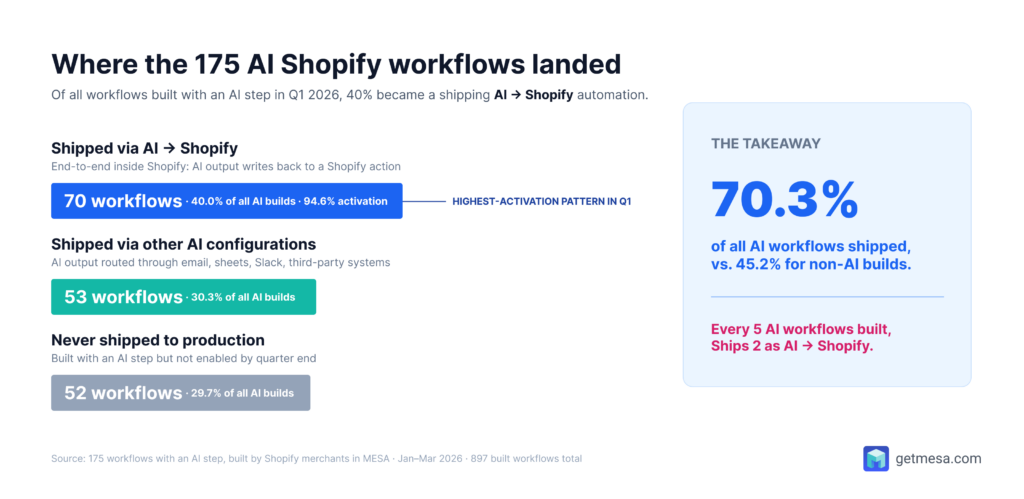
The most-shipped integration pattern in the entire Q1 dataset is AI → Shopify: workflows where an AI step’s output becomes the input to a Shopify action. 74 built, 70 shipped. A 94.6% activation rate, 44 points above the overall baseline.
Two structural features of this pattern stand out.
First, the AI output is going somewhere immediately useful. A generated product description gets written back to the Shopify product record. A classification result gets applied as a customer tag. There’s no detour through an external system, no intermediate Google Sheet, no human-in-the-loop review queue. The workflow either works end-to-end or it doesn’t, and when it works, there’s nowhere for it to stall.
Second, the schema on both ends is narrow. Shopify’s API accepts a specific set of fields. The AI step has been prompted to produce text that maps to those fields. The cognitive load of “configure the connection” is small. Compare that to a workflow that pipes AI output into a Slack message into a Notion record into a CRM update; every hop is a chance to give up.
End-to-end workflows that stay inside Shopify ship more often than workflows that need to be configured across systems.
Two explanations for the gap
Two readings of the activation gap are both defensible, and they’re complementary rather than competing.
Reading one: AI output is easier to verify before flipping the switch. When a workflow’s output is a generated product description, a customer tag, or an SEO meta title, the merchant can preview the result and decide whether it’s good enough to ship. They generate five descriptions, eyeball them, and either approve or rewrite the prompt. Compare that to a workflow whose output is a Slack message, a row in a Google Sheet, or an API call to a third-party system. The only way to know if it’s working as intended is to let real data flow through and watch what happens. AI workflows have a verification step built into their nature; most non-AI workflows don’t, and that uncertainty is one reason merchants stall at the “is this ready?” moment.
Reading two: AI replaces the brittle middle of the workflow. A workflow that uses an AI step often does fewer other things, because the AI is doing the heavy lifting that would otherwise require six conditional branches, three lookups, or a chain of string transforms. Fewer steps, fewer failure points, fewer reasons to bail out before flipping the switch. The signal holds even when the merchant isn’t bringing deep first-principles intent to the build: when someone clicks the “Write Shopify Product Descriptions with AI” template just to see what it does, the workflow’s simplicity carries it the rest of the way. Under this reading, the AI step isn’t a signal of a better workflow; it’s the reason the workflow ships at all. The AI → Shopify pattern at 94.6% is the cleanest evidence: when the AI step is doing the entire middle and the result writes directly to Shopify, there’s almost nothing left to break.
Both readings point at the same underlying mechanism: AI shortens the path from “I built it” to “it works the way I expected.” Easier to verify, fewer failure points, less brittle middle. Whether the same dynamic shows up in workflows that use other “middle-abstracting” steps is a question we’ll have data on at the end of Q2. the prompt. Compare that to a workflow whose output is a Slack message, a row in a Google Sheet, or an API call to a third-party system. The only way to know if it’s working as intended is to let real data flow through and watch what happens. AI workflows have a verification step built into their nature; most non-AI workflows don’t, and that uncertainty is one reason merchants stall at the “is this ready?” moment.
Reading two: AI replaces the brittle middle of the workflow. A workflow that uses an AI step often does fewer other things, because the AI is doing the heavy lifting that would otherwise require six conditional branches, three lookups, or a chain of string transforms. Fewer steps, fewer failure points, fewer reasons to bail out before flipping the switch. The signal holds even when the merchant isn’t bringing deep first-principles intent to the build: when someone clicks the “Write Shopify Product Descriptions with AI” template just to see what it does, the workflow’s simplicity carries it the rest of the way. Under this reading, the AI step isn’t a signal of a better workflow; it’s the reason the workflow ships at all. The AI + Shopify pattern at 94.6% is the cleanest evidence: when the AI step is doing the entire middle and the result writes directly to Shopify, there’s almost nothing left to break.
Both readings point at the same underlying mechanism: AI shortens the path from “I built it” to “it works the way I expected.” Easier to verify, fewer failure points, less brittle middle. Whether the same dynamic shows up in workflows that use other “middle-abstracting” steps is a question we’ll have data on at the end of Q2.
What this means for merchants and builders
The headline finding (workflows with AI ship about 1.5× as often) is large enough and consistent enough that it should change how the next quarter’s automations get built. For merchants picking a use case to start with, the data suggests prioritizing automations where a single AI step replaces a human judgment call: writing copy, classifying customers or orders, pulling structure out of free-text input. For builders deciding what to ship, the AI → Shopify end-to-end pattern is the clearest activation winner in the Q1 dataset, and the smallest jump from “I built it” to “it’s running.”
The 1.5× shipping advantage isn’t a verdict on AI being better. Workflows without AI still ship 45% of the time, which is plenty of evidence that traditional automations are alive and well. It’s a verdict on a particular shape of automation: one that replaces a judgment step with a model call and routes the result back into Shopify, end-to-end, without a configuration tour through other systems. The full Q1 2026 benchmark covers six other findings from the same dataset: what merchants automate most, what they ask for that doesn’t exist yet, and why half of all built workflows never ship.